
Opening your dashboard
Class 11 Biology Chapter 15 Cell Cycle and Cell Division: Practice Questions
163 questions on Chapter 15, each worked through on its own page with the AI tutor. Class 11 Biology, ICSE 2026-27.
163 questions
1–4 marks · Mixed difficulty
- 11 mark
Question 1
Which feature shows that a nucleus is dividing by amitosis and not by mitosis?
- 22 marks
Question 2
In amitosis the nucleus simply constricts into two. Explain why this method, unlike mitosis, cannot make sure that each daughter nucleus receives one complete copy of every chromosome.
- 31 mark
Question 3
In amitosis, the division of the nucleus is not always followed by division of the cytoplasm. What is formed when the cytoplasm does not divide?
- 43 marks
Question 4
Compare amitosis with mitosis with respect to
(a) the appearance of chromosomes,
(b) the formation of a spindle, and
(c) the size and genetic content of the daughter nuclei.
- 51 mark
Question 5
(Hypothetical data.) The phases of a cell cycle in a culture last: G₁ 9 h, S 8 h, G₂ 4 h and M 1 h. A cell has just entered S phase. How long will it take to reach the start of M phase?
- 63 marks
Question 6
(Hypothetical data.) The table gives the length of each phase of the cell cycle in two cell types, A and B, of the same animal.
Phase Cell type A Cell type B G₁ 10 h 2 h S 7 h 7 h G₂ 3 h 3 h M 1 h 1 h (a) Find the total length of the cell cycle in each cell type.
(b) Which phase accounts for the difference between them?
(c) Both cell types divide at random times (not together). In a stained sample of each tissue, which would show the larger percentage of cells in M phase? Show your working.
- 71 mark
Question 7
(Hypothetical data.) In a tissue, every cell in G₁ contains 6 pg of DNA. A cell from the same tissue is found to contain 9 pg of DNA. In which phase of the cell cycle is this cell?
- 82 marks
Question 8
In an adult, most liver cells and most heart muscle cells are in the G₀ phase. If part of the liver is removed, the remaining liver cells divide and restore it, but heart muscle cells that die are not replaced by new heart muscle cells. Explain this difference in terms of the cell cycle.
- 91 mark
Question 9
A drug that blocks DNA replication is added to a culture of dividing cells. What will happen to the cells that were already in G₂ when the drug was added?
- 104 marks
Question 10
The graph shows how the DNA content of one cell changes during one cell cycle.

(a) Name the phases shown by P and Q.
(b) R covers two phases of the cell cycle. Name them and explain why the DNA content does not change during R.
(c) What event is shown by the fall T, and why does the DNA content fall to exactly half?
- 112 marks
Question 11
(Hypothetical data.) A yeast cell divides once every 90 minutes and a human cell in culture divides once every 24 hours. Start with one cell of each. Assuming that every cell divides on time and none dies, how many cells of each kind will there be after 24 hours?
- 121 mark
Question 12
Signals from inside and outside a cell decide whether it will go on to replicate its DNA, pause for a short while, or withdraw from the cycle into G₀. In which phase is this decision made?
- 131 mark
Question 13
An onion plant has 2n = 16. How many chromatids are present in one of its root-tip cells at metaphase of mitosis?
- 144 marks
Question 14
(Hypothetical data.) An animal cell has 2n = 10, and its DNA content in G₁ is 2C. Give the number of chromosomes, the number of chromatids and the DNA content of the cell at
(a) G₁,
(b) G₂,
(c) anaphase of mitosis (the whole cell), and
(d) each daughter cell just after cytokinesis.
- 151 mark
Question 15
The figure shows an animal cell in anaphase of mitosis.
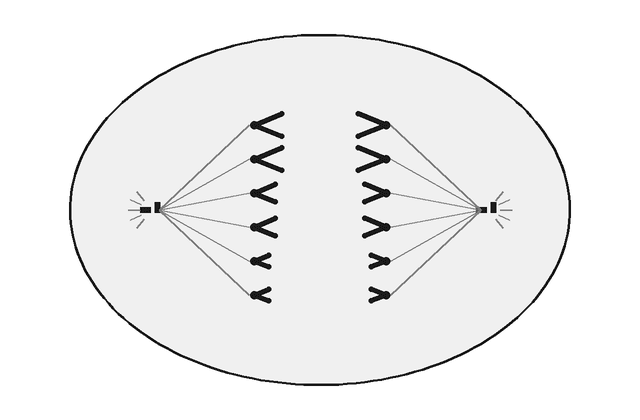
What is the diploid number (2n) of this species?
- 164 marks
Question 16
The figure shows two dividing cells, X and Y, from the root tip of a plant with 2n = 4.

(a) Name the stages shown by X and Y, and give one visible feature that identifies each.
(b) Which of the two stages comes first in mitosis?
(c) Name the structure P and state what it develops into.
- 171 mark
Question 17
In a stained squash of onion root tip, most cells are in interphase and only a few show stages of mitosis. Which is the best explanation?
- 182 marks
Question 18
In the activity to study mitosis, the onion root tips are warmed in 1N hydrochloric acid at 60 °C, and after staining the tip is gently tapped under the coverslip with the blunt end of a pencil. Give the purpose of each of these two steps.
- 191 mark
Question 19
During anaphase of mitosis the moving chromosomes often look V- or J-shaped. Why?
- 203 marks
Question 20
(Hypothetical data.) A student counted 400 cells in a squash of onion root tip and recorded:
Stage Number of cells Interphase 340 Prophase 32 Metaphase 12 Anaphase 6 Telophase 10 (a) The mitotic index is the percentage of cells that are in any stage of mitosis. Calculate it.
(b) If one cell cycle in this root tip lasts 20 hours, estimate how long prophase and anaphase each last. State the assumption you make.
(c) Do your estimates agree with what is known about the relative lengths of prophase and anaphase?
- 211 mark
Question 21
In a dividing cell with 2n = 8, the centromere of one chromosome fails to split at anaphase, and both of its chromatids are pulled to the same pole. What will the two daughter cells contain?
- 222 marks
Question 22
When a Planaria (a flatworm) is cut into two pieces, each piece regrows the missing part and becomes a complete worm. Name the type of cell division involved and explain why the new worm is genetically identical to the original one.
- 232 marks
Question 23
(Hypothetical data.) A cell of a haploid plant body has n = 8 chromosomes.
(a) How many chromosomes will each daughter cell have if this cell divides by mitosis?
(b) Why can this cell not divide by meiosis?
- 242 marks
Question 24
A student writes: "After mitosis each daughter cell has half the DNA of the parent cell, so it must also have half the number of chromosomes." Point out the error in this reasoning.
- 253 marks
Question 25
(Hypothetical data.) A fertilised egg divides by mitosis, and all its cells keep dividing at the same time (synchronously) until there are 64 cells. Each round of division takes 30 minutes.
(a) How many cells divide in the last round?
(b) How many separate mitotic divisions take place in all, from the single egg to 64 cells?
(c) How long does it take to reach 64 cells?
- 261 mark
Question 26
A cell with 2n = 20 is in pachytene of meiosis I. How many chromatids does each bivalent contain, and how many chromatids are there in the whole cell?
- 274 marks
Question 27
(Hypothetical data.) An animal has 2n = 8, and the DNA content of its diploid cells in G₁ is 2C. For a cell that goes through meiosis, give the number of chromosomes, the number of chromatids and the DNA content
(a) in G₁ before meiosis,
(b) at prophase I,
(c) in each cell at the end of meiosis I, and
(d) in each cell at the end of meiosis II.
- 281 mark
Question 28
Taking the DNA content of a diploid cell in G₁ as 2C, which pair of cells has the same DNA content?
- 294 marks
Question 29
The figure shows a cell from the anther of a flowering plant, dividing to form pollen grains.
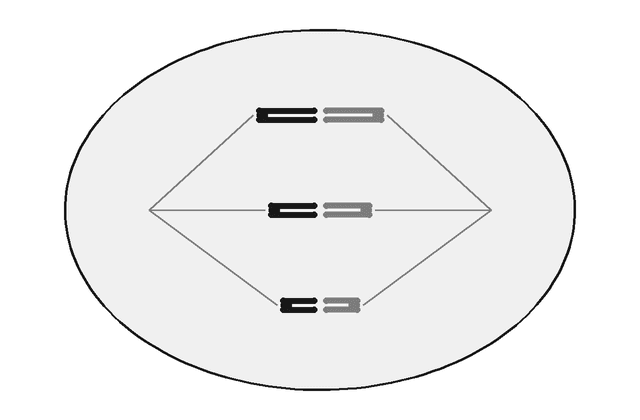
(a) Name the stage shown and give two features in the figure that identify it.
(b) What is the diploid number (2n) of this plant?
(c) At the end of this division, how many chromosomes, and how many chromatids, will each daughter cell receive?
- 301 mark
Question 30
Read these four events of prophase I of meiosis.
-
Chiasmata are first seen as the synaptonemal complex dissolves.
-
Homologous chromosomes pair (synapsis).
-
Chiasmata move towards the ends of the bivalents (terminalisation).
-
Crossing over takes place at recombination nodules.
Which is the correct order?
-
- 313 marks
Question 31
The two chromatids of a chromosome are exact copies of each other when they are formed in S phase. Yet at telophase I the two chromatids of a chromosome are often not genetically identical. Explain why.
- 321 mark
Question 32
(Hypothetical data.) A plant has 2n = 6, and the two members of each homologous pair carry different alleles. Ignoring crossing over, how many genetically different kinds of gametes can it form because of the random way the homologous pairs separate in meiosis I?
- 333 marks
Question 33
(Hypothetical data.) In the testis of a man (2n = 46), 250 cells begin meiosis.
(a) How many sperm can these cells give rise to?
(b) How many separate cell divisions (meiosis I and meiosis II together) take place?
(c) How many chromosomes, and how many chromatids, does each cell have just after meiosis I?
- 341 mark
Question 34
(Hypothetical data.) In a cell with 2n = 8, one homologous pair fails to separate at anaphase I, and both of its chromosomes go to the same pole. Meiosis II is normal. What will be the chromosome numbers of the four gametes?
- 352 marks
Question 35
There is no S phase (no DNA replication) during interkinesis, the interval between meiosis I and meiosis II. What would be the DNA content of the gametes if the DNA were replicated again during interkinesis? Why is the absence of replication at this point important?
- 363 marks
Question 36
(Hypothetical data.) One chromosome of a homologous pair carries genes A and B; its partner carries a and b at the same positions. During pachytene a single crossing over takes place between the A/a and B/b positions, involving one chromatid of each chromosome.
(a) Write the gene combinations carried by the four chromatids at the end of meiosis.
(b) Which of these combinations are new (recombinant), and which are the same as in the parent's chromosomes?
- 371 mark
Question 37
(Hypothetical data.) A plant has 2n = 12. A dividing cell from its anther shows 6 chromosomes, each made of two chromatids, lined up singly on the equator. Which stage is this?
- 383 marks
Question 38
(Hypothetical data.) The DNA content of single nuclei from a young anther was measured. A diploid nucleus in G₁ has 2C. The nuclei fell into three classes: 1C, 2C and 4C. Suggest which cells could give each class.
- 392 marks
Question 39
In mitotic metaphase the centromeres of the chromosomes lie on the equator, but in metaphase I of meiosis the centromeres point towards the poles while the arms lie towards the equator. Explain the reason for this difference.
- 401 mark
Question 40
Garden pea has 2n = 14. In a pollen mother cell at anaphase I, what moves towards each pole?
- 411 mark
Question 41
When the skin is cut, cells around the wound divide until it heals, but a tumour keeps on growing. Which statement best explains this difference?
- 422 marks
Question 42
Why is cancer often described as a disease of the cell cycle? Give two points.
- 431 mark
Question 43
A person exposed to a large dose of radiation develops radiation sickness. Which of these tissues is least affected?
- 443 marks
Question 44
The figure shows a simplified karyotype prepared from a white blood cell of a person. The pairs of autosomes are numbered 1 to 22; the two chromosomes after pair 22 are the sex chromosomes.

(a) How many chromosomes does this person's cell contain?
(b) Is the person male or female? Give a reason.
(c) What abnormality does the karyotype show, and with which condition is it associated?
- 451 mark
Question 45
To prepare a human karyotype, white blood cells from a blood sample are cultured. Why are red blood cells not used?
- 462 marks
Question 46
In a human karyotype, the chromosomes of pairs 19 and 20 look very similar in size and shape. How can they be told apart in a modern karyotype, and why is this method useful?
- 471 mark
Question 47
A karyotype shows 45 chromosomes in all, with only one sex chromosome, an X. How many autosomes does it contain?
- 483 marks
Question 48
(Hypothetical data.) A tumour starts from a single cell that has escaped the normal controls on division. Assume that all its descendants divide once every 2 days and that none of them dies.
(a) How many tumour cells will there be after 20 days?
(b) After how many days will the tumour first contain more than one million cells?
(c) Most cells of an adult's heart muscle are in G₀. How does the behaviour of these tumour cells differ from that of the heart muscle cells?
- 492 marks
Question 49
(Hypothetical data.) Two karyotypes are compared with a normal karyotype.
Karyotype 1: one chromosome 5 is shorter than its partner because the end of one of its arms is missing.
Karyotype 2: a segment of chromosome 4 is found attached to the end of one chromosome 15, and that chromosome 4 is shorter than its partner.
Name the kind of chromosome change seen in each karyotype.
- 503 marks
Question 50
A karyotype is prepared from a white blood cell of a healthy woman (46 chromosomes, XX), arrested at metaphase. The DNA content of her body cells in G₁ is 2C.
(a) How many chromatids can be seen in the photographed cell?
(b) What is the DNA content of the photographed cell?
(c) How many chromosomes, and what DNA content, will each of her egg cells have?
- 511 mark
Question 51
The replication of DNA takes place during
- 521 mark
Question 52
The replication of centriole takes place during
- 531 mark
Question 53
The formation of structural and functional proteins, RNA and enzymes takes place in a cell cycle during
- 541 mark
Question 54
The formation of cell plate is completed during
- 551 mark
Question 55
The period between two successive mitotic divisions is called as
- 561 mark
Question 56
The phase of cell division by which the chromosome number is halved is known as
- 571 mark
Question 57
The nuclear membrane and nucleolus reappear during
- 581 mark
Question 58
The chromatids of a chromosome are attached at a point called
- 591 mark
Question 59
The centromere divides into two during
- 601 mark
Question 60
The chromosomes get aligned at the equator during
- 611 mark
Question 61
The two cells formed during mitosis contain
- 621 mark
Question 62
If the initial amount of DNA in a cell is 2c then, the amount of DNA at the end of interphase will be
- 631 mark
Question 63
A single cell gives rise to 32 cells by dividing mitotically. How many times has it undergone mitotic divisions?
- 641 mark
Question 64
In how many cells the meiotic division has taken place if the total number of pollen grains is 32?
- 651 mark
Question 65
How many cells will be produced if a cell divides mitotically 6 times?
- 661 mark
Question 66
The meiotic stage where synapsis takes place is
- 671 mark
Question 67
The chromomeres are distinct during
- 681 mark
Question 68
The crossing over takes place during
- 691 mark
Question 69
The centromeres divide during
- 701 mark
Question 70
The separated homologous chromosomes of a pair move towards opposite poles during
- 711 mark
Question 71
The bivalents are attached to the spindle at
- 721 mark
Question 72
During meiosis, the replication of DNA takes place during
- 731 mark
Question 73
The two daughter cells produced at the end of meiosis I when compared to the parent diploid cell will have
- 741 mark
Question 74
The formation of chiasma is seen during
- 751 mark
Question 75
Identify the stage when the bivalents are arranged at the equatorial plate with the arms of the chromatid pointing inward and centromeres pointing the poles.
- 761 mark
Question 76
In which phase are spindle fibres and proteins synthesised?
- 771 mark
Question 77
Cytokinesis refers to
- 781 mark
Question 78
Mitosis occurs in
- 791 mark
Question 79
During meiosis, crossing over occurs between which part of homologous chromosomes?
- 801 mark
Question 80
The number of chromosomes become half in
- 811 mark
Question 81
The longest phase of meiosis-I is
- 821 mark
Question 82
Colchicine prevents the mitosis of cell at
- 831 mark
Question 83
At which phase of meiosis, the sister chromatids move towards the opposite poles?
- 841 mark
Question 84
In meiosis I, which of the following is present at the equator?
- 851 mark
Question 85
During mitotic metaphase
- 861 mark
Question 86
When synapsis is completed all along the chromosome, the cell is said to have entered the following stage
- 871 mark
Question 87
Synthesis of RNA and proteins takes place in
- 881 mark
Question 88
During cell division, chromosome get attached with spindle fibres at
- 891 mark
Question 89
When does synapsis occur in meiosis?
- 901 mark
Question 90
Astral rays arise from
- 911 mark
Question 91
The zygote of a diploid living organism undergoes which type of repeated cell division?
- 921 mark
Question 92
Synaptonemal complex is observed during cell division in
- 931 mark
Question 93
During G₁ phase of cell division
- 941 mark
Question 94
Number of mitotic divisions required for the formation of 128 cells are
(i) 127
(ii) 32
(iii) 12
(iv) 7
- 951 mark
Question 95
In a cell cycle, DNA replication occurs during
- 961 mark
Question 96
Crossing over that results in genetic recombination in higher organisms occurs between
- 971 mark
Question 97
Replication of centriole occurs during
- 981 mark
Question 98
The number of mitotic cell division required to produce 256 cells from a single cell would be
- 991 mark
Question 99
In meiosis, the chromosome number becomes
- 1001 mark
Question 100
In meiosis, synapsis occurs during
- 1011 mark
Question 101
In meiosis, the chromosomes replicate during
- 1021 mark
Question 102
Chromosomes are visible with chromatids at one of the following phases of mitosis
- 1031 mark
Question 103
Which of the following sequence is a correct one for a meiotic cell cycle?
- 1041 mark
Question 104
In ____________ phase of interphase, proteins are synthesised and mitotic spindle begins to get formed.
- 1051 mark
Question 105
In ____________ stage the equatorial plate gets formed.
- 1061 mark
Question 106
Scientific term for division of the nucleus is ____________.
- 1071 mark
Question 107
In a diploid cell, the chromosomes exist in pairs called ____________.
- 1081 mark
Question 108
Crossing over in a cell occurs during ____________ stage of meiosis.
- 1091 mark
Question 109
Kind of cell division that occurs in the injured part of the body is ____________.
- 1101 mark
Question 110
The systematic arrangement of chromosomes according to their size and shape is called ____________.
- 1111 mark
Question 111
The mitotic division of a cell can be arrested by using ____________ chemical.
- 1121 mark
Question 112
____________ is a region where two chromatids of a chromosome are attached.
- 1131 mark
Question 113
Amoeba undergoes binary fission by cell division called ____________.
- 1141 mark
Question 114
The cells formed by meiotic division contain half the number of chromosomes and are identical to each other.
- 1151 mark
Question 115
The significance of mitosis is to keep the chromosome number constant in a species.
- 1161 mark
Question 116
The cell plate forms only after karyokinesis.
- 1171 mark
Question 117
The cells duplicate the DNA content twice during meiosis.
- 1181 mark
Question 118
Nucleolus reappears in telophase of mitotic divisions only.
- 1191 mark
Question 119
The number of chromosomes becomes half in prophase I of meiosis.
- 1201 mark
Question 120
DNA replication occurs during the G₁ phase of interphase.
- 1211 mark
Question 121
Mitotic division occur rapidly in the meristematic tissues.
- 1221 mark
Question 122
The synaptonemal complex is formed during the leptotene stage of meiosis I.
- 1231 mark
Question 123
In meiosis, chromosomes replicate during interphase-I only.
- 1241 mark
Question 124
Stage in which chromosomes appear thread-like as a chromatin network.
- 1251 mark
Question 125
Stage when homologous chromosomes of a pair separate to opposite poles.
- 1261 mark
Question 126
A division that restores the number of chromosomes in a species.
- 1271 mark
Question 127
A quiescent phase cells remain metabolically active but do not divide unless required.
- 1281 mark
Question 128
Kind of division that occurs during the formation of pollen grains.
- 1291 mark
Question 129
Diploid number of chromosomes in a human skin cell.
- 1301 mark
Question 130
Membrane that disappears during prophase stage.
- 1311 mark
Question 131
A stage when the synapsis occurs.
- 1321 mark
Question 132
A stage at the end of which four nuclei are formed.
- 1331 mark
Question 133
A technique by which trisomy of 21 chromosome or other chromosomal abnormalities can be identified.
- 1341 mark
Question 134
Assertion (A): DNA synthesis occurs in G₁ and G₂ period of cell cycle.
Reason (R): During G₁ and G₂ phase, the DNA content becomes double.
- 1351 mark
Question 135
Assertion (A): Meiosis results in the production of haploid cells.
Reason (R): Synapsis occurs during the leptotene stage.
- 1361 mark
Question 136
Assertion (A): Meiosis II is known as equational or homotypic division.
Reason (R): Meiosis II produces the same number of chromosomes in daughter cells.
- 1371 mark
Question 137
Assertion (A): During metaphase, every chromosome has two chromatids.
Reason (R): Synthesis of DNA takes place during S-phase of interphase.
- 1381 mark
Question 138
Assertion (A): Diplotene stage is characterised by the presence of chiasmata.
Reason (R): Diplotene stage can last for months and years in oocytes of some vertebrates.
- 1391 mark
Question 139
Assertion (A): The stage between two mitotic divisions is called interkinesis.
Reason (R): Interkinesis is generally long lived.
- 1401 mark
Question 140
Assertion (A): During zygotene stage, the chromosomes are present as bivalents.
Reason (R): Bivalent is half the number of chromosomes.
- 1411 mark
Question 141
Assertion (A): Variations are critical for the process of evolution.
Reason (R): Meiosis increases the genetic variability in the population of organisms from one generation to the next.
- 1421 mark
Question 142
Assertion (A): Meiosis is known as the reductional division.
Reason (R): During meiosis, the chromosome number gets reduced by half of its total number.
- 1431 mark
Question 143
Assertion (A): In animal cells, the cytokinesis is marked by the appearance of a furrow in plasma membrane.
Reason (R): In plant cells, the formation of a new cell wall starts with the formation of cell plate that represents the middle lamella between the walls of adjacent cells.
- 1441 mark
Question 144
Haploid : n :: Diploid : ____________
- 1451 mark
Question 145
Mitosis : 2n :: Meiosis : ____________
- 1461 mark
Question 146
Pachytene : Crossing over :: Zygotene : ____________
- 1471 mark
Question 147
G₁ phase : Proteins :: S phase : ____________
- 1482 marks
Question 148
Look at the figure given below and answer the questions given.

(a) Identify the stage.
(b) Label the parts (i), (ii) and (iii).
- 1493 marks
Question 149
Look at the figure given below and answer the questions given.

(a) Name the stage shown.
(b) Name the parts labelled i and ii.
(c) In which type of cells this type of division occurs?
- 1502 marks
Question 150
Look at the figure given below and answer the questions given.

(a) Label the parts i and ii in the diagram given.
(b) What is the function of part ii?
- 1511 mark
Question 151
What is average cell cycle span for a mammalian cell?
- 1522 marks
Question 152
Distinguish between cytokinesis from karyokinesis.
- 1533 marks
Question 153
Describe the events taking place during interphase.
- 1542 marks
Question 154
What is G₀ (quiescent phase) of cell cycle?
- 1552 marks
Question 155
Why is mitosis called equational division?
- 1562 marks
Question 156
Name the stage of cell cycle at which one of the following events occur
(i) Chromosomes are moved to spindle equator.
(ii) Centromere splits and chromatids separate.
(iii) Pairing between homologous chromosomes takes place.
(iv) Crossing over between homologous chromosomes takes place.
- 1573 marks
Question 157
Describe the following:
(i) Synapsis
(ii) Bivalent
(iii) Chiasmata
- 1582 marks
Question 158
How does cytokinesis in plant cells differ from that in animal cells?
- 1592 marks
Question 159
Find examples where the four daughter cells from meiosis are equal in size and where they are found unequal in size.
- 1602 marks
Question 160
Distinguish anaphase of mitosis from anaphase I of meiosis.
- 1612 marks
Question 161
Discuss with your teacher and find out from the internet or books about
(i) Haploid insects and lower plants where cell division occurs, and
(ii) Some haploid cells in higher plants where cell division does not occur.
- 1622 marks
Question 162
Can there be mitosis without DNA replication in S phase?
- 1632 marks
Question 163
Can there be DNA replication without cell division?