
Opening your dashboard
Class 11 Biology Chapter 13 Biomolecules: Practice Questions
157 questions on Chapter 13, each worked through on its own page with the AI tutor. Class 11 Biology, ICSE 2026-27.
157 questions
1–5 marks · Mixed difficulty
- 11 mark
Question 1
On a hot day a cyclist loses heat mainly by the evaporation of sweat, and only a small volume of water is lost to remove a large amount of heat. Which property of water is responsible for this efficient cooling?
- 22 marks
Question 2
In winter a layer of ice forms over a lake, yet the fish below stay alive in liquid water all winter. Explain this using two properties of water.
- 33 marks
Question 3
A student weighed a fresh spinach leaf sample and found its mass to be 25.0 g. After drying it in an oven until its mass stopped changing, the dry mass was 2.0 g. (Hypothetical data.)
(a) Calculate the percentage of water in the fresh leaves.
(b) Why was the sample dried until its mass stopped changing?
(c) Which class of organic compounds makes up the largest share of the dry mass of plants? Give one example from a leaf.
- 41 mark
Question 4
Micromolecules have a low molecular weight, while macromolecules are large molecules formed by joining many smaller units. In which pair are both molecules micromolecules?
- 51 mark
Question 5
A teenager complains of tiredness and breathlessness. A blood test shows that the amount of haemoglobin in their blood is much lower than normal. A shortage of which mineral element in their diet is the most likely cause?
- 63 marks
Question 6
A patient who has lost a lot of body fluid is given a drip of 0.9% sodium chloride solution (0.9 g of salt in every 100 mL) into a vein.
(a) Why is pure water never dripped into a vein in place of this salt solution?
(b) State one role of sodium ions in nerve cells.
(c) State one role of chloride ions in the stomach.
- 71 mark
Question 7
A white powder X dissolves in water. Its solution gives no blue-black colour with iodine and no brick-red precipitate when boiled with Benedict's solution. After boiling with dilute hydrochloric acid and then neutralising, the same solution gives a brick-red precipitate with Benedict's solution. X is most likely
- 82 marks
Question 8
Glyceraldehyde and dihydroxyacetone have the same molecular formula, C₃H₆O₃. Explain how their structures differ, and name the group of monosaccharides to which each belongs.
- 93 marks
Question 9
A short unbranched chain of five α-glucose units, joined by α-1,4 glycosidic bonds, is a small fragment of amylose.
(a) How many glycosidic bonds does the chain contain?
(b) How many molecules of water were removed when it was formed from free glucose?
(c) Work out its molecular formula, given that glucose is C₆H₁₂O₆.
- 104 marks
Question 10
The figure shows a fragment of a storage polysaccharide. Each hexagon is one α-glucose unit, and each line joining two hexagons is one glycosidic bond.
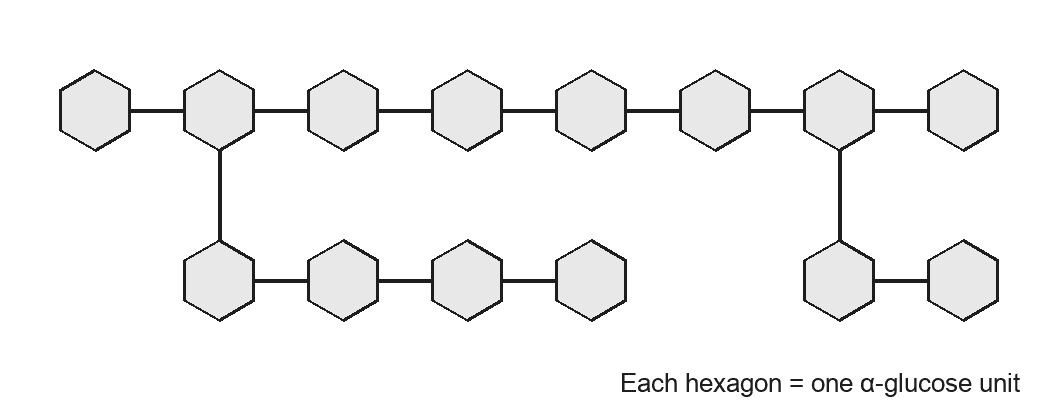
(a) Count the glucose units and the glycosidic bonds in the fragment.
(b) How many of the bonds are α-1,6 bonds and how many are α-1,4 bonds? Explain how you decided.
(c) Is this a fragment of amylose, amylopectin or cellulose? Give a reason.
(d) How would a fragment of glycogen of the same size usually look different?
- 111 mark
Question 11
Both starch and cellulose are polymers of glucose, yet a person can digest the starch in rice but not the cellulose in its husk. The main reason is that cellulose
- 123 marks
Question 12
A drop of iodine solution was placed on a freshly cut potato slice and on a piece of cotton wool.
(a) State the colour seen on each and explain the difference.
(b) Some boiled potato paste was mixed with saliva, which contains an enzyme that digests starch, and kept warm. Iodine was added to small samples every five minutes. Predict and explain how the colour would change over time.
- 131 mark
Question 13
The hard outer covering of a prawn is treated to break down its main polysaccharide. Every monomer obtained contains a nitrogen atom, and the monomers were joined in long unbranched chains by β-1,4 links, as in cellulose. The polysaccharide is
- 143 marks
Question 14
Read the composition of these four polysaccharides:
- Glycogen: glucose units only.
- Inulin: fructose units only.
- Hyaluronic acid: two different sugar units (glucuronic acid and N-acetylglucosamine) that alternate along the chain.
- Chitin: N-acetylglucosamine units only.
(a) Define a homopolysaccharide and a heteropolysaccharide.
(b) Classify each of the four polysaccharides above as one or the other.
- 151 mark
Question 15
Which pair of sugars both have the formula C₆H₁₂O₆, but one carries an aldehyde group while the other carries a ketone group?
- 163 marks
Question 16
Plant cells store glucose as starch and animal cells store it as glycogen, instead of keeping large amounts of free glucose.
(a) Give two reasons why a polysaccharide is a better store than free glucose.
(b) Glycogen is more highly branched than starch. Suggest why this suits an animal that may suddenly need a lot of glucose.
- 172 marks
Question 17
α-glucose and β-glucose differ only at carbon atom 1. Describe this difference and state one consequence it has for the polysaccharides they form.
- 181 mark
Question 18
A fatty acid has the condensed formula CH₃(CH₂)₇CH=CH(CH₂)₇COOH. Which description fits it?
- 194 marks
Question 19
The figure shows the structure of a fat molecule. P, Q and R mark its three fatty-acid chains.
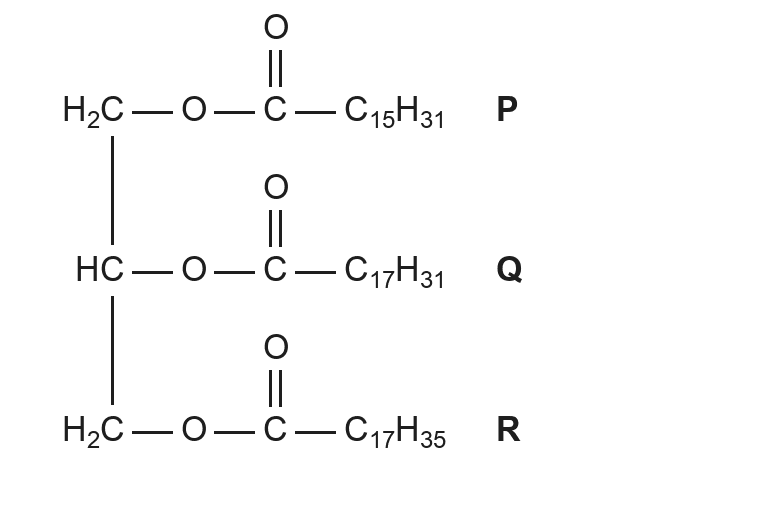
(a) Which of the chains P, Q and R come from saturated fatty acids? How many C=C double bonds does the remaining chain have? (A saturated chain has the formula CₙH₂ₙ₊₁.)
(b) How many ester bonds does the molecule contain, and how many water molecules were removed when it was formed from glycerol and fatty acids?
(c) Count the atoms in the figure to find the molecular formula of the fat.
- 201 mark
Question 20
Three fats were analysed. (Hypothetical data.) Fat X contains 85% saturated fatty acids, fat Y 50% and fat Z 15%; the rest of each is unsaturated fatty acids. Which of them is most likely to be a liquid oil at 20 °C, and why?
- 213 marks
Question 21
When shaken with water, a triglyceride (fat) separates into droplets, but phospholipids arrange themselves into a double layer. Explain this difference in behaviour from the structure of the two molecules.
- 222 marks
Question 22
The leaves of many desert plants are covered by a thick, shiny layer of wax.
(a) What are waxes, chemically?
(b) How does this layer help the plant?
- 233 marks
Question 23
When living tissue is ground in cold trichloroacetic acid and filtered, the small molecules dissolve in the filtrate (the acid-soluble fraction). The material that stays behind (the acid-insoluble fraction) contains proteins, nucleic acids and polysaccharides, and also lipids. Lipids have molecular masses that rarely exceed about 800 daltons, whereas proteins and nucleic acids run into many thousands.
(a) Why are lipids not regarded as true macromolecules or polymers?
(b) Why, then, do they appear in the acid-insoluble fraction?
- 243 marks
Question 24
Classify each of the following as a simple lipid, a compound lipid or a derived lipid, giving a reason for each:
(a) beeswax, which forms the material of the honeycomb;
(b) lecithin, found in cell membranes;
(c) diosgenin, used in the manufacture of anti-fertility pills.
- 251 mark
Question 25
Lipids contain very few oxygen atoms compared with their carbon atoms, much fewer than carbohydrates do. Which statement follows from this?
- 261 mark
Question 26
Every amino acid has the general formula H₂N–CH(R)–COOH. Which side chain R would make the amino acid basic?
- 273 marks
Question 27
The figure shows the structural formula of a short chain of three amino acids. Four of its bonds are lettered W, X, Y and Z.
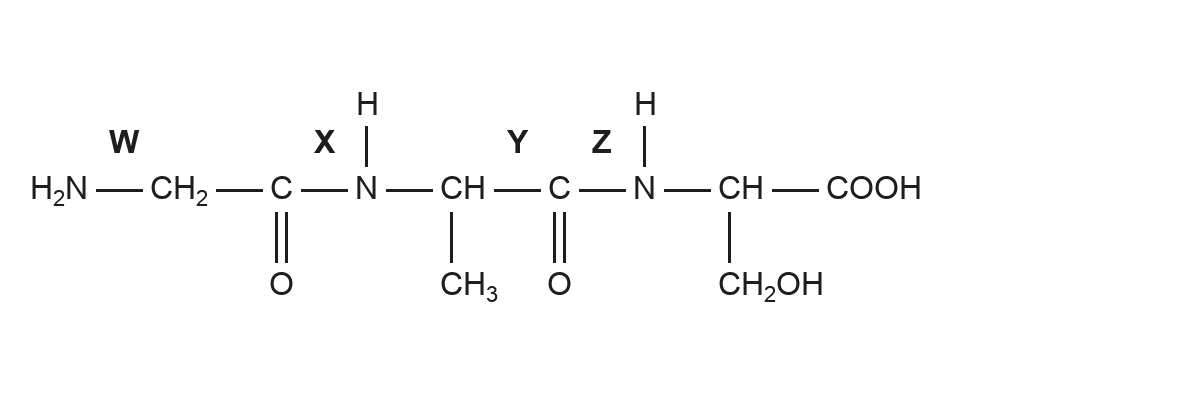
(a) Which of the lettered bonds are peptide bonds? Give a reason.
(b) How many water molecules were removed when this chain was formed from free amino acids?
(c) Name the three amino acids from their side chains, starting from the end that carries the free –NH₂ group.
- 281 mark
Question 28
In a solution near neutral pH, most molecules of alanine exist in the form H₃N⁺–CH(CH₃)–COO⁻. This form is best described as
- 292 marks
Question 29
For human beings, glycine and alanine are non-essential amino acids, while valine and leucine are essential amino acids.
(a) Explain what the two terms mean.
(b) Why do green plants not need any "essential amino acids" from outside?
- 301 mark
Question 30
A protein extracted from milk is hydrolysed completely. Besides amino acids, the only other product is phosphoric acid. The protein is therefore
- 313 marks
Question 31
Myoglobin, the oxygen-storing protein of muscle, is a single polypeptide chain folded into a compact shape. Haemoglobin of red blood cells is made of four polypeptide chains fitted together.
(a) State the highest level of structure found in each protein, with a reason.
(b) Name two kinds of bonds or interactions that hold a polypeptide chain in its folded tertiary shape.
(c) Both proteins contain a non-protein group that binds oxygen. Name this group and the metal in it.
- 321 mark
Question 32
After a meal, the hormone insulin makes muscle cells take up glucose from the blood through a protein in their plasma membrane. Which protein carries out this transport of glucose into the cells?
- 333 marks
Question 33
Three simple proteins X, Y and Z were tested in the laboratory.
Test X Y Z Soluble in water Yes No Yes Soluble in dilute salt solution Yes Yes Yes Coagulates when heated Yes Yes No Nature Neutral Neutral Basic, small molecules Identify X, Y and Z as an albumin, a globulin or a histone, and name one place where each kind of protein is found.
- 343 marks
Question 34
(a) Cellulose is called a homopolymer but a protein is called a heteropolymer. Explain why.
(b) Using the 20 kinds of amino acids that commonly occur in proteins, how many different chains of exactly three amino acids (tripeptides) could be made? Show your working.
- 351 mark
Question 35
If every protein on Earth could be weighed, the single protein present in the greatest total amount would be an enzyme found in green leaves. Which protein is it?
- 361 mark
Question 36
A molecule is made of adenine joined to ribose and contains no phosphate group. It is
- 374 marks
Question 37
The figure shows a single unit of a nucleic acid. P, Q and R mark its three parts, and the numbers 1′ to 5′ mark the carbon atoms of part Q.

(a) Name the parts P, Q and R.
(b) Is this unit a ribonucleotide or a deoxyribonucleotide? Give the evidence from the figure.
(c) Is R a purine or a pyrimidine? Give a reason.
(d) What is the molecule called if part P is removed?
- 384 marks
Question 38
Two samples of DNA were analysed for their bases. (Hypothetical data.)
Sample 1 is double-stranded DNA in which 23% of the bases are adenine.
Sample 2 has this base composition: adenine 24%, thymine 32%, guanine 18%, cytosine 26%.
(a) Find the percentage of thymine in sample 1.
(b) Find the percentages of guanine and of cytosine in sample 1.
(c) What is the ratio of purines to pyrimidines in sample 1?
(d) What can you conclude about the structure of sample 2? Give a reason.
- 392 marks
Question 39
A student labels a molecule made of uracil joined to ribose as "uridylic acid".
(a) Is the label correct? Give the correct name of the molecule.
(b) What must be added to this molecule to make uridylic acid, and is uridylic acid a nucleoside or a nucleotide?
- 404 marks
Question 40
A circular DNA molecule found in a bacterium contains 5,000 base pairs, and 40% of its base pairs are G≡C pairs. It has the B-DNA structure of the Watson and Crick model, with a rise of 0.34 nm per base pair and about 10 base pairs per turn. (Hypothetical data.)
(a) Calculate the length of the DNA in nanometres and in micrometres (1 µm = 1000 nm).
(b) How many complete turns of the helix does it have?
(c) How many nucleotides does it contain?
(d) How many hydrogen bonds hold its two strands together?
- 411 mark
Question 41
One strand of a DNA segment reads 5′–ATGC–3′. Which is the sequence of the complementary strand, also written in the 5′ → 3′ direction?
- 423 marks
Question 42
Three kinds of RNA molecule in a cell are described below. Identify each and state its function.
(a) A long chain made in the nucleus that moves to the cytoplasm and attaches to ribosomes; its bases are read in groups of three (codons).
(b) A small single-stranded molecule folded into a clover-leaf shape, with an anticodon at one end.
(c) A coiled molecule found only in ribosomes, closely bound to protein.
- 431 mark
Question 43
Each option gives one strand of a 10-base-pair segment of double-stranded DNA. (Hypothetical data.) Which segment would need the most heat to separate its two strands?
- 442 marks
Question 44
In the Watson and Crick model, the DNA double helix has the same width (about 20 Å, or 2 nm) all along its length. Explain how base pairing keeps the width constant.
- 451 mark
Question 45
The nucleic acid extracted from a certain plant virus contains ribose and uracil, and no deoxyribose or thymine. Which conclusion is correct?
- 463 marks
Question 46
A protein is made of two polypeptide chains: one of 120 amino acids and the other of 85 amino acids. (Hypothetical data.)
(a) How many peptide bonds are present in each chain?
(b) How many water molecules were released in forming all these peptide bonds?
(c) If all the peptide bonds were hydrolysed, how many water molecules would be used and how many amino acids would be released?
- 472 marks
Question 47
Name the bond that is broken, and the products formed, when each of the following is hydrolysed:
(a) a molecule of sucrose;
(b) a dipeptide made of glycine and alanine.
- 483 marks
Question 48
A laboratory makes two short, straight (not circular) pieces of DNA. (Hypothetical data.)
- Piece 1 is a single strand of 30 nucleotides.
- Piece 2 is double stranded, with 30 base pairs.
(a) How many phosphodiester bonds are there in piece 1 and in piece 2?
(b) Between which carbon atoms of neighbouring sugars does each phosphodiester bond form a link?
(c) Why is the bond called a phosphodiester bond?
- 491 mark
Question 49
An enzyme from the pancreas splits a fat molecule into glycerol and fatty acids. Which bonds does it break?
- 503 marks
Question 50
When egg white is boiled, its albumin coagulates and turns into a white solid, but chemical analysis shows that the chains of amino acids are still complete.
(a) Which kinds of bonds are broken by the heat?
(b) Which bonds survive, and why?
(c) Which level of protein structure is therefore still present, and which levels are lost?
- 511 mark
Question 51
Which one of the following is a reducing sugar?
(i) Maltose
(ii) Cellulose
(iii) Glucose
(iv) Sucrose
- 521 mark
Question 52
Two monosaccharides are bound together by
- 531 mark
Question 53
The reducing sugars are called so because they
- 541 mark
Question 54
The sugar found in fruits, honey and nectar is
- 551 mark
Question 55
The common sugar present in milk is
- 561 mark
Question 56
Ribose sugar belongs to following group
- 571 mark
Question 57
Maltose is formed by the following monosaccharides
- 581 mark
Question 58
Lactose is formed by
- 591 mark
Question 59
Sucrose is commonly found in
- 601 mark
Question 60
Unsaturated fatty acids have
- 611 mark
Question 61
The use of sunflower oil is recommended by the doctors because it is
- 621 mark
Question 62
A phospholipid molecule has a polar group which is
- 631 mark
Question 63
An acidic amino acid has an alkyl R chain containing an extra
- 641 mark
Question 64
An amino acid is essential because it is
- 651 mark
Question 65
A peptide bond is formed when NH group combines with
- 661 mark
Question 66
RNA contains a base uracil in place of
- 671 mark
Question 67
A phosphodiester bond joins two nucleotides together. It is present between
- 681 mark
Question 68
Phospholipid is
- 691 mark
Question 69
Sucrose, a common table sugar, is composed of
- 701 mark
Question 70
Which is a non-reducing sugar?
- 711 mark
Question 71
The basic unit of chitin is
- 721 mark
Question 72
The basic unit of chitin is
- 731 mark
Question 73
DNA and RNA differ in the following molecule
- 741 mark
Question 74
The secondary structure of a protein is due to the presence of
- 751 mark
Question 75
The cell wall of a plant cell contains
- 761 mark
Question 76
β-pleated structure of a molecule can be seen in the following level of protein
- 771 mark
Question 77
The proteins associated with nucleic acids are
- 781 mark
Question 78
The proteins which are found in antibodies in blood are
- 791 mark
Question 79
Which of the following sugar is present in nucleic acid?
- 801 mark
Question 80
One of the very important carrier proteins is
- 811 mark
Question 81
tRNA is found in
- 821 mark
Question 82
mRNA is found attached to
- 831 mark
Question 83
The width of a DNA molecule is
- 841 mark
Question 84
Adenine base always pairs with the following in RNA
- 851 mark
Question 85
Hydrogen bonds are found in between the
- 861 mark
Question 86
If on one helix of DNA the base is cytosine the other helix could have
- 871 mark
Question 87
DNA is a molecule of heredity because
- 881 mark
Question 88
The primary level of protein is due to the presence of
- 891 mark
Question 89
mRNA is a polymer of
- 901 mark
Question 90
The storage protein in animal is
- 911 mark
Question 91
One turn of the helix in a β-form of DNA is approximately
- 921 mark
Question 92
Which one of the following pairs of nitrogenous bases of nucleic acids, is wrongly matched with the category mentioned against it?
- 931 mark
Question 93
Uracil is present in RNA at the place of
- 941 mark
Question 94
Quaternary structure of protein
- 951 mark
Question 95
The chemical formula of polysaccharides is ____________ .
- 961 mark
Question 96
Amylose has ____________ linkage in glucose molecules.
- 971 mark
Question 97
Cellulose is made up of ____________ units.
- 981 mark
Question 98
____________ is used as a source of energy in animals.
- 991 mark
Question 99
____________ is a source of food for animals.
- 1001 mark
Question 100
A conjugated protein has ____________ group attached to the simple protein.
- 1011 mark
Question 101
____________ and ____________ are contractile proteins in animals.
- 1021 mark
Question 102
tRNA has a ____________ base instead of thymine.
- 1031 mark
Question 103
DNA takes a complete turn after about ____________ .
- 1041 mark
Question 104
DNA has ____________ nucleotides in a complete turn.
- 1051 mark
Question 105
The ribose sugar is commonly found in ____________ molecule.
- 1061 mark
Question 106
The general formula of fatty acid is ____________ .
- 1071 mark
Question 107
The Benedict's test is used to detect ____________ .
- 1081 mark
Question 108
____________ is the common sugar in germinating seeds.
- 1091 mark
Question 109
____________ is a 16C saturated fatty acid.
- 1101 mark
Question 110
Fats are rich in ____________ fatty acids.
- 1111 mark
Question 111
The basic molecule of cell membranes having polar and non-polar group is ____________ .
- 1121 mark
Question 112
The use of oils instead of fat is recommended to reduce ____________ levels in the blood.
- 1131 mark
Question 113
____________ is a kind of lipid used as a waterproofing material in plants.
- 1141 mark
Question 114
____________ nucleoside is not present in DNA.
- 1151 mark
Question 115
Amino acids are the basic units of carbohydrates.
- 1161 mark
Question 116
Essential amino acids cannot be synthesised by the animals, hence must be obtained from food.
- 1171 mark
Question 117
A simple lipid is an ester of fatty acid and alcohol.
- 1181 mark
Question 118
Fats contain unsaturated fatty acids and so are solid at room temperature.
- 1191 mark
Question 119
In a phospholipid the head is formed by hydrocarbons of fatty acids and tails by the phosphate group.
- 1201 mark
Question 120
Cytosine and uracil are pyrimidines and adenine and guanine are purines.
- 1211 mark
Question 121
When an aldehyde or ketone group binds with the alcoholic group of another monosaccharide, a glycosidic bond is formed.
- 1221 mark
Question 122
Lactose is a disaccharide made up of galactose and glucose.
- 1231 mark
Question 123
A secondary structure of protein is a spiral or coiled chain having only peptide and hydrogen bonds between amino acids.
- 1241 mark
Question 124
Uracil is present instead of adenine in RNA.
- 1255 marks
Question 125
Match the following:
Column I Column II 1. Adenylic acid (a) Ester 2. Cholesterol (b) Nucleotide 3. AMP (c) Nucleoside 4. Galactose (d) Monosaccharide 5. Triglyceride (e) Derived lipid - 1261 mark
Question 126
A substance that does not undergo any change but increases the rate of a chemical reaction.
- 1271 mark
Question 127
A polymer of 1-4 linkage of beta-glucose arranged in linear chains.
- 1281 mark
Question 128
A bond formed by joining two monosaccharide molecules.
- 1291 mark
Question 129
A molecule formed by combination of a pentose sugar and a nitrogenous base.
- 1301 mark
Question 130
A fatty acid that does not contain a double bond between its carbon atoms.
- 1311 mark
Question 131
A long chain of RNA that contain coded information.
- 1321 mark
Question 132
Polymer of α – Glucose units arranged in a branched form.
- 1331 mark
Question 133
A molecule formed by three molecules of fatty acids and one molecule of glycerol.
- 1341 mark
Question 134
A complex lipid molecule that has ring-like arrangement of carbon atoms.
- 1351 mark
Question 135
These are the basic units of proteins.
- 1361 mark
Question 136
Assertion (A): Human diet should compulsorily contain glycine, serine and tyrosine.
Reason (R): Essential amino acids can be synthesised in the human body.
- 1371 mark
Question 137
Assertion (A): The long protein chain folds upon itself like a hollow ball giving rise to the tertiary structure exposing hydrophilic chains.
Reason (R): Tertiary structure of protein gives a 3-dimensional view of a protein.
- 1381 mark
Question 138
Assertion (A): Unsaturated fats are more reactive compared to the saturated fats.
Reason (R): Unsaturated fats have only single bonds in their structure.
- 1391 mark
Question 139
Assertion (A): In a DNA molecule, adenine (A) pairs with thymine (T) while guanine (G) pairs with cytosine (C).
Reason (R): In between A and T, there are three H-bonds, whereas between G and C, there are two H-bonds.
- 1401 mark
Question 140
Assertion (A): Glycosidic bonds are formed by dehydration.
Reason (R): Cellulose is formed by 1–4 linkages of beta-glucose by glycosidic bonds.
- 1411 mark
Question 141
Complete the analogy:
Nucleotides : DNA :: Amino acids : ________
- 1421 mark
Question 142
Complete the analogy:
Animals : Glycogen :: Plants : ________
- 1431 mark
Question 143
Complete the analogy:
Starch : α-glucose :: Chitin : ________
- 1441 mark
Question 144
Complete the analogy:
Haemoglobin : Iron :: Chlorophyll : ________
- 1451 mark
Question 145
Complete the analogy:
Primary molecule : Peptide bond :: Tertiary molecule : ________
- 1461 mark
Question 146
Complete the analogy:
Double helix : DNA :: Single helix : ________
- 1471 mark
Question 147
Complete the analogy:
Adenine : Thymine :: Cytosine : ________
- 1482 marks
Question 148
What are macromolecules? Give examples.
- 1495 marks
Question 149
Find and write down structures of 10 interesting small molecular weight biomolecules. Find if there is any industry which manufactures the compounds by isolation. Find out who are the buyers.
- 1503 marks
Question 150
Proteins have primary structure. If you are given a method to know which amino acid is at either of the two termini (ends) of a protein, can you connect this information to purity or homogeneity of a protein?
- 1512 marks
Question 151
Explain the composition of triglyceride.
- 1523 marks
Question 152
Can you describe what happens when milk is converted into curd or yoghurt, from your understanding of proteins.
- 1532 marks
Question 153
Can you attempt building models of biomolecules using commercially available atomic models (Ball and Stick models)?
- 1543 marks
Question 154
Attempt titrating an amino acid against a weak base and discover the number of dissociating (ionisable) functional groups in the amino acid.
- 1552 marks
Question 155
Draw the structure of the amino acid, alanine.
- 1562 marks
Question 156
What are gums made of? Is fevicol different from gums?
- 1575 marks
Question 157
Find out a qualitative test for proteins, fats and oils, amino acids and test any fruit juice, saliva, sweat and urine for them.