
Opening your dashboard
Class 11 Biology Chapter 12 Cell - The Unit of Life: Practice Questions
170 questions on Chapter 12, each worked through on its own page with the AI tutor. Class 11 Biology, ICSE 2026-27.
170 questions
1–4 marks · Mixed difficulty
- 11 mark
Question 1
Which observation best supports the statement that the cell is the functional unit of life?
- 22 marks
Question 2
Robert Hooke (1665) is usually credited with discovering the cell, yet Antonie van Leeuwenhoek is said to have been the first to observe living cells. Explain why both statements are correct.
- 33 marks
Question 3
A frog begins life as a single fertilised egg. Study these three observations:
(a) The egg divides again and again to form a tadpole made of millions of cells.
(b) A thin section of the tadpole's tail, seen under a microscope, is made entirely of cells.
(c) The tail moves because the muscle cells in it contract.
Link each observation to one point of the modern cell theory, explaining your choice.
- 41 mark
Question 4
In a Gram-staining practical, two bacteria X and Y were both stained purple by crystal violet and then treated with iodine. After a wash with alcohol, X became colourless while Y stayed purple. Safranin then stained X red. Which feature of the cell envelope of X best explains its result?
- 53 marks
Question 5
An electron micrograph of a rod-shaped bacterium is printed at a magnification of ×20,000. On the print, the cell is 80 mm long. (Hypothetical data.)
(a) Calculate the real length of the bacterium in micrometres (1 mm = 1000 µm).
(b) Does this length fall within the size range of 3–5 µm usually given for bacteria?
(c) A Mycoplasma cell, the smallest known cell, is about 0.3 µm long. How long, in mm, would it appear on a print at the same magnification?
- 61 mark
Question 6
The figure shows a bacterial flagellum set in the cell envelope of a Gram-negative bacterium.
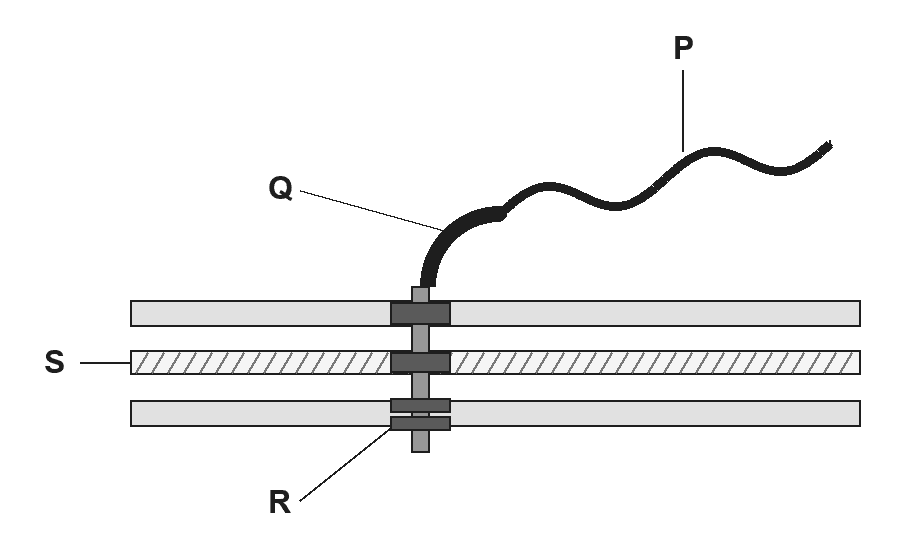
Which lettered part belongs to the basal body, the part that anchors the flagellum in the envelope and turns it round like a propeller?
- 74 marks
Question 7
Penicillin and lysozyme (an enzyme found in tears and saliva) can both kill certain bacteria by acting on their cell wall.
(a) How does each of them act on the wall?
(b) Why does a bacterium whose wall has been weakened burst in a dilute (hypotonic) medium?
(c) Why are Gram-negative bacteria far less affected by lysozyme?
- 82 marks
Question 8
Cyanobacteria in a pond stay floating near the surface, where light for photosynthesis is strongest.
(a) Name the inclusion in their cells that keeps them afloat.
(b) Which property of its wall lets it stay filled with gas instead of water?
- 91 mark
Question 9
Under the electron microscope, a cell shows a nucleus bounded by a nuclear envelope, mitochondria, a cell wall with plasmodesmata and a large central vacuole, but no chloroplasts. Which cell is it most likely to be?
- 103 marks
Question 10
A student has two unlabelled electron micrographs, P and Q, of eukaryotic cells.
- Cell P shows a pair of centrioles at right angles near the nucleus, many small vacuoles and one compact Golgi complex near the nucleus.
- Cell Q shows plasmodesmata in a thick outer layer, one large central vacuole bounded by a tonoplast, and several small Golgi units scattered through the cytoplasm.
Identify P and Q as an animal cell or a plant cell, giving three features in support of each answer.
- 111 mark
Question 11
Protoplasm is the living substance of a cell, made up of the cytoplasm and the nucleus. Which of the following parts of a leaf cell is not a part of its protoplasm?
- 121 mark
Question 12
A mouse cell and a human cell were fused to form one hybrid cell. Before fusion, the membrane proteins of the mouse cell were labelled with a green fluorescent dye and those of the human cell with a red dye. At first the two colours stayed in separate halves of the hybrid cell; about 40 minutes later they were evenly mixed over the whole surface. What does this result show?
- 133 marks
Question 13
A sample of plasma membranes was gently washed in a salt solution. Some of the proteins (fraction X) came off into the solution. The remaining proteins (fraction Y) came off only when the lipid bilayer itself was dissolved with a detergent. (Hypothetical experiment.)
(a) Identify the proteins of fraction X and fraction Y.
(b) Explain why the proteins of fraction Y were harder to remove.
(c) To which fraction do channel proteins belong? Give a reason.
- 144 marks
Question 14
Two substances, P and Q, move into a cell down their concentration gradients. The rate of entry was measured at different outside concentrations. (Hypothetical data.)
Outside concentration (mM) 1 2 4 8 16 Rate of entry of P (units) 2 4 8 16 32 Rate of entry of Q (units) 6 10 14 17 18 (a) Which substance enters by facilitated diffusion? Give evidence from the table.
(b) Why does the rate of entry of this substance level off?
(c) Predict the effect of an inhibitor that blocks the membrane's carrier proteins on the entry of P and of Q.
(d) Does either substance need ATP to enter? Give a reason.
- 151 mark
Question 15
A carrier protein in the plasma membrane of an intestinal cell carries sodium ions and glucose molecules into the cell together, both crossing in the same direction at the same time. Such a carrier is called
- 163 marks
Question 16
By dry mass, the membrane of a human red blood cell is about 52% protein and 40% lipid.
(a) Calculate the ratio of protein to lipid in this membrane, correct to one decimal place.
(b) What percentage of the dry mass is left over? Name the kind of molecule this remainder mostly is.
(c) State one reason why a membrane needs so much protein.
- 172 marks
Question 17
The hormone adrenaline does not enter a liver cell, yet the cell responds to it. Explain how the plasma membrane makes this possible.
- 181 mark
Question 18
In a laboratory, a piece of plant tissue was treated with pectinase, an enzyme that breaks down pectin. After some time the cells came apart from one another. Which layer did the enzyme dissolve to separate the cells?
- 193 marks
Question 19
Three cell-wall samples were analysed. (Hypothetical data.)
- Sample P is mainly chitin, a nitrogen-containing polysaccharide, with a thin layer of mixed glycans.
- Sample Q is mainly murein (peptidoglycan), a polysaccharide linked to amino acids.
- Sample R contains cellulose, hemicellulose, pectin and lignin.
Name the group of organisms from which each sample most likely came, giving a reason in each case.
- 203 marks
Question 20
Human red blood cells and onion peel cells were each placed in distilled water. After some time the red blood cells had swollen and burst, but the onion cells had swollen only a little and stayed whole. Explain both results.
- 212 marks
Question 21
Cells from two different tissues of an embryo were separated and mixed together in a dish. Over the next few hours, cells of each kind gathered into clumps of their own type.
(a) Which outer layer of animal cells makes this sorting possible?
(b) What in this layer allows cells to "recognise" one another?
- 221 mark
Question 22
Goblet cells of the intestine, which secrete mucus glycoproteins, were given radioactive amino acids for a few minutes. The radioactivity was then tracked through the cell over the next hour. In which order would it most likely appear?
- 232 marks
Question 23
Cell P, from the adrenal cortex, makes steroid hormones. Cell Q, a fibroblast, makes and secretes large amounts of protein. Which type of endoplasmic reticulum would you expect to be abundant in each cell? Give a reason for each.
- 241 mark
Question 24
As a tadpole changes into a frog, the cells of its tail are broken down and the tail disappears. The enzymes of which organelle mainly digest these tail cells?
- 253 marks
Question 25
The digestive enzymes of lysosomes are called acid hydrolases.
(a) Why are they given this name?
(b) How is the inside of a lysosome kept acidic?
(c) The cytoplasm around a lysosome is nearly neutral. Suggest why a small leak of lysosomal enzymes into the cytoplasm does far less harm than you might expect.
- 261 mark
Question 26
(Hypothetical experiment.) A chemical binds to the head piece (F₁) of the elementary particles on the inner mitochondrial membrane and stops it working. Which process is directly stopped?
- 271 mark
Question 27
(Hypothetical experiment.) Isolated mitochondria are broken open and separated into four fractions. Only fraction X shows high activity of the enzyme adenylate kinase. Fraction X is most likely
- 283 marks
Question 28
Give reasons:
(a) The middle piece of a sperm is packed with mitochondria.
(b) Mitochondria of heart muscle cells have many closely packed cristae.
(c) In ciliated cells, many mitochondria lie at the base of the cilia.
- 293 marks
Question 29
(Hypothetical experiment.) Chloroplasts from spinach leaves are broken and separated into two fractions: fraction P contains the membrane system (grana and stroma lamellae) and fraction Q contains the fluid stroma.
(a) Which fraction will release oxygen when it is lit and given water and an electron acceptor (NADP⁺)? Give a reason.
(b) Which fraction will fix carbon dioxide into sugar in the dark if it is supplied with ATP and NADPH? Give a reason.
(c) Why does neither fraction alone make sugar from carbon dioxide and water in light?
- 303 marks
Question 30
Explain the changes in the plastids in each case:
(a) A green tomato turns red as it ripens.
(b) A potato tuber left in sunlight turns green on its surface.
(c) Why are plastids able to change from one type to another like this?
- 311 mark
Question 31
Which plastid is correctly matched with what it stores or does?
- 321 mark
Question 32
A pancreatic cell makes a digestive enzyme that it will secrete out of the cell. This enzyme is made on
- 334 marks
Question 33
(Hypothetical data.) The sedimentation coefficient of a particle is , where is the speed at which the particle sinks and is the centrifugal acceleration; 1 Svedberg unit (1 S) s. In an ultracentrifuge with , ribosome sample X sinks at and ribosome sample Y at .
(a) Calculate the sedimentation coefficient of X and of Y in Svedberg units.
(b) Which sample is a bacterial ribosome and which is a ribosome from the cytoplasm of a liver cell?
(c) X splits into subunits of 60S and 40S. A student says this cannot be right because 60 + 40 = 100, not the value found for X. Explain why the student is mistaken.
- 342 marks
Question 34
(Hypothetical observation.) Onion root-tip cells are treated with colchicine. Their chromosomes condense and each becomes doubled into two chromatids, but the chromosomes never move to the poles, and the cells end up with twice the normal chromosome number. Explain this observation using what you know about the cytoskeleton.
- 351 mark
Question 35
Cells of the outer layer of the skin are stretched and rubbed all day yet do not tear apart. The cytoskeletal element that mainly gives them this mechanical strength is
- 363 marks
Question 36
(Hypothetical measurements.) Three kinds of protein filaments, X, Y and Z, are measured in electron micrographs of an animal cell.
Filament Diameter Appearance X 7 nm solid, thin and fine Y 25 nm hollow tube with a 5 nm wall Z 10 nm twisted like a rope; stays stable Identify X, Y and Z. For each, name its protein and give one function.
- 371 mark
Question 37
(Hypothetical experiment.) The membrane of isolated sperm tails is removed with a detergent. The bare tails beat when ATP is added and stop when the ATP is used up. The best explanation is that ATP is needed by
- 381 mark
Question 38
How many microtubules in all are seen in a transverse section through the shaft (axoneme) of a cilium?
- 391 mark
Question 39
A zoospore has one tinsel flagellum at its front end. The flagellum sends waves from its base towards its tip. In which direction does the zoospore move?
- 403 marks
Question 40
A Paramecium moves smoothly through water although each of its cilia only beats back and forth.
(a) Explain why the effective (power) stroke moves the cell forward but the recovery stroke does not undo it.
(b) How are the beats of the many cilia coordinated?
(c) Give one way in which the beat of a cilium differs from the beat of a whiplash flagellum.
- 413 marks
Question 41
(Hypothetical data.) A Paramecium 200 µm long swims at 1.0 mm s⁻¹. A swimmer 1.8 m tall swims at 2.0 m s⁻¹.
(a) For each, find the speed in body lengths per second.
(b) How many times faster is the Paramecium than the swimmer when speed is compared with body size?
(c) Name the structures and the protein whose ATP-splitting powers the Paramecium's movement.
- 424 marks
Question 42
The figure shows a transverse section through the shaft of a cilium.
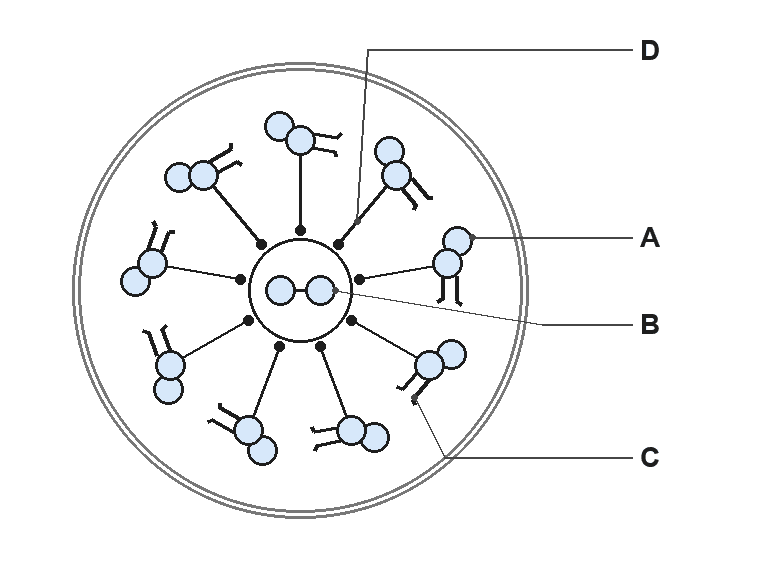
(a) Name the parts labelled A, B, C and D.
(b) What does part C do, and what supplies its energy?
(c) How would a transverse section through the basal body of the same cilium look different?
- 431 mark
Question 43
Which pair of cells both lack a nucleus when they are mature?
- 444 marks
Question 44
For each substance, state whether it passes into or out of the nucleus through the nuclear pores, and give a reason:
(i) messenger RNA (mRNA)
(ii) ribosomal proteins
(iii) ribosomal subunits
(iv) nucleotides
- 452 marks
Question 45
(Hypothetical observation.) The nucleoli in pancreatic cells that are making large amounts of digestive enzymes are large, while those in resting cells of the same tissue are small. Explain this difference.
- 461 mark
Question 46
(Hypothetical data.) The DNA of one chromosome is 4.5 cm long. At metaphase this DNA is packed about 10,000 times shorter. About how long is the metaphase chromosome?
- 473 marks
Question 47
A karyotype (the systematic arrangement of a cell's chromosomes by size and shape) is normally prepared from cells at metaphase, not from interphase cells. Give three reasons.
- 481 mark
Question 48
In a germinating castor seed, the oil stored in the endosperm is turned into sugar that feeds the young seedling. The organelles that carry out this conversion of fat into carbohydrate are
- 493 marks
Question 49
A drop of hydrogen peroxide placed on a fresh slice of potato fizzes strongly, but a drop on a boiled slice does not fizz.
(a) Name the gas given off and write the balanced equation for the reaction.
(b) Name the enzyme and the microbody that contains it, and say why the cell needs this enzyme.
(c) Why does the boiled slice not fizz?
- 503 marks
Question 50
(Hypothetical slides.) Three plant slides are examined under a microscope:
P: cells of a potato tuber containing oval grains, each with rings around a small dot near one end;
Q: a leaf of the Indian rubber plant, with a grape-like mass of crystals hanging on a stalk inside an enlarged cell below the surface;
R: the outermost layer of endosperm cells of a wheat grain, packed with small granules.
Identify the cell inclusion in each slide and state what it is made of.
- 511 mark
Question 51
The infoldings of plasma membrane in a bacterial cell form
- 521 mark
Question 52
The layer of the cell wall that is formed soon after the cell division and is composed of calcium pectate is
- 531 mark
Question 53
The cell wall is interrupted by minute pores called
- 541 mark
Question 54
The secondary cell wall is present
- 551 mark
Question 55
Which one is not a function of cell coat?
- 561 mark
Question 56
Which one is not true of nuclear membrane?
- 571 mark
Question 57
The unit membrane concept was given by
- 581 mark
Question 58
According to unit membrane concept the plasma membrane has the following arrangement
- 591 mark
Question 59
Unit membrane structure is found in
- 601 mark
Question 60
The peripheral proteins found in fluid mosaic model of membrane are
- 611 mark
Question 61
Which one of the following is an energy involving process?
- 621 mark
Question 62
Euchromatin is that part of chromatin network which
- 631 mark
Question 63
Nucleolus is present in
- 641 mark
Question 64
In mitochondria the enzymes of Krebs cycle are present
- 651 mark
Question 65
The enzymes for electron transport chain are present
- 661 mark
Question 66
Leucoplasts are plastids that
- 671 mark
Question 67
The stacked, fluid-filled sacs in chloroplasts are called
- 681 mark
Question 68
The light reaction does not take place in
- 691 mark
Question 69
The organelle associated with the synthesis of lipids and steroids is
- 701 mark
Question 70
The bodies that contain the enzyme catalase are called
- 711 mark
Question 71
The 80S ribosome has two subunits which are
- 721 mark
Question 72
The ribosomes are found attached to the membrane of
- 731 mark
Question 73
Cilia and flagella both have
- 741 mark
Question 74
Which one is not true of centriole?
- 751 mark
Question 75
The tubular structures which help in the formation of cell plate are
- 761 mark
Question 76
Which one of the following is not found in an animal cell?
- 771 mark
Question 77
Which of the following is not membrane bound?
- 781 mark
Question 78
Which of the following is associated with cell division?
- 791 mark
Question 79
Which of the following is the site of protein synthesis?
- 801 mark
Question 80
The “power house” of a cell is
- 811 mark
Question 81
DNA is present in
- 821 mark
Question 82
Fluid Mosaic Model was given by
- 831 mark
Question 83
Chlorophyll occurs in– part of chloroplast
- 841 mark
Question 84
Enzymes associated with oxidative ETC are found in
- 851 mark
Question 85
Cell organelles associated with secretion are
- 861 mark
Question 86
The cell organelle responsible for autolysis is
- 871 mark
Question 87
Ribosomes contain large quantities of
- 881 mark
Question 88
Single membrane-bound organelles are
- 891 mark
Question 89
Non-membranous organelles are
- 901 mark
Question 90
Ribosomes that occur exclusively in mitochondria are
- 911 mark
Question 91
The term mitochondrion was given by
- 921 mark
Question 92
Inner membrane of mitochondrion has series of folding known as
- 931 mark
Question 93
The nucleus is separated from surrounding cytoplasm by a nuclear membrane, which is
- 941 mark
Question 94
Besides proteins, ribosomes contain
- 951 mark
Question 95
The person who modified Schleiden and Schwann's cell theory
- 961 mark
Question 96
The vacuole in the plant cell contains
- 971 mark
Question 97
Prokaryotic cells do not have
- 981 mark
Question 98
Centrosomes are present
- 991 mark
Question 99
Lysosomes contain
(i) lytic enzymes
(ii) hydrolytic enzymes
(iii) hormone
(iv) useful material
- 1001 mark
Question 100
The organelle associated with aerobic respiration is
- 1011 mark
Question 101
Plasma membrane helps in
- 1021 mark
Question 102
Centrioles take part in formation of
- 1031 mark
Question 103
The vacuole is lined by a membrane called
- 1041 mark
Question 104
____________ separates the contents of a cell from its surrounding medium.
- 1051 mark
Question 105
Cell wall is made up ____________ and is present in the ____________ cells.
- 1061 mark
Question 106
____________ allows exchange of substances between nucleus and cytoplasm.
- 1071 mark
Question 107
Peroxisomes help in the process of ____________ in leaves.
- 1081 mark
Question 108
When several ribosomes are attached to a single mRNA, it is called ____________ .
- 1091 mark
Question 109
The intrinsic protein of cell membrane are embedded in the ____________ layer.
- 1101 mark
Question 110
The microfilaments are made up of proteins called ____________ .
- 1111 mark
Question 111
Centrioles are present inside a specialised cytoplasm called ____________ .
- 1121 mark
Question 112
A chromosome is called ____________ when its centromere is in the middle of a chromosome.
- 1131 mark
Question 113
The genetic material in a prokaryotic cell is present in a nucleoid region in cytoplasm.
- 1141 mark
Question 114
The small circular DNA present outside the genomic DNA is called euchromatin.
- 1151 mark
Question 115
Glycocalyx layer in a prokaryotic cell is present inner to the plasma membrane.
- 1161 mark
Question 116
Sodium-potassium pump is an example of active transport of molecules.
- 1171 mark
Question 117
Plasmodesmata are minute pores present in the cell membrane of animal cells.
- 1181 mark
Question 118
Spherosomes are associated with the synthesis and storage of lipids.
- 1191 mark
Question 119
Mitochondria contain DNA and are semi-autonomous organelles.
- 1201 mark
Question 120
Stroma of a chloroplast is a site for light reaction.
- 1211 mark
Question 121
Centrioles act as MTOCs during the formation of spindle fibres.
- 1221 mark
Question 122
The primary constriction of a chromosome is also referred as satellite.
- 1231 mark
Question 123
Cell without membrane-bound nucleus.
- 1241 mark
Question 124
An organelle with cristae.
- 1251 mark
Question 125
Several ribosomes attached to a single mRNA.
- 1261 mark
Question 126
Cytoplasmic bridges between adjacent cells.
- 1271 mark
Question 127
Thin, elongated, tubular structures on the surface of bacteria that help them to attach to other bacteria and solid surfaces.
- 1281 mark
Question 128
Proteins superficially or loosely attached to the surface of membrane.
- 1291 mark
Question 129
Structures attached to the outer surface of rough endoplasmic reticulum.
- 1301 mark
Question 130
Projections on the bacterial surface not used for locomotion but for helping the bacteria to stick to each other.
- 1311 mark
Question 131
Diffusion across a membrane with the help of carrier molecules.
- 1321 mark
Question 132
Diffused form of Golgi apparatus scattered in the cytoplasm, present in plant cells.
- 1331 mark
Question 133
Stalked bodies attached to the inner membrane of mitochondrial membrane.
- 1341 mark
Question 134
Non-photosynthetic plastids that give colour to flowers and fruits.
- 1351 mark
Question 135
Tightly coiled part of chromatin matter that gets stained intensely, that are supposed to be genetically inert.
- 1361 mark
Question 136
Complete the analogy:
Chloroplasts : Grana :: Mitochondria : ________
- 1371 mark
Question 137
Complete the analogy:
Localised form : Golgi complex :: Diffused form : ________
- 1381 mark
Question 138
Complete the analogy:
Food particle : Secondary lysosome :: Part of the cell : ________
- 1391 mark
Question 139
Complete the analogy:
9+2 arrangement : Cilia :: 9+0 arrangement : ________
- 1401 mark
Question 140
Complete the analogy:
Actin : Microfilaments :: Tubulin : ________
- 1411 mark
Question 141
In which organelle will you find: Chlorophyll?
- 1421 mark
Question 142
In which organelle will you find: Zymogen granule?
- 1431 mark
Question 143
In which organelle will you find: Phosphatase?
- 1441 mark
Question 144
In which organelle will you find: 9+0 arrangement of microtubules?
- 1451 mark
Question 145
In which organelle will you find: Tannin or latex?
- 1461 mark
Question 146
Assertion (A): Rudolf Virchow modified the hypothesis of cell theory given by Schleiden and Schwann.
Reason (R): According to cell theory, the cells arise from pre-existing cells.
- 1471 mark
Question 147
Assertion (A): Lipids present in the outer and inner side of the bilayer membrane are commonly different.
Reason (R): Oligosaccharides are attached to the external as well as inner surface of a bio-membrane.
- 1481 mark
Question 148
Assertion (A): A cell membrane shows quasi-fluid behaviour.
Reason (R): A membrane is a mosaic or composite of diverse lipids and proteins which move within the membrane.
- 1491 mark
Question 149
Assertion (A): The endomembrane system comprises of endoplasmic reticulum (ER), Golgi complex, lysosomes and vacuoles.
Reason (R): Mitochondria, chloroplast and peroxisomes are not the part of endomembrane system as their functions are not coordinated with the same.
- 1501 mark
Question 150
Assertion (A): Mitochondria and chloroplasts are semi-autonomous organelles.
Reason (R): They are formed by division of pre-existing organelles as well as they contain DNA but lack protein synthesising machinery.
- 1511 mark
Question 151
Assertion (A): Centrosomes and centrioles are related to each other.
Reason (R): Centrosome usually contains two cylindrical structures called centrioles.
- 1521 mark
Question 152
Assertion (A): Plasmids are double-stranded extra chromosomal DNA.
Reason (R): Plasmids are possessed by eukaryotic cells.
- 1531 mark
Question 153
Assertion (A): Leucoplasts and chromoplasts perform photosynthesis.
Reason (R): Chloroplasts store fats, starch and proteins.
- 1541 mark
Question 154
Assertion (A): The endoplasmic reticulum which lacks ribosomes is called smooth endoplasmic reticulum (SER).
Reason (R): SER is mainly involved in protein synthesis.
- 1551 mark
Question 155
Assertion (A): Peripheral proteins are totally or partially buried in the cell membrane.
Reason (R): Integral proteins lie on the surface of cell membrane.
- 1563 marks
Question 156
Given below is a diagram of a cell under compound microscope:

(i) Name the structure labelled A, B, C and D
(ii) Give one reason why you would call this cell, an animal or a plant cell.
(iii) Give one important function of structure D.
- 1571 mark
Question 157
Which of the following is not correct?
- 1581 mark
Question 158
New cells generate from
- 1593 marks
Question 159
Match the following
Column A Column B 1. Cristae (a) Flat membranous sacs in stroma 2. Cisternae (b) Infoldings in mitochondria 3. Thylakoids (c) Disc-shaped sacs in Golgi apparatus - 1601 mark
Question 160
Which of the following is correct:
- 1612 marks
Question 161
What is a mesosome in a prokaryotic cell? Mention the functions that it performs.
- 1623 marks
Question 162
How do neutral solutes move across the plasma membrane? Can the polar molecules also move across it in the same way? If not, then how are these transported across the membrane?
- 1631 mark
Question 163
Name two cell-organelles that are double membrane bound.
- 1643 marks
Question 164
What are the characteristics of prokaryotic cells?
- 1653 marks
Question 165
Multicellular organisms have division of labour. Explain.
- 1663 marks
Question 166
Cell is the basic unit of life. Discuss in brief.
- 1672 marks
Question 167
What are nuclear pores? State their function.
- 1682 marks
Question 168
Both lysosomes and vacuoles are endomembrane structures, yet they differ in terms of their functions. Comment.
- 1691 mark
Question 169
Which of the following statements is not correct?
- 1701 mark
Question 170
Which of the following statements regarding mitochondria is incorrect?