
Opening your dashboard
Class 11 Biology Chapter 10 Structural Organisation in Animals: Animal Tissues: Practice Questions
150 questions on Chapter 10, each worked through on its own page with the AI tutor. Class 11 Biology, ICSE 2026-27.
150 questions
1–4 marks · Mixed difficulty
- 11 mark
Question 1
In a tissue, the cells lie far apart in a large amount of matrix, and the main jobs of the tissue are binding other tissues together, giving support and transporting materials round the body. To which of the four basic types of animal tissue does it belong?
- 22 marks
Question 2
Arrange the following in order of increasing level of organisation, starting with the simplest:
the stomach; one columnar cell; the human body; the digestive system; the columnar epithelium lining the stomach.
Then define the term tissue.
- 32 marks
Question 3
Epithelial tissue and connective tissue differ greatly in the amount of extracellular material between their cells.
Compare the two tissues on this point, and state how the cells of epithelial tissue are held together.
- 41 mark
Question 4
A slide of the lining of an air passage shows a single sheet of cells. Some cells are tall and bear cilia; others are short and do not reach the free surface. The nuclei lie at two different levels, yet every cell touches the basement membrane. Which tissue is this?
- 53 marks
Question 5
The inner lining of the urinary bladder looks thick when the bladder is empty and much thinner when the bladder is full of urine.
(i) Name the epithelium that lines the bladder.
(ii) Explain how its cells allow this change in thickness.
(iii) State one other function of this epithelium.
- 61 mark
Question 6
Which one of the following correctly matches a modification of the free surface of epithelial cells with its feature and a place where it occurs?
- 73 marks
Question 7
A student gently scrapes the inner lining of her cheek with a sterile toothpick, mounts the scrapings in a drop of 0.9% sodium chloride solution, stains them with methylene blue and looks at them under a microscope.
(i) Why is 0.9% sodium chloride used instead of tap water?
(ii) Why is methylene blue added?
(iii) Describe the cells she will see and name the tissue they come from.
- 83 marks
Question 8
A mild burn damages only the outer layers of the epidermis of a boy's arm, and the skin heals within a few days.
(i) Name the type of epithelium that forms the epidermis.
(ii) Which layer of this epithelium makes the new cells, and how?
(iii) Why is a many-layered epithelium more suitable for the skin than a single-layered one?
- 91 mark
Question 9
In a gland of mammalian skin, each secretory cell fills up with an oily product and then the whole cell breaks apart, so that the cell itself becomes the secretion. Which mode of secretion and example is this?
- 101 mark
Question 10
A gland in the skin has a single unbranched duct, and its secretory part is a long tube rolled up into a coil deep in the dermis. Which type of gland and example is this?
- 113 marks
Question 11
For each situation below, name the type of cell junction that best meets the need, and say how it does so.
(i) The lining of an organ must stop its contents from leaking between neighbouring cells.
(ii) Neighbouring cells must pass ions and small molecules to each other very quickly.
(iii) Cells of the skin must stay firmly anchored to one another when the skin is pulled and stretched.
- 124 marks
Question 12
Four slides of epithelial tissue, labelled P, Q, R and S, are described below.
P: a single layer of thin, flat cells with irregular (tessellated) margins and a central nucleus.
Q: a single layer of cube-like cells whose free surface bears a dense brush border of microvilli.
R: many layers of cells; the upper layers are flat, dead and filled with keratin.
S: a single layer of tall, narrow cells with cilia at their free ends.
Name the epithelium on each slide and give one place in the human body where it is found.
- 132 marks
Question 13
A goblet cell is called a unicellular gland.
Explain why, and state how the mucus it secretes is useful in the lining of the intestine and in the lining of the air passages.
- 141 mark
Question 14
In a stained section of areolar tissue near an infected wound, a large cell of irregular outline is seen moving by amoeboid movement and engulfing bacteria. This cell is most likely a
- 153 marks
Question 15
Every spring, when pollen fills the air, a girl gets red, swollen, itchy eyes and a runny nose.
(i) What name is given to the pollen in this situation?
(ii) Which cells of the connective tissue are mainly responsible for her symptoms, and what chemical do they release?
(iii) Explain how this chemical causes the redness and swelling.
- 162 marks
Question 16
In a section of adipose tissue, cell X contains one large fat droplet, while cell Y contains many small fat droplets. In both, the nucleus lies close to the cell membrane.
(i) Name cells X and Y.
(ii) Why does the nucleus lie at the edge of the cell?
- 171 mark
Question 17
The Achilles tendon joins the calf muscle to the heel bone. It must pull on the bone with great force without stretching. Its tissue is best described as
- 183 marks
Question 18
A sports injury to cartilage usually heals much more slowly than a fracture of a bone.
Use the structure of the two tissues to explain this difference.
- 191 mark
Question 19
The flap of the external ear (pinna) can be folded flat and springs straight back to its shape when released. The supporting tissue of the pinna is
- 204 marks
Question 20
The figure shows a transverse section of one Haversian system (osteon) of compact bone.

Identify the parts labelled P, Q, R and S, and give one function of each.
- 213 marks
Question 21
Two similar pieces of chicken leg bone are treated differently. Piece A is left in dilute hydrochloric acid for a few days. Piece B is heated strongly in a flame until it stops burning.
Predict how each piece will behave when you try to bend it, and explain what each result shows about the composition of bone.
- 223 marks
Question 22
A sample of oxalated blood is spun at high speed in a haematocrit tube. The total height of the blood column is 50 mm. After spinning, the red bottom layer is 22 mm high, the thin buff-coloured middle layer is 0.5 mm and the clear top layer is 27.5 mm. (Hypothetical data.)
(i) Name the cells or fluid in each of the three layers.
(ii) Calculate the haematocrit (packed cell volume) and the percentage of plasma in this blood.
- 234 marks
Question 23
In a blood test, a technician counts 200 white blood cells on a stained smear and finds: neutrophils 124, lymphocytes 60, monocytes 10, eosinophils 5, basophils 1. The total leucocyte count of the sample is 7,500 per mm³. (Hypothetical data.)
(i) Calculate the percentage of neutrophils.
(ii) Calculate the number of neutrophils per mm³ of blood.
(iii) What percentage of the white cells counted are granulocytes?
(iv) Is the total leucocyte count within the normal range? Give the range.
- 241 mark
Question 24
Blood collected into a tube containing a pinch of sodium oxalate stays liquid and does not clot. The best explanation is that the oxalate
- 251 mark
Question 25
A blood test shows that a person's plasma albumin is very low, and the person's feet and hands are swollen (oedema). Which statement best explains the swelling?
- 261 mark
Question 26
A student looks at teased muscle cells under a microscope. Each cell is spindle-shaped, tapers at both ends, has one centrally placed nucleus and shows no cross-striations. The sample was most likely taken from the
- 271 mark
Question 27
A very thin transverse section is cut through the H zone of a relaxed sarcomere and viewed under the electron microscope. Which filaments will be seen in this section?
- 281 mark
Question 28
A skeletal muscle fibre contracts and each of its sarcomeres becomes shorter. Which of the following changes in the sarcomere is correct?
- 293 marks
Question 29
(Hypothetical data.) A 25 µm long piece of a myofibril contains 10 sarcomeres lying end to end. When the muscle contracts, every sarcomere shortens to 2.0 µm.
(a) Find the length of one sarcomere at rest.
(b) Find the length of the piece after contraction and the percentage by which it has shortened.
- 304 marks
Question 30
The figure shows one relaxed sarcomere of a skeletal muscle. (Hypothetical data.) The distance between the two Z lines is 2.4 µm, the A band is 1.6 µm wide, and each thin filament is 1.0 µm long, measured from its Z line.
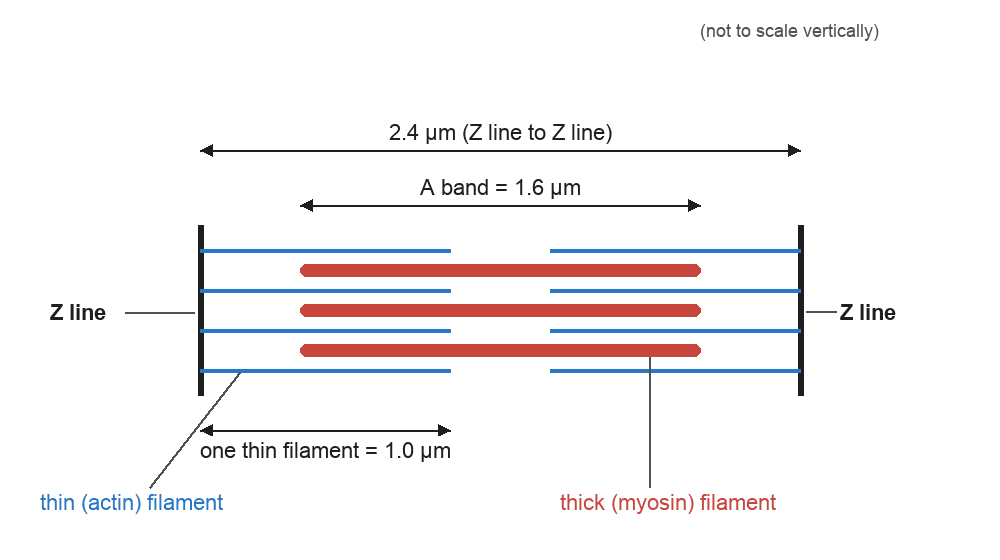
(a) Find the total width of I band inside this sarcomere, and the width of the I band part on each side.
(b) Find the width of the H zone.
(c) The sarcomere now contracts to 2.2 µm. Find the new widths of the A band, the I band (total) and the H zone.
- 311 mark
Question 31
Which feature is shared by skeletal muscle and cardiac muscle but is NOT seen in smooth muscle?
- 323 marks
Question 32
The leg muscles of a long-distance runner keep contracting for a long time during a race. Their fibres have numerous mitochondria and glycogen granules and are richly supplied with blood capillaries. Explain how each of these three features helps the muscle do its work.
- 333 marks
Question 33
The smooth muscle in the wall of the intestine contracts as one sheet, in rhythmic waves, while the tiny smooth muscle at the base of each body hair contracts on its own, fibre by fibre. Name the type of smooth muscle in each place and explain the difference in the way their fibres are arranged and work.
- 342 marks
Question 34
A heart taken from a donor is transplanted into a patient. At first its nerve connections to the patient’s brain are cut, yet the heart starts beating on its own. Explain why.
- 351 mark
Question 35
In a cross-section of a skeletal muscle, the muscle fibres are seen grouped into bundles (fascicles). The connective tissue sheath that surrounds each such bundle is the
- 363 marks
Question 36
A student records three muscle samples, X, Y and Z.
Sample Shape of cells Nuclei Cross-striations Other feature X Branched, joined end to end One or two, central Faint, regular Zig-zag junctions between cells Y Long, cylindrical, unbranched Many, near the periphery Distinct light and dark bands Fibres in bundles Z Spindle-shaped, tapering One, central Absent Fibres in sheets Identify the type of muscle in each sample and name one place in the body where each is found.
- 372 marks
Question 37
Smooth muscle fibres contain the same contractile proteins, actin and myosin, as skeletal muscle fibres. Explain why smooth muscle still shows no light and dark bands.
- 382 marks
Question 38
A student writes: “Smooth muscle is called involuntary muscle because it has no nerve supply.” Is the student right? Correct the statement and explain what “involuntary” means here.
- 391 mark
Question 39
Under the microscope a neuron is seen with a single process leaving its cell body; a short distance away this process divides into two branches, one working as a dendron and the other as an axon. This neuron is
- 401 mark
Question 40
In a disease, the cells that wrap myelin around the axons inside the brain and spinal cord are slowly destroyed. Which cells are being lost?
- 413 marks
Question 41
(Hypothetical data.) An impulse has to travel 0.9 m along a nerve fibre from the spinal cord to a foot muscle. In a myelinated fibre it travels at 90 m/s; in a non-myelinated fibre of the same length it would travel at 1.5 m/s.
(a) Find the time taken in each fibre.
(b) How many times faster is the myelinated fibre? Give the reason for the difference.
- 421 mark
Question 42
Four nerve fibres are compared. Which of them will conduct an impulse the fastest?
- 431 mark
Question 43
When a neuron is stimulated, the potential difference across its membrane changes and the cell is said to be excited. This property of a neuron is called
- 441 mark
Question 44
After a small injury to the brain, some cells move to the damaged area and engulf germs, dead cells and foreign particles. These cells are
- 453 marks
Question 45
The figure shows a neuron with six parts marked A to F.

(a) Name the parts A to F.
(b) In which direction does the nerve impulse normally travel through this neuron? Use the letters.
- 463 marks
Question 46
A transverse section of a myelinated peripheral nerve fibre shows the axoplasm surrounded by three concentric layers. Name these three layers in order from the inside outwards, and state what each one is or what forms it.
- 472 marks
Question 47
Most tumours that start in the brain’s own nervous tissue arise from neuroglia cells, not from neurons. Explain this using one property in which neuroglia differ from neurons.
- 482 marks
Question 48
A nerve in the arm is cut across and viewed under the microscope. It shows many nerve fibres grouped into bundles. Name the connective tissue sheaths that surround (a) each nerve fibre, (b) each bundle, and (c) the whole nerve.
- 493 marks
Question 49
When you touch a hot pan, the message to pull your hand away must travel very quickly, while slow movements of the gut can tolerate a delay. Relate this to the kinds of nerve fibres found in the cranial and spinal nerves and in the autonomic nervous system.
- 501 mark
Question 50
The basic function of simple squamous epithelium is
- 511 mark
Question 51
The epithelium present in the lining of stomach and intestine is
- 521 mark
Question 52
Which one of the following has keratinised epithelium?
- 531 mark
Question 53
The gastric glands of stomach are examples of
- 541 mark
Question 54
The alveoli of the lungs are lined with
- 551 mark
Question 55
Ciliated epithelium is found in the lining of
- 561 mark
Question 56
Which of the following epithelium is found in urinary bladder?
- 571 mark
Question 57
Which of the following cells secrete heparin?
- 581 mark
Question 58
The long wavy, unbranched fibres present in bundles in connective tissue are
- 591 mark
Question 59
The function of ligaments is to join
- 601 mark
Question 60
Osteocytes are present in the
- 611 mark
Question 61
Osteocytes are present in fluid filled cavities known as
- 621 mark
Question 62
Which of the following is not present in the cartilage?
- 631 mark
Question 63
Which of the following plasma proteins act as antibodies?
- 641 mark
Question 64
Which of the following is a type of white blood cell?
- 651 mark
Question 65
What is true of eosinophils?
- 661 mark
Question 66
Blood platelets are formed from
- 671 mark
Question 67
Enzyme thromboplastin converts
- 681 mark
Question 68
Which of the following proteins is present in the circulating blood of man?
- 691 mark
Question 69
After the formation of blood clot, the clear colourless or yellowish fluid that remains on top is
- 701 mark
Question 70
All the lymph collected from the body is poured into the
- 711 mark
Question 71
An area between two Z lines forms
- 721 mark
Question 72
I band has
- 731 mark
Question 73
Which of the following muscles are under voluntary nervous control?
- 741 mark
Question 74
In cardiac muscles, the cells are connected to each other by
- 751 mark
Question 75
Nissl's granules are found in the cytoplasm of
- 761 mark
Question 76
A non-medullated nerve fibre does not have
(A) Schwann cells
(B) neurilemma
(C) Nissl's granules
(D) nodes of Ranvier
- 771 mark
Question 77
In the central nervous system, interneuron space is filled by
- 781 mark
Question 78
Which of the following cells lie on a basement membrane?
- 791 mark
Question 79
Small and numerous cytoplasmic extensions that conduct the impulse towards the cell body are called
- 801 mark
Question 80
Squamous epithelium consists of
- 811 mark
Question 81
Surface layers of mouth and skin are made up of
- 821 mark
Question 82
Intercalated discs are found in
- 831 mark
Question 83
Which of the following is true of striated muscles?
- 841 mark
Question 84
Canaliculi can be seen in a
- 851 mark
Question 85
Which of the following cells do not have a nucleus?
- 861 mark
Question 86
White blood cells help in
- 871 mark
Question 87
Volkman's canals occur in
- 881 mark
Question 88
Choose the odd pair out in the following
- 891 mark
Question 89
Mast cells secrete
(A) haemoglobin
(B) heparin
(C) myoglobin
(D) histamine
- 901 mark
Question 90
The type of epithelial cells which line the inner surface of fallopian tubes, bronchioles and small bronchi are known as
- 911 mark
Question 91
Which of the following is a semi transparent tissue?
- 921 mark
Question 92
Tendons and ligaments are specialised types of
- 931 mark
Question 93
Keratinised dead layer of skin is made of
- 941 mark
Question 94
Myelin sheath is derived from
(A) neuroglial cells
(B) Schwann cells
(C) nerve cells
(D) all of these
- 951 mark
Question 95
Dark bands of muscle fibres are made of the protein _____ while light bands are composed of _____.
- 961 mark
Question 96
Nerve impulses come to the cell body of a neuron along its _____ and go away from the cell body along its _____.
- 971 mark
Question 97
Lacunae of bones contain _____ while lacunae of cartilages contain _____.
- 981 mark
Question 98
Tendons contain bundles of _____ fibres and rows of _____ cells between them.
- 991 mark
Question 99
Epidermal cells rest on a non-cellular membrane called _____.
- 1001 mark
Question 100
_____ are the voluntary muscles of the body.
- 1011 mark
Question 101
_____ attaches bones to bones at the joints.
- 1021 mark
Question 102
Blood platelets help in _____.
- 1031 mark
Question 103
_____, _____ and _____ are three basic components of the connective tissue.
- 1041 mark
Question 104
Collagen fibres are _____ while yellow fibres are _____.
- 1051 mark
Question 105
Bone matrix contains the protein _____ while cartilage contains the protein _____.
- 1061 mark
Question 106
A compact long bone has a number of _____ systems arranged in concentric circles.
- 1071 mark
Question 107
_____ blood cells help in blood clotting.
- 1081 mark
Question 108
_____ and _____ agranulocytes are phagocytic in function.
- 1091 mark
Question 109
The area between two Z lines is called a _____.
- 1101 mark
Question 110
A-band contains _____ filaments while I-band contains _____ filaments.
- 1111 mark
Question 111
An impulse in a myelinated nerve fibre jumps from one _____ to another.
- 1121 mark
Question 112
Acetylcholine is a _____ that is released at the _____.
- 1131 mark
Question 113
Pseudostratified epithelial cells line the inner surface of fallopian tubes and bronchioles.
- 1141 mark
Question 114
Mast cells secrete histamine.
- 1151 mark
Question 115
Tendons and ligaments are specialised types of nervous tissue.
- 1161 mark
Question 116
Keratinised dead layer of skin is made of stratified squamous epithelium.
- 1171 mark
Question 117
Myelin sheath is formed by Schwann cells.
- 1181 mark
Question 118
Hyaline cartilage is present in epiglottis.
- 1191 mark
Question 119
Thromboplastin is released from the ruptured white blood cells at the place of injury.
- 1201 mark
Question 120
Specialised cytoplasm present in muscle fibre is called sarcoplasm.
- 1211 mark
Question 121
Smooth muscles are involuntary in function.
- 1221 mark
Question 122
Cardiac muscles are myogenic in nature meaning the contractions are generated within the muscles.
- 1231 mark
Question 123
Zig-zag special thickenings in cardiac muscles.
- 1241 mark
Question 124
Another name for cartilage cells.
- 1251 mark
Question 125
The pigment present in red blood cells.
- 1261 mark
Question 126
Long and generally unbranched extension of a neuron.
- 1271 mark
Question 127
Regions on axon where fatty sheath is absent.
- 1281 mark
Question 128
Fluid-filled cavities present in cartilage cells.
- 1291 mark
Question 129
Connective tissue containing large amount of fat cells.
- 1301 mark
Question 130
Junctions that help to stop substances from leaking across a tissue.
- 1311 mark
Question 131
Junctions that facilitate the cells to communicate by connecting the cytoplasm of adjoining cells.
- 1321 mark
Question 132
Tissue that connects muscle to bone in humans.
- 1331 mark
Question 133
Specialised neuroglia cells that form the myelin sheath around the axons in the central nervous system.
- 1341 mark
Question 134
Cells that are present in the central nervous system and bind the nervous tissue together by filling up the spaces in between.
- 1351 mark
Question 135
Assertion (A): The squamous epithelium is made of a single layer of thin flattened cells with irregular boundaries.
Reason (R): They are found in walls of blood vessels and air sacs of lungs.
- 1361 mark
Question 136
Assertion (A): Columnar epithelium lining the intestinal mucosa appears to have a brush-like appearance.
Reason (R): A large number of microvilli are present on the brush-bordered columnar epithelium.
- 1371 mark
Question 137
Assertion (A): Tendons are present in all bone joints.
Reason (R): Tendons connect the bones together and hold them in position.
- 1381 mark
Question 138
Assertion (A): Haemoglobin is said to be a conjugated protein.
Reason (R): It is composed of a protein called haem and a non-protein iron porphyrin complex called globin.
- 1391 mark
Question 139
Assertion (A): Thrombin is necessary to initiate blood coagulation.
Reason (R): Thrombin helps in the formation of thromboplastin.
- 1401 mark
Question 140
Assertion (A): Special zig-zag junctions called intercalated discs are important regions of cardiac muscle cells.
Reason (R): Intercalated discs function as boosters for muscle contraction waves and allow cells to contract as a unit.
- 1411 mark
Question 141
Assertion (A): Neurons protect and support the neuroglial cells.
Reason (R): Neuroglial cells help in conduction of nerve impulse.
- 1421 mark
Question 142
Assertion (A): Non-myelinated nerve fibres do not possess nodes of Ranvier.
Reason (R): This is due to the absence of Nissl's granules in the node of Ranvier.
- 1431 mark
Question 143
Assertion (A): Histamine is involved in allergic and inflammatory reactions.
Reason (R): Histamine is a vasodilator.
- 1441 mark
Question 144
Mark the odd one out: Areolar tissue; blood; neuron; tendon
- 1451 mark
Question 145
Mark the odd one out: Prothrombin; heparin; fibrinogen; thromboplastin
- 1461 mark
Question 146
Mark the odd one out: Salivary gland; gastric gland; tear gland; thyroid gland
- 1471 mark
Question 147
Mark the odd one out: Neurilemma; dendrite; Z band; myelin
- 1481 mark
Question 148
Mark the odd one out: Erythrocyte; leucocyte; thrombocyte; lymphocyte
- 1491 mark
Question 149
What are the cellular components of blood?
- 1503 marks
Question 150
What are the following and where do you find them in animal body?
(i) Chondrocytes
(ii) Axons
(iii) Ciliated epithelium