
Opening your dashboard
Class 10 Physics Chapter 8 Current Electricity: Practice Questions
44 questions on Chapter 8, each worked through on its own page with the AI tutor. Class 10 Physics, ICSE 2026-27.
44 questions
1–5 marks · Mixed difficulty
- 11 mark
Question 1
Bloom's level: Remember
An electric current in a metal wire is due to the flow of :
- 21 mark
Question 2
Bloom's level: Remember
A data book lists the resistivity of copper as in S.I. units. That unit is :
- 31 mark
Question 3
Bloom's level: Understand
The resistance of a copper wire increases when it is heated. The best explanation is that, on heating :
- 41 mark
Question 4
Bloom's level: Understand
In a wire connected across a cell, the free electrons move from :
- 51 mark
Question 5
Bloom's level: Apply
A torch bulb draws a current of 0.25 A when the potential difference across it is 3 V. The resistance of its glowing filament is :
- 61 mark
Question 6
Bloom's level: Apply
A student joins a 3 Ω, a 6 Ω and a 2 Ω resistor side by side between the same two terminals. What single resistor could replace all three ?
- 71 mark
Question 7
Bloom's level: Apply
A family runs a 1.5 kW room heater for 2 hours each evening throughout a 30-day month. How many units (kWh) does the heater add to their bill ?
- 81 mark
Question 8
Bloom's level: Analyse
Wire A has length and radius . Wire B, of the same material, has length and radius . The ratio of their resistances is :
- 91 mark
Question 9
Bloom's level: Evaluate
Anil says, "A 2 kW heater always uses more electrical energy than a 100 W bulb." On one day the heater is used for 1 hour and the bulb is left on for 24 hours. Which is the best judgement ?
- 101 mark
Question 10
Bloom's level: Understand
Read the Assertion (A) and the Reason (R) and choose the correct option.
Assertion (A): The e.m.f. of a cell is equal to the reading of a high-resistance voltmeter connected across its terminals when the cell is not sending current to any external circuit.
Reason (R): When no current is drawn from a cell, there is no potential drop across its internal resistance.
- 111 mark
Question 11
Bloom's level: Understand
Read the Assertion (A) and the Reason (R) and choose the correct option.
Assertion (A): When a nichrome wire is cut into two equal halves, each half has the same specific resistance as the whole wire.
Reason (R): The resistance of a wire is directly proportional to its length.
- 121 mark
Question 12
Bloom's level: Apply
Read the Assertion (A) and the Reason (R) and choose the correct option.
Assertion (A): When a current of 0.32 A flows in a wire for 5 s, electrons pass through any cross-section of the wire.
Reason (R): The number of electrons passing in time is given by , where C.
- 131 mark
Question 13
Bloom's level: Remember
Write the relation between the current , the charge and the time . Name the S.I. unit of charge.
- 141 mark
Question 14
Bloom's level: Remember
Name the S.I. unit of potential difference and express it in terms of joule and coulomb.
- 152 marks
Question 15
Bloom's level: Understand
A student doubles the potential difference across a carbon resistor and finds that the current also doubles. When he does the same with a torch-bulb filament, the current increases but becomes less than double. Explain the difference.
- 162 marks
Question 16
Bloom's level: Understand
When the starter motor of a car is switched on, the headlights, which are already on, become dim for a moment. Explain why.
- 172 marks
Question 17
Bloom's level: Understand
Give two reasons why the lights and appliances in a house are connected in parallel and not in series.
- 182 marks
Question 18
Bloom's level: Apply
Find the resistance of a nichrome wire 2 m long with a cross-sectional area of 0.5 mm². The specific resistance of nichrome is Ω m.
- 192 marks
Question 19
Bloom's level: Apply
A cell of e.m.f. 1.5 V and internal resistance 0.5 Ω is connected to a resistor of 2.5 Ω. Find (a) the current in the circuit, and (b) the terminal voltage of the cell.
- 202 marks
Question 20
Bloom's level: Apply
An electric kettle is rated '1000 W, 250 V'. Find (a) the current it draws when working normally, and (b) the resistance of its heating element.
- 212 marks
Question 21
Bloom's level: Analyse
Readings for two components X and Y are :
Potential difference (V) 1 2 3 4 Current in X (mA) 50 100 150 200 Current in Y (mA) 40 70 90 100 (a) Find the resistance of each component at each reading.
(b) Which one obeys Ohm's law ? What happens to the resistance of the other as the voltage increases ?
- 222 marks
Question 22
Bloom's level: Analyse
Two identical bulbs A and B are joined in series with a 6 V cell of negligible internal resistance, as in figure (a). A third identical bulb C is then joined in parallel with B, as in figure (b).
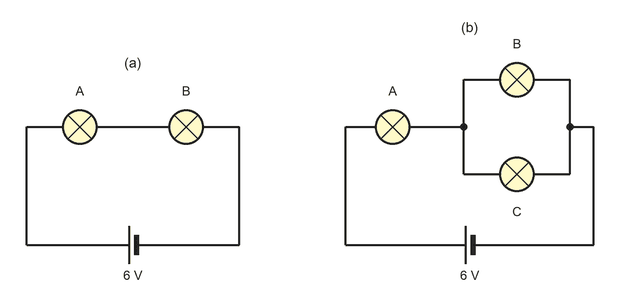
Find the voltage across each bulb in both cases, and state how the brightness of A and of B changes. (Assume each bulb has a constant resistance.)
- 234 marks
Question 23
Bloom's level: Apply
In the circuit shown, the battery has an e.m.f. of 12 V and negligible internal resistance.

Calculate (a) the total resistance of the circuit, (b) the current drawn from the battery, (c) the potential difference across the 4 Ω resistor and across the parallel pair, and (d) the current in the 6 Ω and in the 12 Ω resistor.
- 244 marks
Question 24
Bloom's level: Apply
Case study: The Sharma family's daily use of electricity is :
Appliance Power Number Hours per day LED bulb 10 W 5 6 Ceiling fan 60 W 1 10 Refrigerator 200 W 1 12 Electric iron 1000 W 1 0.5 (a) Find the energy used by each appliance in a day, in kWh.
(b) Find the total energy used in a 30-day month.
(c) If electricity costs ₹ 6 per kWh, find the monthly bill. Which appliance should the family use less to save the most money ?
- 255 marks
Question 25
Bloom's level: Analyse
Case study: To test an old battery, a student connects it to different resistors and records the terminal voltage with a high-resistance voltmeter and the current with an ammeter :
External resistance open circuit 7.5 Ω 3 Ω Current (A) 0 0.5 1.0 Terminal voltage (V) 4.5 3.75 3.0 (a) What is the e.m.f. of the battery ? Give a reason.
(b) Find the internal resistance of the battery from each closed-circuit reading.
(c) Explain why the terminal voltage falls as the current increases.
(d) Predict the current if the terminals were joined by a thick copper wire of almost zero resistance, and say why this should never be done.
- 264 marks
Question 26
Bloom's level: Evaluate
Check these notes written by a student. State whether each is correct or not, and correct the wrong ones.
(a) "In a series circuit, a bulb uses up some current, so less current returns to the cell than leaves it."
(b) "A 12 V battery gives 12 J of energy to each coulomb of charge that passes through it."
(c) "To measure the potential difference across a resistor, a voltmeter is connected in series with it."
(d) "In the wires outside a cell, the conventional current flows from the negative terminal to the positive terminal."
- 274 marks
Question 27
Bloom's level: Evaluate
An engineer chooses materials for four jobs. Judge each choice and give a reason based on the properties of the material. Suggest a better material where the choice is wrong.
(a) Nichrome for the connecting wires of a house.
(b) Copper for the heating coil of a room heater.
(c) Tungsten for the filament of an electric bulb.
(d) Manganin for a standard resistance coil.
- 284 marks
Question 28
Bloom's level: Analyse
In the circuit shown, a 12 V battery of negligible internal resistance is connected to resistors of 1 Ω, 2 Ω and 3 Ω in series. Point P is joined to the positive terminal and S to the negative terminal.

(a) Find the current in the circuit.
(b) Taking the potential of S as zero, find the potentials of P, Q and R.
(c) Across which resistor is the potential difference largest ? What does this tell you about where the most energy is changed into heat ?
(d) In which direction do the electrons move through the resistors ?
- 295 marks
Question 29
Bloom's level: Create
You have a box of identical 6 Ω resistors. Design combinations, using the fewest resistors in each case, to get an equivalent resistance of (a) 2 Ω, (b) 9 Ω, (c) 4 Ω and (d) 10 Ω. For each, describe the arrangement and show by calculation that it gives the required value.
- 304 marks
Question 30
Bloom's level: Create
Case study: Your team is designing a room heater that works on a 220 V supply. You have nichrome wire of specific resistance Ω m and cross-sectional area 0.2 mm².
(a) The heater must give 1210 W. Find the resistance its element must have, and the current it will draw.
(b) Find the length of nichrome wire needed for this element.
(c) Plan how two such identical elements and a switch could give the heater a 'low' and a 'high' setting. Find the power at each setting.
- 312 marks
Question 31
A lamp uses energy at the rate of 48 W on a 12 V supply. How much charge passes through the lamp in 2.0 s ?
- 324 marks
Question 32
Five resistors of different resistances are connected together as shown in the figure. A 12 V battery is connected to the arrangement.

With the key K closed, calculate :
(i) the total resistance in the circuit
(ii) the total current flowing in the circuit
- 332 marks
Question 33
A 12 V lamp is connected to a 12 V supply using very long leads (connecting wires). The lamp glows dimly, and not with its full brightness. Explain why.
- 344 marks
Question 34
The circuit diagram shows four identical resistors connected in series with a 12 V battery. Voltmeter V₁ is connected across the first resistor and voltmeter V₂ is connected across the second and the third resistors together.

What would be the reading of :
(i) voltmeter V₁
(ii) voltmeter V₂ ?
- 351 mark
Question 35
A torch bulb draws a steady current of 0.4 A from a battery. The time in which a charge of 240 C passes through the bulb is :
- 361 mark
Question 36
Two wires X and Y are made of the same material and have the same length. The diameter of X is twice the diameter of Y. If the resistance of Y is 24 Ω, the resistance of X at the same temperature is :
- 371 mark
Question 37
Assertion (A): The resistance of a copper wire increases when its temperature is raised.
Reason (R): The resistance of a wire is directly proportional to its length.
- 382 marks
Question 38
A student records the current I through a conductor for different potential differences V across it, keeping its temperature constant. The readings are given in the table below.
V (in volt) 1.5 3.0 4.5 6.0 I (in ampere) 0.3 0.6 0.9 1.2 (i) Is the conductor ohmic or non-ohmic ? Give a reason.
(ii) Calculate the resistance of the conductor.
- 392 marks
Question 39
90 J of work is done in moving a charge of 15 C from one end of a conductor to the other end.
(i) Calculate the potential difference between the ends of the conductor.
(ii) If this charge flows through the conductor in 10 s, calculate the resistance of the conductor.
- 402 marks
Question 40
An electric heater is rated 1000 W, 200 V.
(i) Calculate the resistance of its heating element when it is in use.
(ii) Calculate the power it consumes when it is connected to a 100 V supply. Assume that the resistance of the element does not change.
- 412 marks
Question 41
In a house, a geyser of power 2 kW is used for 1.5 hours every day and five LED lamps of 10 W each are used for 6 hours every day.
(i) Calculate the electrical energy consumed by them in 30 days, in kWh.
(ii) Calculate the cost of this energy at the rate of ₹ 6 per unit.
- 424 marks
Question 42
In the circuit shown below, the battery has an e.m.f. of 6 V and negligible internal resistance. The key K is closed.
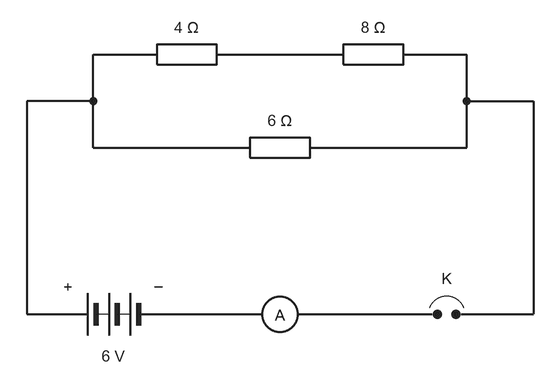
(i) Calculate the equivalent resistance of the circuit.
(ii) Find the reading of the ammeter A.
(iii) Calculate the potential difference across the 8 Ω resistor.
- 433 marks
Question 43
A high resistance voltmeter connected across a cell reads 1.5 V when the cell is in open circuit. When the cell sends a current of 0.5 A through an external resistor, the voltmeter reads 1.25 V.
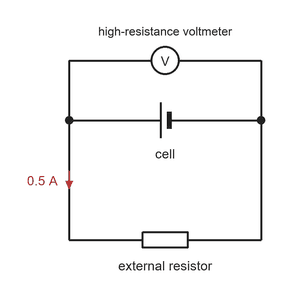
(i) State the e.m.f. of the cell and explain why the reading of the voltmeter falls when current is drawn from the cell.
(ii) Calculate the internal resistance of the cell.
(iii) Calculate the resistance of the external resistor.
- 444 marks
Question 44
Two filament lamps, one rated 60 W, 240 V and the other rated 40 W, 240 V, are connected in series across a 240 V supply.
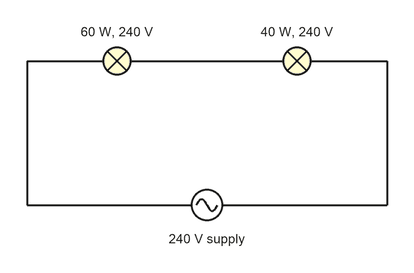
Assume that the resistance of each lamp remains the same as at its rated voltage.
(i) Calculate the resistance of each lamp.
(ii) Calculate the current through the lamps.
(iii) Calculate the power consumed by each lamp and state which lamp glows brighter.