
Opening your dashboard
Class 10 Physics Chapter 3 Machines: Practice Questions
42 questions on Chapter 3, each worked through on its own page with the AI tutor. Class 10 Physics, ICSE 2026-27.
42 questions
1–5 marks · Mixed difficulty
- 11 mark
Question 1
Bloom's level: Remember
A machine can not be used to :
- 21 mark
Question 2
Bloom's level: Remember
In a machine, the effort moves through a distance while the load moves through a distance in the same time. The load is L and the effort is E. The velocity ratio of the machine is :
- 31 mark
Question 3
Bloom's level: Understand
A wheelbarrow, a nutcracker and a bottle opener are all levers of the same class because in each of them :
- 41 mark
Question 4
Bloom's level: Apply
A machine has a velocity ratio of 5 and an efficiency of 80%. The effort needed to lift a load of 1000 N with it is :
- 51 mark
Question 5
Bloom's level: Apply
A block and tackle system has 4 pulleys in all, and its efficiency is 75%. With an effort of 300 N, it can lift a load of :
- 61 mark
Question 6
Bloom's level: Analyse
In an experiment with a lever, the effort needed for different loads is :
Load (in N) 20 40 60 Effort (in N) 8 16 24 Which conclusion is correct ? (Neglect friction and the weight of the lever.)
- 71 mark
Question 7
Bloom's level: Understand
A load of 200 N is raised through 3 m using an ideal single fixed pulley. Which of these is correct ?
- 81 mark
Question 8
Bloom's level: Evaluate
A student finds that a single movable pulley has a mechanical advantage of 1.8. She says, "The pulley must be faulty, because a single movable pulley has a mechanical advantage of 2." Which is the best judgement ?
- 91 mark
Question 9
Bloom's level: Understand
When we nod our head forward and backward, the head acts as a lever. The class of this lever and the position of its fulcrum are :
- 101 mark
Question 10
Bloom's level: Understand
Read the Assertion (A) and the Reason (R) and choose the correct option.
Assertion (A): A pair of sugar tongs has a mechanical advantage greater than 1.
Reason (R): In a pair of sugar tongs, the effort is applied between the fulcrum and the load, so the effort arm is shorter than the load arm.
- 111 mark
Question 11
Bloom's level: Remember
Read the Assertion (A) and the Reason (R) and choose the correct option.
Assertion (A): A pulley is a simple machine.
Reason (R): A pulley is a wheel with a grooved rim that can rotate about an axle, and a string or rope passes over the groove.
- 121 mark
Question 12
Bloom's level: Analyse
Read the Assertion (A) and the Reason (R) and choose the correct option.
Assertion (A): In a block and tackle system, increasing the number of pulleys increases the velocity ratio but decreases the efficiency.
Reason (R): Adding pulleys makes the lower block heavier and adds friction, so a larger part of the effort is wasted in lifting the lower block and overcoming friction.
- 131 mark
Question 13
Bloom's level: Remember
What is the velocity ratio of a combination of one fixed pulley and three movable pulleys, in which each movable pulley hangs in a loop of its own string ?
- 142 marks
Question 14
Bloom's level: Understand
Explain why mechanical advantage and velocity ratio are pure numbers without any unit, while efficiency is commonly expressed as a percentage.
- 152 marks
Question 15
Bloom's level: Apply
A boy uses a plank 2 m long as a lever to raise a rock of weight 900 N. He places a brick under the plank as the fulcrum, 0.4 m from the rock end, and pushes down at the other end.
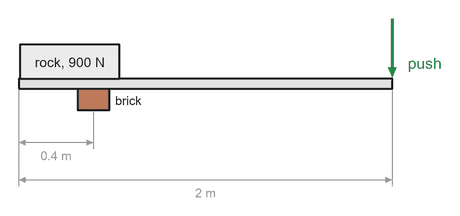
Find the mechanical advantage and the least effort needed.
- 162 marks
Question 16
Bloom's level: Apply
A load of 400 N is lifted using a single movable pulley by an effort of 250 N. Find (a) the mechanical advantage and (b) the efficiency of the pulley.
- 172 marks
Question 17
Bloom's level: Apply
A nutcracker is 16 cm long from its hinge to the end of the handles. A nut placed 4 cm from the hinge cracks when a force of 120 N acts on it. Name the class of the lever and find the effort needed at the ends of the handles.
- 182 marks
Question 18
Bloom's level: Apply
When a person rises on the toes, the foot acts as a lever with the fulcrum at the ball of the foot. The body's weight acts through the ankle, 10 cm from the fulcrum, and the calf muscle pulls up at the heel, 15 cm from the fulcrum. Name the class of lever and find the total pull of the calf muscles needed to lift a person of weight 600 N.
- 192 marks
Question 19
Bloom's level: Apply
A flag of weight 20 N is hoisted 10 m up a flagpole using a single fixed pulley at the top. The effort needed is 25 N. Find the velocity ratio, the mechanical advantage and the efficiency of the pulley.
- 202 marks
Question 20
Bloom's level: Analyse
Machine A has V.R. 4 and M.A. 3. Machine B has V.R. 6 and M.A. 4. Which machine is more efficient ? Which needs the smaller effort to lift the same load ?
- 212 marks
Question 21
Bloom's level: Evaluate
Aryan says, "A machine with a mechanical advantage of 0.5 is useless, because the effort is twice the load." Do you agree ? Justify your answer with an example.
- 222 marks
Question 22
Bloom's level: Understand
In an ideal pulley system, the tension is the same at every point of a single string. Explain how this helps us find the mechanical advantage of a pulley system just by counting the strands of the string that hold up the load.
- 234 marks
Question 23
Bloom's level: Apply
A block and tackle system of 5 pulleys is used to raise a load of 1200 N through 2 m. The effort needed is 300 N.
(a) Find the velocity ratio, mechanical advantage and efficiency of the system.
(b) How far does the effort move ?
(c) Find the work done by the effort, the work done on the load, and the energy wasted.
- 244 marks
Question 24
Bloom's level: Analyse
A system has one fixed pulley and three movable pulleys, each movable pulley hanging in a loop of its own string. It is used to lift a load of 1600 N.
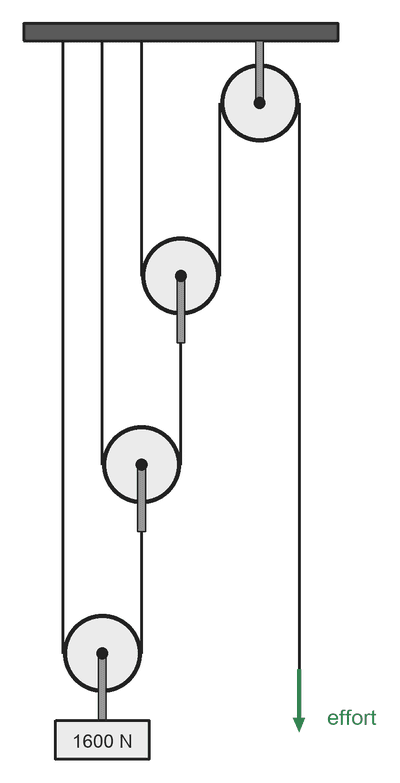
(a) Find its velocity ratio and the effort needed if it were ideal.
(b) The actual effort needed is 250 N. Find the mechanical advantage and the efficiency.
(c) Give two reasons why the actual effort is more than the ideal effort, and say what the fixed pulley contributes to the system.
- 254 marks
Question 25
Bloom's level: Apply
Case study: A gardener uses a pair of pruning shears to cut branches. The pivot (rivet) of the shears is between the blades and the handles. He holds the handles 20 cm from the pivot. A branch placed 4 cm from the pivot needs a force of 300 N to be cut.
(a) Name the class of lever and state where the fulcrum, load and effort are.
(b) Find the mechanical advantage and the effort needed.
(c) If the gardener places the branch 8 cm from the pivot instead, find the effort now. What advice would you give him ?
- 264 marks
Question 26
Bloom's level: Evaluate
Case study: In a gym, Ravi holds a 50 N dumbbell in his palm with his forearm horizontal. His biceps muscle is attached to the forearm 4 cm from the elbow joint, and the dumbbell is 30 cm from the elbow. Ravi says, "The human arm is a badly designed lever, because the muscle must pull much harder than the load."
(a) Name the class of lever formed by the forearm, and identify the fulcrum, effort and load.
(b) Find the pull of the biceps needed to hold the dumbbell (neglect the weight of the forearm).
(c) Judge Ravi's claim.
- 274 marks
Question 27
Bloom's level: Analyse
A student tested four machines and recorded the following :
Machine V.R. M.A. P 4 3.2 Q 2 2.4 R 1 0.9 S 6 5.1 (a) Find the efficiency of each machine.
(b) One reading is certainly wrong. Identify it and explain why it is impossible.
(c) Of the remaining machines, which needs the least effort for a given load, and which is the most efficient ?
- 285 marks
Question 28
Bloom's level: Create
Case study: Movers have to lift a piano of weight 2000 N to a first-floor balcony. The strongest mover can pull down with at most 600 N. Assume that any block and tackle system they build has an efficiency of about 80%.
(a) Find the least mechanical advantage needed.
(b) Decide how many pulleys the block and tackle must have. Show your reasoning.
(c) Describe how the pulleys should be arranged in the two blocks, where the string is tied and where the effort is applied.
(d) Find the effort needed with your design, and the length of rope the mover must pull to raise the piano by 4 m.
- 293 marks
Question 29
Bloom's level: Understand
(a) Use the principle of moments to show that the mechanical advantage of a lever is equal to the ratio of its effort arm to its load arm.
(b) Hence explain why a lever with a long effort arm needs less effort.
(c) Why can a class II lever never be used as a speed multiplier ?
- 304 marks
Question 30
Bloom's level: Create
Design a simple hand-operated lever to crush empty aluminium cans. A can needs a force of 400 N to crush it, and a child should not need to apply more than 50 N.
(a) Choose the class of lever and give a reason for your choice.
(b) Choose suitable lengths for the load arm and the effort arm, and show by calculation that your design works.
(c) Describe your design in words (where the hinge, the can and the handle are), and suggest one improvement for safety or ease of use.
- 312 marks
Question 31
A crowbar of total length 140 cm has its fulcrum at a distance of 20 cm from the load.
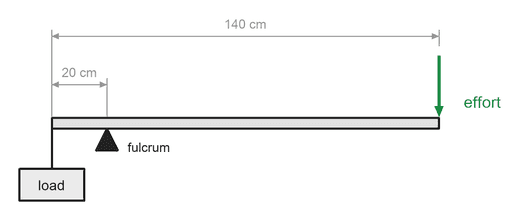
What is the mechanical advantage of this crowbar ?
- 323 marks
Question 32
Sketch a diagram to illustrate the positions of the fulcrum, the load and the effort in the working of a pair of scissors.
- 331 mark
Question 33
A machine has a mechanical advantage of 3 and an efficiency of 75%. Its velocity ratio is :
- 341 mark
Question 34
A pair of fire tongs is used to pick up a piece of burning coal. Used in this way, the machine acts as :
- 351 mark
Question 35
Assertion (A): The mechanical advantage of a single fixed pulley can never be greater than 1.
Reason (R): In a single fixed pulley, the effort moves through the same distance as the load, so its velocity ratio is 1.
- 362 marks
Question 36
(i) Define the term velocity ratio of a machine.
(ii) Friction in the moving parts of a machine lowers its mechanical advantage but does not change its velocity ratio. Explain why.
- 372 marks
Question 37
A crowbar 1.5 m long is used as a lever to raise a stone. The fulcrum is placed 0.3 m from the end which is under the stone, and the effort is applied at the other end. Neglect the weight of the crowbar and friction.

(i) Calculate the mechanical advantage of the crowbar.
(ii) Calculate the effort needed to raise a stone which exerts a load of 600 N on the crowbar.
- 382 marks
Question 38
For each of the following actions of the human body, state the class of lever and name the part which acts as the fulcrum :
(i) nodding the head,
(ii) raising a book kept on the palm by bending the arm at the elbow.
- 392 marks
Question 39
A single movable pulley is used to raise a load of 300 N through a height of 2 m. The effort applied at the free end of the string is 200 N.
(i) Through what distance does the effort move ?
(ii) Calculate the work done by the effort and the efficiency of the pulley.
- 404 marks
Question 40
A block and tackle system has four pulleys, two in the upper fixed block and two in the lower movable block. The lower block weighs 40 N. The system is used to raise a load of 360 N. Neglect friction and the weight of the string.
(i) State the velocity ratio of the system and calculate the effort needed.
(ii) Calculate the mechanical advantage and the efficiency of the system.
(iii) The lower block is replaced by a heavier one of weight 90 N. Calculate the efficiency of the system now, for the same load.
- 413 marks
Question 41
The diagram shows a straight lever FA with its fulcrum at F. The effort E acts at B and the load L acts at A. FB = 5 cm and FA = 15 cm. Neglect the weight of the lever and friction.
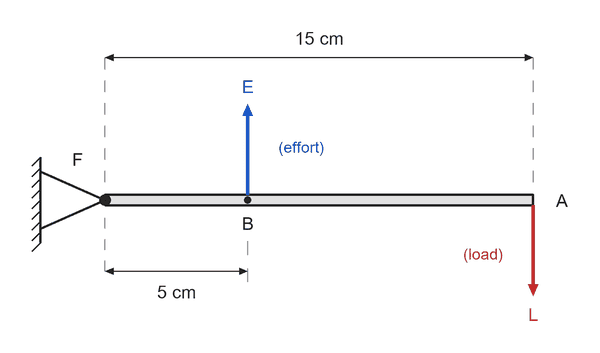
(i) State the class of this lever. Give a reason for your answer.
(ii) Calculate the mechanical advantage of the lever.
(iii) Calculate the effort needed to support a load of 2 N. What is gained by using such a lever ?
- 423 marks
Question 42
A machine of velocity ratio 5 needs an effort of 200 N to raise a load of 750 N.
(i) Calculate the mechanical advantage and the efficiency of the machine.
(ii) What effort would be needed to raise the same load if the machine were ideal ?
(iii) Explain why the mechanical advantage of an actual machine is always less than its velocity ratio.