
Opening your dashboard
Class 10 Biology Chapter 9 The Excretory System: Practice Questions
46 questions on Chapter 9, each worked through on its own page with the AI tutor. Class 10 Biology, ICSE 2026-27.
46 questions
1–5 marks · Mixed difficulty
- 11 mark
Question 1
Bloom's level: Remember
Bile pigments such as bilirubin are formed from the breakdown of :
- 21 mark
Question 2
Bloom's level: Remember
In a longitudinal section of the kidney, the apex of each renal pyramid that projects into the pelvis is called the :
- 31 mark
Question 3
Bloom's level: Remember
The hormone that controls the amount of water reabsorbed in the kidney tubules is secreted by the :
- 41 mark
Question 4
Bloom's level: Understand
Passing out faeces through the rectum is not called excretion because faeces mainly contain :
- 51 mark
Question 5
Bloom's level: Understand
Sweat glands are counted only among the accessory organs of excretion and are not truly excretory in function because :
- 61 mark
Question 6
Bloom's level: Apply
A patient suffering from jaundice passes unusually dark yellow urine. The extra substance in the urine is most likely :
- 71 mark
Question 7
Bloom's level: Apply
A patient is given penicillin by injection. A few hours later penicillin is found in the urine. It was added to the forming urine mainly by :
- 81 mark
Question 8
Bloom's level: Apply
On a cool evening, Raghav drinks about two litres of water within half an hour. Over the next two hours his urine will most likely be :
- 91 mark
Question 9
Bloom's level: Analyse
A fluid sample taken from a nephron contains water, urea, glucose, amino acids and salts, but no proteins and no blood cells. The sample was most likely taken from the :
- 101 mark
Question 10
Bloom's level: Understand
Assertion (A): Drinking several cups of strong tea or coffee makes a person pass urine more often.
Reason (R): Tea and coffee are diuretics, which increase the formation of urine.
- 111 mark
Question 11
Bloom's level: Analyse
Assertion (A): Fresh urine has a faint smell, but urine left standing for some time smells strongly of ammonia.
Reason (R): Normal urine consists of about 95% water and 5% dissolved solid wastes.
- 121 mark
Question 12
Bloom's level: Evaluate
Assertion (A): A person who has lost one kidney in an accident can still lead a normal life.
Reason (R): Such a person must be put on a dialysis machine twice every week.
- 131 mark
Question 13
Bloom's level: Remember
Name the two waste products formed in large amounts when carbohydrates, fats and proteins are broken down in the body cells.
- 142 marks
Question 14
Bloom's level: Understand
In humans, the kidneys, ureters, urinary bladder and urethra are often called the urinary system rather than the excretory system. Explain why this name is more suitable.
- 152 marks
Question 15
Bloom's level: Understand
A body builder eats far more protein than his body needs. Explain what happens to the extra amino acids and why the product formed must be removed quickly.
- 162 marks
Question 16
Bloom's level: Apply
The liver of a patient stops working properly. Predict two effects this will have on the removal of wastes from the body, with a reason for each.
- 172 marks
Question 17
Bloom's level: Apply
In a resting adult, about litres of blood flow through the two kidneys every minute. If the body contains litres of blood, how many times does the whole blood pass through the kidneys in one day ?
- 182 marks
Question 18
Bloom's level: Apply
On an ordinary day, Kiran gains mL of water from drinks, mL from food and mL as metabolic water. She loses mL in sweat, mL in breath and mL in faeces. The rest is lost as urine.
(a) How much urine must she pass to keep her water balance ?
(b) On a hot day her sweat loss rises to mL, while everything else stays the same. How much urine will she now pass?
- 192 marks
Question 19
Bloom's level: Analyse
One litre of a person's urine was analysed :
Constituent Mass (g) Water 955 Urea 22 Creatinine 1.4 Uric acid 0.6 Sodium chloride 9 Potassium chloride 2.4 Others 9.6 (a) Find the total mass of the nitrogenous wastes listed.
(b) Which listed substance is the main inorganic constituent?
- 202 marks
Question 20
Bloom's level: Evaluate
Nisha writes in her summary: "The kidneys only remove urea from the blood. They have nothing to do with how much water stays in the body." Evaluate her statement.
- 211 mark
Question 21
Bloom's level: Understand
Why must nitrogenous wastes such as ammonia and urea be sent out of the body rather than stored in it?
- 222 marks
Question 22
Bloom's level: Understand
Explain briefly how a dialysis machine (artificial kidney) cleans the blood of a patient whose kidneys have failed.
- 233 marks
Question 23
Bloom's level: Apply
In a certain adult, the kidneys form litres of glomerular filtrate in a day, but only litres of urine is passed.
(a) How many litres of filtrate are reabsorbed in the day?
(b) What percentage of the filtrate is reabsorbed ?
(c) Name the part of the tubule where most of the water is reabsorbed, and state how the great total length of the tubules helps.
- 244 marks
Question 24
Bloom's level: Apply
Case: During a flood, eight-year-old Tara drank contaminated water and got cholera. She had repeated vomiting and very watery motions for a whole day, and passed hardly any urine. The doctor at the relief camp said her blood urea was rising dangerously.
(a) Why did Tara pass very little urine?
(b) Explain why the urea in her blood kept rising, and name this condition.
(c) What immediate treatment should be given, and how does it help her kidneys?
- 254 marks
Question 25
Bloom's level: Analyse
The table compares three fluids in a healthy person ( ✓ = present, ✗ = absent ) :
Substance Blood in afferent arteriole Fluid in Bowman's capsule Fluid in collecting duct Plasma proteins ✓ ✗ ✗ Glucose ✓ ✓ ✗ Urea ✓ (low) ✓ (low) ✓ (high) (a) Why are plasma proteins present in the first fluid but absent in the second ?
(b) Why is glucose present in the second fluid but absent in the third ?
(c) The amount of urea does not increase between the second and third fluids, yet its concentration becomes much higher. Explain.
- 264 marks
Question 26
Bloom's level: Analyse
Case: Mr. Sen, aged 45, complains of extreme thirst. His test report shows :
- Urine volume : litres per day (normal about to litres)
- Urine : very pale, tasteless, no glucose
- Blood sugar : normal
(a) How many times the upper normal limit is his urine volume?
(b) Name the likely disorder, the hormone that is deficient and the gland that secretes it.
(c) Analyse how a shortage of this hormone leads to such a large volume of dilute urine.
- 273 marks
Question 27
Bloom's level: Evaluate
Two students argue :
- Aman : "The skin is just as important an excretory organ as the kidney, because sweat also contains water, salt and urea."
- Bela : "The kidney is far more important for excretion than the skin."
(a) State what the skin does remove from the body.
(b) Give two reasons that support Bela's view.
(c) Whose view do you accept? Justify your verdict in one or two sentences.
- 283 marks
Question 28
Bloom's level: Apply
Dev eats a very high-protein dinner of paneer, eggs and dal.
(a) His body cannot store the extra amino acids. Where are they broken down, and into what two products?
(b) Trace the path of the nitrogenous waste formed, from the organ where it is made to the organ that excretes it.
(c) Predict how his protein-rich diet would affect the pH of his urine, and compare it with the urine of a person on a mainly vegetable diet.
- 295 marks
Question 29
Bloom's level: Create
Design a simple working model to show how ultrafiltration takes place in a Malpighian capsule. You may use a rubber tube, a thinner rubber tube, a small piece of a porous cloth bag, a funnel, a syringe, and a mixture of water, salt, dissolved sugar and small beads.
(a) State which part of the model will stand for each of the following : afferent arteriole, glomerulus, efferent arteriole, Bowman's capsule, blood plasma with proteins.
(b) Explain how you will build up pressure in the model, linking it to the real structure.
(c) Predict what will be collected in the funnel and what will stay back, and state one way in which the model differs from the real kidney.
- 305 marks
Question 30
Bloom's level: Create
Prepare a summary table of excretion in humans with three columns — Waste substance, Organ that removes it, Form in which it leaves the body.
(a) Include these wastes : carbon dioxide, urea, excess water (three organs), excess salts and bile pigments.
(b) Below the table, write one sentence stating which organ removes the widest range of wastes.
(c) Add one row for a substance that is not an excretory product but is often wrongly listed as one, and explain why it does not belong.
- 311 mark
Question 31
Some vitamins, when taken in excess, cannot be kept in the body and have to be eliminated. Which are they ?
- 321 mark
Question 32
Which one of the following substances is present in the glomerular filtrate of a healthy person but is not found in the urine ?
- 331 mark
Question 33
Assertion (A): Urea is produced in the liver.
Reason (R): Urea is thrown out of the body by the liver.
- 342 marks
Question 34
(i) How does excretion differ from secretion ? Give one example of a substance passed out in each of the two processes.
(ii) The passing out of faeces from the rectum is not counted as excretion. What is this process called, and what do the faeces consist of ?
- 352 marks
Question 35
(i) Name the substances that are passed out of the body in the sweat.
(ii) The liver is an accessory excretory organ. State two ways in which it helps to rid the body of harmful substances.
- 362 marks
Question 36
(i) Name the hormone that controls the reabsorption of water in the kidney tubules, and the exact part of the gland that secretes it.
(ii) What happens to the amount of urine formed when less of this hormone is secreted ? Give the term for this, and name the disease in which a large amount of tasteless urine is passed for want of this hormone.
- 372 marks
Question 37
(i) Normal urine is usually slightly acidic. How does the kind of food eaten change this ?
(ii) Uric acid is a normal constituent of urine. Name two disorders that an excess of uric acid in the body may lead to, and state the property of uric acid that is responsible.
- 384 marks
Question 38
The figure shows a single kidney tubule together with its blood supply.
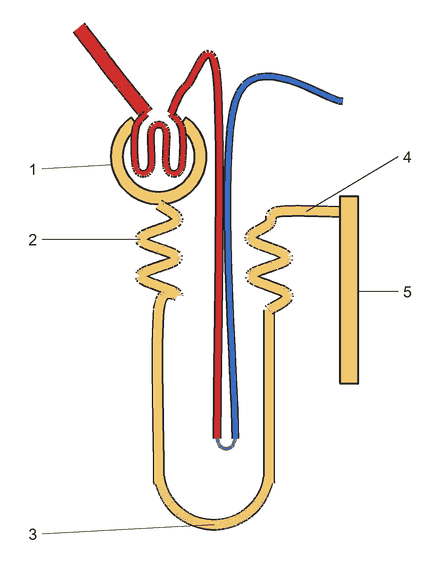
(i) Identify the parts of the tubule marked 1, 2, 3, 4 and 5.
(ii) In which of the numbered parts (a) is most of the water of the filtrate reabsorbed, and (b) are potassium and foreign chemicals such as penicillin passed into the forming urine ? Name the process that takes place in (b).
(iii) Which two of the numbered parts lie in the medulla of the kidney ? What appearance do they give to the medulla in a section of the kidney ?
- 394 marks
Question 39
The figure shows a human kidney cut lengthwise.
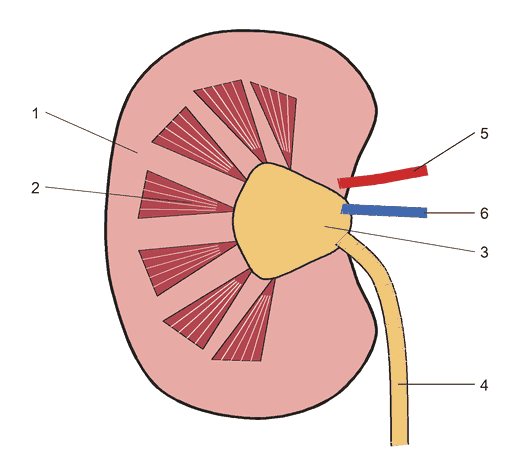
(i) Identify the regions and the tube marked 1, 2, 3 and 4 in this section.
(ii) What is the tip of part 2 called ? Into which numbered part does it project ?
(iii) Name the blood vessels 5 and 6. State one difference between the blood in vessel 5 and the blood in vessel 6.
- 403 marks
Question 40
Both the kidneys of a patient have stopped working, and the doctor has put him on an artificial kidney.
(i) What is an artificial kidney ? Why can a person whose one kidney alone has been removed do without it ?
(ii) From which blood vessel is the patient's blood led into the machine, and to which kind of blood vessel is it returned ?
(iii) Name two substances that are removed from the blood in the machine. For how long, and how often, must the treatment be repeated if the kidneys are damaged permanently ?
- 411 mark
Question 41
Class 10 Sample Paper 1 · Section A
Correct the following statement:
Bile pigments are secreted by the kidneys.
- 421 mark
Question 42
Class 10 Sample Paper 1 · Section A
Correct the following statement:
The afferent arteriole carries blood away from the glomerulus.
- 432 marks
Question 43
Class 10 Sample Paper 1 · Section B
Where do ultrafiltration, reabsorption and secretion occur in a nephron?
- 441 mark
Question 44
Class 10 Sample Paper 2 · Section A
The thin membranous sac serving as a reservoir of urine is the
- 451 mark
Question 45
Class 10 Sample Paper 2 · Section A
Fill in the blank:
.......... takes place through the sweat pores.
- 465 marks
Question 46
Class 10 Sample Paper 2 · Section B
The given diagram shows a structure of the excretory system. Study the diagram and answer the following questions.
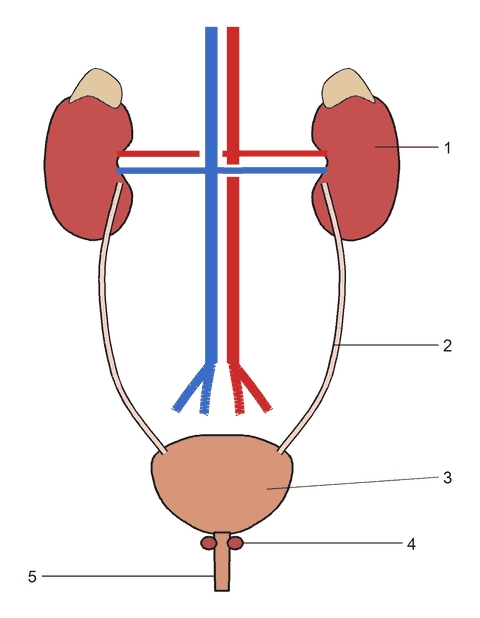
(i) What structure is shown in the diagram?
(ii) Name the fluid that comes to part 2. Name the main nitrogenous waste present in it.
(iii) Label the parts 1–4.
(iv) What are the three steps of urine formation?