
Opening your dashboard
Class 10 Biology Chapter 8 The Circulatory System: Practice Questions
47 questions on Chapter 8, each worked through on its own page with the AI tutor. Class 10 Biology, ICSE 2026-27.
47 questions
1–5 marks · Mixed difficulty
- 11 mark
Question 1
Bloom's level: Remember
The pH of human blood is about :
- 21 mark
Question 2
Bloom's level: Remember
The fluid part of the blood, the plasma, forms about :
- 31 mark
Question 3
Bloom's level: Remember
Which one of these body fluids does not circulate ?
- 41 mark
Question 4
Bloom's level: Remember
The circulating fluids act both as a distributing and a collecting system. Which pair shows one substance distributed to the cells and one collected from them ?
- 51 mark
Question 5
Bloom's level: Understand
The small size and the biconcave shape of red blood cells help them because :
- 61 mark
Question 6
Bloom's level: Understand
A person who is deficient in vitamin K bleeds for a long time from a small cut. This is because vitamin K is needed :
- 71 mark
Question 7
Bloom's level: Understand
The heart lies in the centre of the chest, yet we feel it beating on the left side. This is because :
- 81 mark
Question 8
Bloom's level: Apply
A patient with blood group B needs a transfusion. Blood from which donors can be given safely ?
- 91 mark
Question 9
Bloom's level: Apply
An oxygen molecule picked up in the lungs is carried to a kidney. Which route does it follow ?
- 101 mark
Question 10
Bloom's level: Analyse
Assertion (A): Arteries do not collapse when empty, but veins do.
Reason (R): Arteries have thick, elastic, muscular walls, while veins have thin and less muscular walls.
- 111 mark
Question 11
Bloom's level: Evaluate
Assertion (A): Veins carry only carbon dioxide and no oxygen.
Reason (R): In the respiring tissues, haemoglobin releases only about 23% of its oxygen.
- 121 mark
Question 12
Bloom's level: Understand
Assertion (A): Lymph contains leukocytes but no red blood cells.
Reason (R): Lymph flows in the lymph vessels due to the contraction of the surrounding muscles.
- 132 marks
Question 13
Bloom's level: Understand
Explain why both the digestive system and the excretory system depend on the circulating blood.
- 142 marks
Question 14
Bloom's level: Understand
Human blood circulation is called a closed system, while that of an insect is called an open system. Explain the difference.
- 152 marks
Question 15
Bloom's level: Understand
Explain how haemoglobin carries oxygen from the lungs to the tissues, and why it is important that the compound formed is unstable.
- 162 marks
Question 16
Bloom's level: Apply
An adult man has about 5 litres of blood and about 5 million red blood cells per . Find the total number of red blood cells in his body. If about 1 per cent of them are destroyed every day, how many are destroyed daily ? (1 litre )
- 172 marks
Question 17
Bloom's level: Apply
A laboratory collects a blood sample in a tube containing a chemical that removes all the calcium ions from the plasma. The blood does not clot. Explain why.
- 181 mark
Question 18
Bloom's level: Apply
A nurse takes one blood sample from an artery and one from a vein of the same patient. Predict how the two samples will differ in colour, and give the reason.
- 192 marks
Question 19
Bloom's level: Apply
An Rh-negative man receives Rh-positive blood after an accident and has no problem. A year later he is given Rh-positive blood again and has a serious reaction. Explain both events.
- 202 marks
Question 20
Bloom's level: Analyse
One heart-beat of an adult lasts about 0.85 s : atrial systole 0.15 s, ventricular systole 0.30 s, and all chambers relaxed 0.40 s.
(a) Calculate the number of heart-beats per minute.
(b) For what fraction of each beat are the ventricles relaxed ? Why is this rest useful ?
- 212 marks
Question 21
Bloom's level: Analyse
One hour after a sugary meal, blood samples are taken from the hepatic portal vein and from the hepatic vein. Which sample will have more glucose ? Analyse the reason.
- 222 marks
Question 22
Bloom's level: Evaluate
Karan says: "People with blood group O are universal donors, so they can also safely receive blood of any group." Evaluate his statement.
- 233 marks
Question 23
Bloom's level: Apply
A blood report shows a white blood cell count of per , and of these are neutrophils.
(a) How many times the upper normal limit of per is this count ?
(b) What does such a count most likely indicate ?
(c) Explain how the neutrophils reach the affected tissue and what they do there.
- 244 marks
Question 24
Bloom's level: Apply
Case: During a check-up, a doctor finds that the bicuspid (mitral) valve of a patient does not close properly.
(a) Where is this valve located, and in which phase of the heart-beat should it be closed ?
(b) Which way will some blood leak during that phase ?
(c) How will this affect the supply of blood to the body ? Give the reason.
- 254 marks
Question 25
Bloom's level: Apply
A medicine is injected into a vein of a patient's left arm. It has to act on the kidneys.
(a) Trace the path of the medicine from the arm vein to the kidney, naming every blood vessel and every chamber of the heart in order.
(b) How many times does the medicine pass through the heart on this journey ?
(c) Name the two circulations it passes through.
- 264 marks
Question 26
Bloom's level: Analyse
Case: Tara had an infected boil on her foot. Two days later she noticed painful swellings in her groin. They went away after the boil healed. Later, after a twelve-hour bus journey sitting still, her ankles became puffy, but the puffiness went down after she walked around for a while.
(a) Which structures swelled up in her groin ? Explain why they swelled and how this protected her.
(b) Why did her ankles become puffy during the bus journey ?
(c) Why did walking reduce the puffiness ?
- 274 marks
Question 27
Bloom's level: Analyse
Four blood samples P, Q, R and S were taken, one each from the pulmonary artery, pulmonary vein, hepatic portal vein (after a meal) and renal vein :
Sample Oxygen Carbon dioxide Glucose Urea P High Low Normal Normal Q Low High Normal Normal R Low High Very high Normal S Low High Normal Lowest Identify the vessel from which each sample was taken, giving one reason for each.
- 284 marks
Question 28
Bloom's level: Evaluate
Case: In a class discussion, Rohan says: "Blood is just a delivery van — it only drops things off at the cells."
(a) Name two substances that blood delivers, and to where.
(b) Name two substances that blood collects, and where it takes them.
(c) Evaluate Rohan's comparison. What important jobs of blood does it leave out ?
- 295 marks
Question 29
Bloom's level: Create
Plan a simple investigation to show that the body's need for transport increases during exercise, by measuring the pulse.
(a) Describe how you will measure the pulse and what you will keep the same.
(b) Draw up a table for your readings, and fill it with the kind of results you expect.
(c) Explain your expected results in terms of what the blood must carry.
- 305 marks
Question 30
Bloom's level: Create
Construct a flow chart of the double circulation of blood in humans.
(a) Show all four chambers of the heart, the four valves, and the main vessels, in the order in which blood passes them, starting from the venae cavae.
(b) Mark the parts where the blood is oxygenated and where it is deoxygenated.
(c) Explain, from your chart, why this is called double circulation.
- 311 mark
Question 31
In which one of the following is the white blood cell correctly matched with its description ?
- 321 mark
Question 32
After a meal, the glucose absorbed in the intestine is carried by the blood to the heart. Through which blood vessels, in the correct order, does it pass on the way ?
- 331 mark
Question 33
Assertion (A): The pulmonary artery carries deoxygenated blood.
Reason (R): The wall of an artery is thick, muscular and elastic.
- 342 marks
Question 34
Every organ system of the body depends on the circulating body fluids.
(i) What do these fluids have to transport, and between which places, on behalf of the respiratory system ?
(ii) Name the organ system to which the extra water, excess salts and urea are sent, and the organ system whose secretions the blood must carry to act wherever they are required.
- 352 marks
Question 35
(i) State the two ways in which carbon dioxide is carried by the blood from the tissues to the lungs.
(ii) Apart from forming a clot at a wound, mention two ways in which the blood protects the body.
- 362 marks
Question 36
On a winter night some workers slept in a small room, with all its windows shut and a coal furnace burning inside. By morning they were found unconscious.
(i) Name the gas responsible, and the compound it forms with the haemoglobin of the blood.
(ii) Explain how the formation of this compound can lead to death.
- 372 marks
Question 37
(i) How is tissue fluid formed ? State one use of this fluid to the cells that it bathes.
(ii) There is no heart to pump the lymph. What makes the lymph flow in the lymph vessels, and where does it finally join the blood again ?
- 384 marks
Question 38
The figure shows a section of the human heart in one phase of its beat. The arrows show the direction in which the blood is moving.
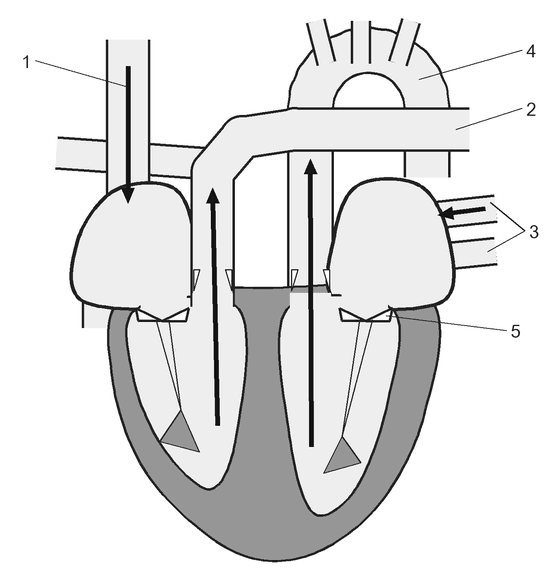
(i) Identify the four vessels marked 1 to 4 in the figure.
(ii) Which two of these four vessels carry deoxygenated blood ?
(iii) Name the valve numbered 5. Is it open or closed in the phase shown ? Name this phase, and the heart sound that is produced as this valve shuts.
- 393 marks
Question 39
Some freshly drawn blood was taken in a clean test tube and left to stand. After some time it looked as shown in the figure.
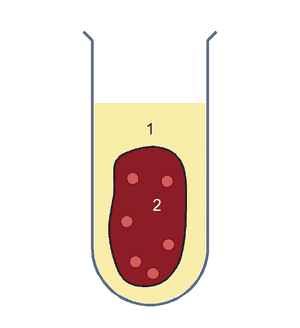
(i) Name the clear liquid 1 and the solid mass 2.
(ii) How does liquid 1 differ from the plasma of the blood ?
(iii) Name the insoluble protein whose threads hold the mass 2 together. From which protein of the plasma is it formed, and by the action of which substance ? Name the mineral ions needed for this change.
- 404 marks
Question 40
The table below gives the antigens found on the red blood cells of three persons, X, Y and Z.
Person Antigens on the red blood cells X antigen A only Y no antigen Z antigen A and antigen B (i) Write the blood group of each person, and the antibody or antibodies present in the plasma of each.
(ii) Which of the three can donate blood to both the others, and which can receive blood from both the others ? Give the term used for each of these two persons.
(iii) The blood of X cannot be given to a patient of blood group B. Give a reason.
- 411 mark
Question 41
Class 10 Sample Paper 1 · Section A
While recording the pulse rate, where exactly does the doctor press on our wrist?
- 421 mark
Question 42
Class 10 Sample Paper 1 · Section A
The chamber of the heart that contains deoxygenated blood is
- 435 marks
Question 43
Class 10 Sample Paper 1 · Section B
Write the functions of the given structures.
(i) Phloem
(ii) Abscisic acid
(iii) Lymph
(iv) Nephron
(v) Seminal vesicles
- 445 marks
Question 44
Class 10 Sample Paper 1 · Section B
Study the given diagram of the human heart and answer the following questions.

(i) Label the parts 1–7.
(ii) What type of blood does part 6 carry?
(iii) Mention one structural difference between part 6 and part 7.
(iv) What happens if the coronary artery gets an internal clot?
- 451 mark
Question 45
Class 10 Sample Paper 2 · Section A
Human blood consists of
- 461 mark
Question 46
Class 10 Sample Paper 2 · Section A
Choose the odd one out:
Arterioles, Vein, Venules, Artery, Red blood cells
- 471 mark
Question 47
Class 10 Sample Paper 2 · Section A
Choose the odd one out:
Basophil, Neutrophil, Eosinophil, Lymphocyte