
Opening your dashboard
Class 10 Biology Chapter 11 Sense Organs: Practice Questions
47 questions on Chapter 11, each worked through on its own page with the AI tutor. Class 10 Biology, ICSE 2026-27.
47 questions
1–5 marks · Mixed difficulty
- 11 mark
Question 1
Bloom's level: Remember
The receptors in the skin that are sensitive to touch, pressure and vibrations are called :
- 21 mark
Question 2
Bloom's level: Remember
The dark pigment in the choroid that prevents light rays from reflecting and scattering inside the eye is :
- 31 mark
Question 3
Bloom's level: Remember
The cochlea of the human inner ear is a spiral, snail-shell-like tube with :
- 41 mark
Question 4
Bloom's level: Understand
Eyebrows are not really a part of the eye, yet they protect it because they :
- 51 mark
Question 5
Bloom's level: Understand
The eye forms an image on the retina, but the actual sensation of sight is produced in the :
- 61 mark
Question 6
Bloom's level: Apply
Rohan's new spectacles have a power marked . Which defect does he have, and what kind of lens is he wearing ?
- 71 mark
Question 7
Bloom's level: Apply
A fielder keeps his eyes on a cricket ball as it comes from far away right into his hands. As the ball comes nearer, in his eyes :
- 81 mark
Question 8
Bloom's level: Apply
As an aeroplane comes down to land, Simran feels her ears 'blocked'. Swallowing or yawning gives relief because it :
- 91 mark
Question 9
Bloom's level: Analyse
Two kinds of retinal cells are compared :
- Cell X : very numerous; mostly at the periphery of the retina; only one type; sensitive to dim light.
- Cell Y : less numerous; mostly at the centre of the retina; three types, each responding to different wavelengths.
Which statement is correct ?
- 101 mark
Question 10
Bloom's level: Understand
Assertion (A): The iris of the eye can be used to identify a person, like a fingerprint.
Reason (R): The pattern and arrangement of the iris muscles is unique for every individual.
- 111 mark
Question 11
Bloom's level: Analyse
Assertion (A): A person suffering from night-blindness finds it difficult to see in dim light.
Reason (R): Rods are the cells of the retina that function only in bright light.
- 121 mark
Question 12
Bloom's level: Evaluate
Assertion (A): Humans can judge the relative distance of objects better with both eyes open than with one eye.
Reason (R): The two eyes form exactly identical images, which the brain adds together to make the picture brighter.
- 131 mark
Question 13
Bloom's level: Remember
The eye is often compared to a camera. Name the part of the eye that works like the diaphragm of the camera, and the part on which the image is formed.
- 142 marks
Question 14
Bloom's level: Understand
The lens divides the eyeball into two chambers. State the fluid in each chamber and one function of each fluid.
- 152 marks
Question 15
Bloom's level: Understand
After spinning round and round on a playground merry-go-round, Ishaan steps off and feels dizzy for a short time. Explain why.
- 162 marks
Question 16
Bloom's level: Apply
In a cinema, pictures are projected at pictures per second, and an after-image in the eye lasts about one-tenth of a second.
(a) How many pictures are projected during one after-image?
(b) How many separate pictures are shown in a 2-hour film? Why do we not see them as separate pictures?
- 172 marks
Question 17
Bloom's level: Apply
A sound-testing app plays four tones of frequencies Hz, Hz, Hz and Hz to a healthy teenager.
(a) Which tones can she hear?
(b) Which one falls in the range to which the human ear is most sensitive?
- 182 marks
Question 18
Bloom's level: Apply
During an eye check-up, Asha looks with one eye at a chart of lines radiating like a star. The vertical lines look dark and sharp, but the horizontal lines look faint and blurred. Name her defect, its cause and the kind of lens used to correct it.
- 192 marks
Question 19
Bloom's level: Analyse
Meera walks from bright sunlight into a dark cinema hall. Her pupil diameter is measured :
Time Pupil diameter In sunlight 2 mm 10 seconds after entering 5 mm 10 minutes after entering 7 mm She could make out the empty seats only after several minutes.
(a) The amount of light entering depends on the area of the pupil (area diameter). How many times more light enters at 7 mm than at 2 mm?
(b) The pupil widened within seconds, yet clear vision took minutes. What other change was needed, and why is it slower?
- 202 marks
Question 20
Bloom's level: Evaluate
A cataract patient says, "My lens has only become cloudy, so I just need stronger glasses — concave ones — and I will see well again." Evaluate his statement.
- 211 mark
Question 21
Bloom's level: Understand
Why are the sensory cells of the tongue and nose called chemoreceptors?
- 222 marks
Question 22
Bloom's level: Apply
On a windy day, dust blows into Arun's eye. His eye waters and he blinks rapidly. Explain how the tears and blinking together protect his eye, and why the eye does not easily get infected.
- 234 marks
Question 23
Bloom's level: Apply
Case: Two patients visit an eye clinic on the same day.
- Mr. Das, 52 : sees distant road signs clearly, but for the last few years has had to hold his phone far away to read it.
- Arjun, 12 : has always found it hard to read his book clearly; the doctor finds his eyeball is slightly short from front to back.
(a) Name the defect of each patient.
(b) State the cause of each defect.
(c) Both are given the same kind of lens. Name it, write the sign of its power, and explain how it helps Arjun see near objects.
- 244 marks
Question 24
Bloom's level: Analyse
Case: An ENT doctor examines three people with hearing problems :
- P : the ear drum has been torn by a sharp object pushed into the ear.
- Q : the three ear ossicles have become stiff and do not move freely.
- R : an infection has destroyed many sensory hair cells in the organ of Corti.
(a) Write the normal path of sound from the pinna to the auditory nerve.
(b) For each person, state the point at which this path is broken.
(c) A hearing aid makes sounds louder before they reach the ear drum. Which person is least likely to be helped by it? Give the reason.
- 253 marks
Question 25
Bloom's level: Apply
(a) Explain why we can judge the depth or relative distance of objects when both eyes are open.
(b) Ravi holds one pencil at arm's length and tries to touch its tip quickly with the tip of a second pencil, first with one eye closed and then with both eyes open. Predict the result of each trial.
(c) He then lines up a pencil with a distant pole, both eyes open. When he closes his right eye the pencil seems to jump sideways; when he closes his left eye it does not. Which eye does he use more? Explain.
- 264 marks
Question 26
Bloom's level: Evaluate
Case: After her grandfather's death, Diya's family discusses eye donation. Three statements are made :
- Statement 1 : "The whole eyeball will be fitted into a blind person's eye socket."
- Statement 2 : "There is no hurry — the cornea stays alive for about 40 hours, so the eyes can be removed tomorrow."
- Statement 3 : "A donated eye can help a person blinded by a scarred, opaque cornea, but not a person whose optic nerve is damaged."
(a) Evaluate Statement 1.
(b) Evaluate Statement 2.
(c) Evaluate Statement 3, giving the reason.
- 274 marks
Question 27
Bloom's level: Analyse
The state of a person's eye at two moments is recorded :
Feature Moment 1 Moment 2 Ciliary muscles Relaxed Contracted Suspensory ligament Tight Loose Lens Thin, flattened Thick, more convex (a) At which moment is the person looking at a nearby object? Give the reason.
(b) After reading a book for three hours without a break, the person's eyes feel tired. Use the table to explain why.
(c) At the age of 60, the person can no longer reach the Moment 2 lens shape even when the ciliary muscles contract. Analyse why, and name the resulting defect.
- 283 marks
Question 28
Bloom's level: Understand
Explain the four major steps by which we see an object :
(a) Entry of light rays and focusing of the image.
(b) Transmission of nerve impulses to the brain.
(c) Interpretation by the brain.
- 295 marks
Question 29
Bloom's level: Create
Construct a comparison table of the human eye and the human ear that summarises the chapter. Use these rows :
(a) Stimulus received; name of the receptors; exact location of the sensory cells.
(b) Nerve that carries impulses to the brain; one part that protects the organ or keeps it working well.
(c) One common defect or problem of each organ, with its cause.
- 305 marks
Question 30
Bloom's level: Create
Your school asks your class to plan a simple eye-screening camp for Class 6 students.
(a) Plan four simple checks, one each for myopia, hyperopia, astigmatism and colour blindness, describing what each child will be asked to do.
(b) Design a record sheet (table) for the results of one child.
(c) For each defect that may be detected, write the advice to be given to the parents.
- 311 mark
Question 31
Which one of the following is not a function of tears ?
- 321 mark
Question 32
In which one of the following defects do the two eyes somewhat converge, giving what is called a “cross eye” ?
- 331 mark
Question 33
Assertion (A): When we look at a nearby object, the lens of the eye becomes thicker and more convex.
Reason (R): When we look at a nearby object, the ciliary muscles relax and the suspensory ligament becomes tight.
- 342 marks
Question 34
Give a reason for each of the following :
(i) While reading a line of print, we move our eyes from word to word.
(ii) The part of an image that falls on the blind spot of the retina is not seen.
- 352 marks
Question 35
(i) Which two parts of the eye converge the light rays so that an image is formed on the retina ?
(ii) The image formed on the retina is inverted, and yet we see the objects upright. Explain.
- 362 marks
Question 36
Anu holds a pencil horizontally at arm's length with its point facing inwards. She tries to touch this point with the point of another pencil, held in her other hand — first with one eye closed, and then with both eyes open.
(i) In which of the two attempts will she be able to do it more easily and quickly ?
(ii) Name the kind of vision that makes this possible, and state how it is produced.
- 372 marks
Question 37
(i) State the range of frequencies of sound that the human ear can detect, and the range in which it is most sensitive.
(ii) A dog comes running at the sound of a special whistle, but its owner, standing next to the whistle, hears nothing. Suggest a reason.
- 384 marks
Question 38
The figure shows a section of the human eye. Four of its parts are numbered 1 to 4.
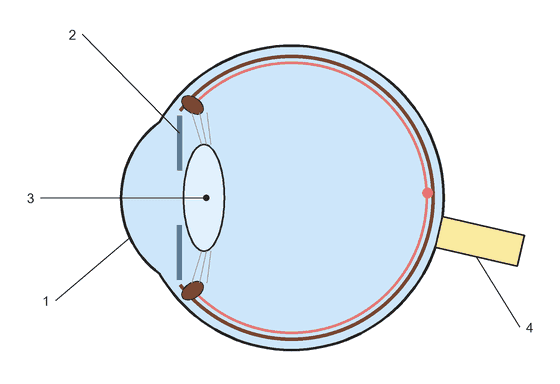
(i) Identify the four structures of the eye numbered 1, 2, 3 and 4.
(ii) Part 1 is a continuation of one layer of the wall of the eyeball, and part 2 is an extension of another layer. Name the layer in each case.
(iii) Name the two kinds of muscles present in part 2, and state the effect of each on the size of the pupil.
- 393 marks
Question 39
The figure shows the membranous labyrinth of the human ear. Three of its parts are lettered P, Q and R.
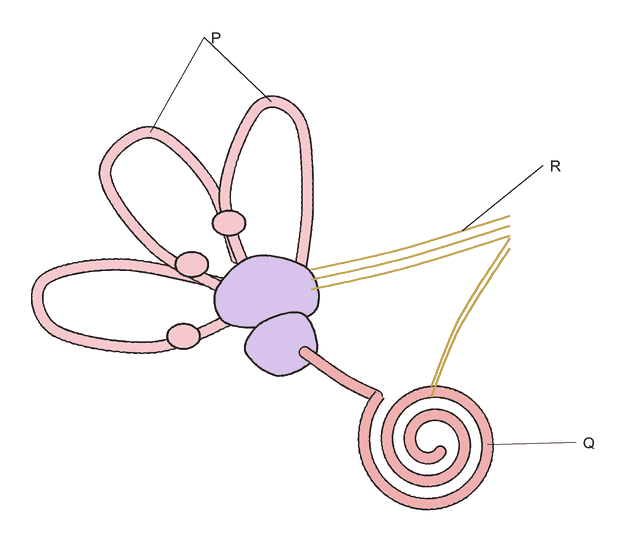
(i) Identify P, Q and R.
(ii) Name the fluid that fills the median canal of part Q, and the sensory organ for hearing that lies in this canal.
(iii) How are the three canals of part P placed with respect to one another ? With which kind of balance of the body are they concerned ?
- 404 marks
Question 40
Sameer, a boy of twelve, reads the number plates of distant vehicles without any difficulty, but the print of a book held at the normal reading distance appears blurred to him.
(i) Name the defect of his eyes. Where is the image of the print formed in his eyes ?
(ii) What may be wrong with the shape of the eyeball, or with the lens, to bring about such a condition ?
(iii) Name the kind of lens that will correct the defect, and draw a labelled diagram to show the correction.
- 411 mark
Question 41
Class 10 Sample Paper 1 · Section A
Name the following:
The part of the internal ear that is related to the static balance of the body.
- 421 mark
Question 42
Class 10 Sample Paper 1 · Section A
Name the following:
The layer of the eyeball that provides nourishment to the eye.
- 431 mark
Question 43
Class 10 Sample Paper 1 · Section A
Correct the following statement:
Tears come from the eyeball.
- 441 mark
Question 44
Class 10 Sample Paper 1 · Section A
Choose the odd one out:
Mouth, Oesophagus, Stomach, Cornea
- 451 mark
Question 45
Class 10 Sample Paper 2 · Section A
Correct the following statement:
The outermost layer of the eye is the choroid.
- 461 mark
Question 46
Class 10 Sample Paper 2 · Section A
Correct the following statement:
Deafness is caused due to the rupturing of the pinna.
- 472 marks
Question 47
Class 10 Sample Paper 2 · Section B
Mention the exact location of the following.
(i) Lacrimal gland
(ii) Malleus