
Opening your dashboard
Class 10 Biology Chapter 10 The Nervous System: Practice Questions
48 questions on Chapter 10, each worked through on its own page with the AI tutor. Class 10 Biology, ICSE 2026-27.
48 questions
1–5 marks · Mixed difficulty
- 11 mark
Question 1
Bloom's level: Remember
In the human body, the activities of different organs are coordinated by two agencies. These are the :
- 21 mark
Question 2
Bloom's level: Remember
The part of the diencephalon that controls body temperature and the pituitary gland is the :
- 31 mark
Question 3
Bloom's level: Remember
Pick the correctly matched pair :
- 41 mark
Question 4
Bloom's level: Understand
A nerve is often compared with an underground electric cable. In this comparison, the myelin sheath around each axon is like the insulation of each wire because it :
- 51 mark
Question 5
Bloom's level: Understand
Which statement correctly distinguishes the central nervous system (CNS) from the peripheral nervous system (PNS) ?
- 61 mark
Question 6
Bloom's level: Apply
While chopping vegetables, Riya accidentally cuts her finger and jerks her hand away even before she feels the pain. The command for this jerk was produced in the :
- 71 mark
Question 7
Bloom's level: Apply
After a head injury, a patient cannot recall recent events, finds it hard to reason out simple problems and cannot plan his day. He still walks steadily and breathes normally. The part of the brain most likely damaged is the :
- 81 mark
Question 8
Bloom's level: Apply
After a heavy lunch, Kunal sits back and relaxes. His heartbeat slows down and the peristalsis in his intestine increases. Which part of the nervous system is most active now ?
- 91 mark
Question 9
Bloom's level: Analyse
Two cross-sections, X and Y, are seen under a microscope :
- In X, the gray matter forms the outer layer and the white matter lies inside.
- In Y, the white matter forms the outer layer and the gray matter lies inside, with a small canal in the centre.
Which identification is correct ?
- 101 mark
Question 10
Bloom's level: Understand
Assertion (A): The conduction of a nerve impulse should not be compared with the flow of electricity through a wire.
Reason (R): In a wire electrons actually move along it, but along a nerve fibre neither electrons nor ions travel; a wave of depolarisation followed by repolarisation passes along.
- 111 mark
Question 11
Bloom's level: Analyse
Assertion (A): Coughing when a food particle enters the wind pipe is a natural reflex.
Reason (R): Most of our daily habits, such as standing up when the teacher enters the class, are conditioned reflexes.
- 121 mark
Question 12
Bloom's level: Evaluate
Assertion (A): The impulse to start walking arises in the cerebellum.
Reason (R): The cerebellum coordinates and times the contraction and relaxation of the many muscles used in walking.
- 131 mark
Question 13
Bloom's level: Remember
Name the outermost thin sheath that covers the myelin sheath of an axon.
- 142 marks
Question 14
Bloom's level: Apply
A fielder sees the ball coming high towards him, judges where it will fall, runs and catches it. By the end, his heart is beating fast and he is breathing hard. Identify four functions of the nervous system that are at work in this event, linking each to a part of the event.
- 152 marks
Question 15
Bloom's level: Understand
Explain what is meant by the polarised state of a resting nerve fibre, and what happens at a spot on the fibre when it is stimulated.
- 162 marks
Question 16
Bloom's level: Apply
A nerve impulse travels at a maximum speed of about m per second, while electricity travels through a wire at about km per second.
(a) How long will an impulse take to travel m from the toe to the spinal cord ?
(b) How many times faster is electricity than the nerve impulse?
- 172 marks
Question 17
Bloom's level: Apply
After a back injury, a patient can feel a pin prick on the sole of his left foot, but he cannot move that foot at all. Which kind of fibres in the nerve supplying the foot are damaged? Explain using the idea of a mixed nerve.
- 182 marks
Question 18
Bloom's level: Apply
In a road accident, Mr. Joshi's spinal cord is completely cut in the lower back region. He can move his arms normally, but he can neither feel nor voluntarily move his legs. Explain both observations.
- 192 marks
Question 19
Bloom's level: Analyse
Vikram's body readings were taken at rest and then while a stray dog was chasing him :
Reading At rest While being chased Heart rate 72 per minute 120 per minute Diameter of pupil 3 mm 6 mm Mouth Moist Dry (a) By how many beats per minute did his heart rate rise, and by what fraction of the resting value?
(b) Which division of the nervous system caused all three changes, and what is its overall role?
- 202 marks
Question 20
Bloom's level: Evaluate
Meena types fast on a computer keyboard without looking at the keys while chatting with a friend. She says, "Since I had to learn typing, it must be a voluntary action." Evaluate her claim.
- 211 mark
Question 21
Bloom's level: Understand
Why must the many activities going on in our body be properly timed and coordinated?
- 222 marks
Question 22
Bloom's level: Understand
The nervous system "keeps us informed about the outside world". Explain, with two examples, why a person would be in danger if this function failed.
- 234 marks
Question 23
Bloom's level: Apply
Case: Walking barefoot in the dark garden, Kabir steps on a sharp thorn. His foot jerks up at once; only a moment later does he feel the pain and look down. A little further on, he sees a coiled garden hose and jumps aside in fright, thinking it is a snake.
(a) Trace the path of the foot-jerk response from the stimulus to the response, naming each component of the reflex arc.
(b) Why did Kabir feel the pain only after his foot had jerked away ?
(c) Why is his jump at the coiled hose called a complex reflex ?
- 244 marks
Question 24
Bloom's level: Analyse
Case: Three patients with brain injuries are admitted to a hospital :
- Patient P thinks clearly and speaks well, but staggers, cannot keep his balance and fumbles when buttoning his shirt.
- Patient Q walks steadily, but cannot recall what he did yesterday and cannot solve simple sums.
- Patient R needs a machine to support his breathing and his heartbeat is irregular.
(a) Name the part of the brain most likely injured in each patient.
(b) Which patient's injury is the most life-threatening? Give the reason.
(c) Name the three protective coverings of the brain, and state how the fluid between them protects it.
- 253 marks
Question 25
Bloom's level: Apply
(a) A student writes : "The human body has 31 spinal nerves and 12 cranial nerves, that is 43 nerves in all." Correct the total, showing your working.
(b) A special dye that marks only sensory fibres is applied to a spinal nerve near the spinal cord. In which root of the spinal nerve will the dye be seen, and where do these fibres end in the spinal cord ?
(c) Through which root do the motor fibres leave the spinal cord?
- 264 marks
Question 26
Bloom's level: Evaluate
Case: Mrs. Kapoor has been under heavy stress at work for many months. She now has high blood pressure and a stomach ulcer. Her doctor says, "Your autonomic nervous system is stuck in emergency mode."
(a) Which division of the autonomic nervous system is the "emergency mode"? State its effect on the heart and on the blood vessels.
(b) Which division re-establishes normal conditions? State its effect on the heart and on the intestine.
(c) Two pieces of advice are given to her :
- Advice X : "Work late every night until everything is finished, so that the worry goes away."
- Advice Y : "Take regular rest, relax daily and keep fixed hours for meals and sleep."
Which advice is sounder? Justify your choice.
- 274 marks
Question 27
Bloom's level: Analyse
Three neurons, X, Y and Z, take part in a spinal reflex :
- X : its cell body lies in the dorsal root ganglion; its dendrites are linked to receptors in the skin.
- Y : its cell body lies in the gray matter of the spinal cord; its axon leaves through the ventral root to a muscle.
- Z : it lies wholly inside the gray matter of the spinal cord, linking the other two.
(a) Identify the type of each neuron.
(b) Write the order in which the impulse passes through them, and name the gap across which it passes from one neuron to the next.
(c) If the axon of Y is cut, predict what will happen when the skin is pricked. Give the reason.
- 283 marks
Question 28
Bloom's level: Understand
(a) What makes up the central nervous system and the peripheral nervous system?
(b) The peripheral nervous system has two subdivisions. Name them and state what each one controls.
(c) Why are the sympathetic and parasympathetic systems said to be opposite in action? Give one example.
- 295 marks
Question 29
Bloom's level: Create
Plan an experiment to develop a conditioned reflex in the goldfish of your home aquarium, using the sound of tapping gently on the glass.
(a) Describe the training procedure, including how often and for how long you will train.
(b) Explain how you will finally test whether the reflex has developed, and what you will use as a check (control).
(c) Draw up a table with the kind of results you expect over three weeks, and state why the response is a conditioned and not a natural reflex.
- 305 marks
Question 30
Bloom's level: Create
Construct a branching chart of the human nervous system that summarises the chapter.
(a) Show the two main divisions, the main parts of each and their subdivisions, including the number of pairs of nerves where relevant.
(b) Beside each of the following, write one main function : cerebrum, cerebellum, medulla oblongata, spinal cord, sympathetic system, parasympathetic system.
(c) Below the chart, write the path of a reflex arc and mark which parts of the chart it uses.
- 311 mark
Question 31
After a nerve impulse has passed a spot on a nerve fibre, that spot becomes repolarised. The repolarisation is brought about by :
- 321 mark
Question 32
Of the 31 pairs of spinal nerves of a human being, how many pairs arise from the lumbar, sacral and coccygeal regions taken together ?
- 331 mark
Question 33
Assertion (A): The outer surface of the cerebrum is thrown into many folds (gyri) and grooves (sulci).
Reason (R): Folding increases the surface area of the gray matter, so that more nerve cells can be accommodated.
- 342 marks
Question 34
One nerve arises from the eye and ends in the brain. Another nerve arises from the spinal cord and supplies the skin and the muscles of an arm.
(i) To which kind of nerves does each of these two nerves belong ?
(ii) How do these two kinds of nerves differ in the nerve fibres that they contain ?
- 352 marks
Question 35
Which major function of the nervous system is illustrated by each of the following ?
(i) A batsman recalls how the bowler bowled the last few balls and works out how to play the next one.
(ii) The heart of a person goes on beating and his breathing continues while he is fast asleep.
- 362 marks
Question 36
Give a reason for each of the following :
(i) Nerve cells of the brain that are destroyed cannot be replaced by the division of the remaining nerve cells.
(ii) At a synapse, a nerve impulse passes only from the axon endings of one neuron to the dendrites of the next neuron, and not in the reverse direction.
- 372 marks
Question 37
After a 400 m race is over, the body of an athlete slowly returns to its normal condition.
(i) Name the part of the autonomic nervous system that brings about this return, and state where it is located.
(ii) State the effect of this part on the bronchi and on the pupil of the eye.
- 384 marks
Question 38
The figure shows the human brain cut through the middle (median section). Four of its parts are lettered A to D.
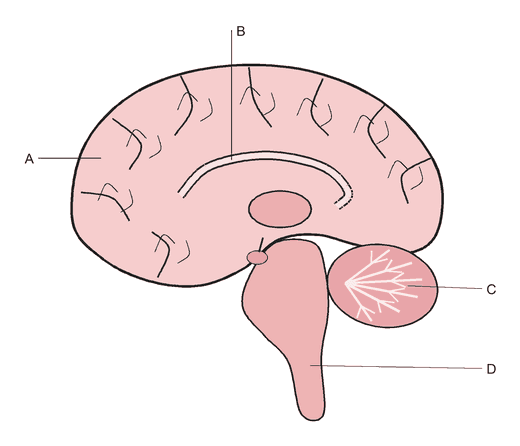
(i) Identify the four regions of the brain lettered A, B, C and D.
(ii) State one function each of part B and part C.
(iii) Name two involuntary activities controlled by part D. What is the general result of an injury to this part ?
- 393 marks
Question 39
A Russian biologist, Pavlov, sounded a bell every time food was given to a dog. After an adequate period of such training, the dog salivated on hearing the bell even when no food was given.
(i) Name the type of reflex that the dog developed, and define it.
(ii) Before the training, which of the two — the food or the sound of the bell — made the dog salivate ? Name that type of reflex.
(iii) Give one example of an inborn reflex that is protective, and one example of an inborn reflex that provides functional efficiency.
- 404 marks
Question 40
The figure shows a cross section of the spinal cord, together with the two roots of a spinal nerve on one side.
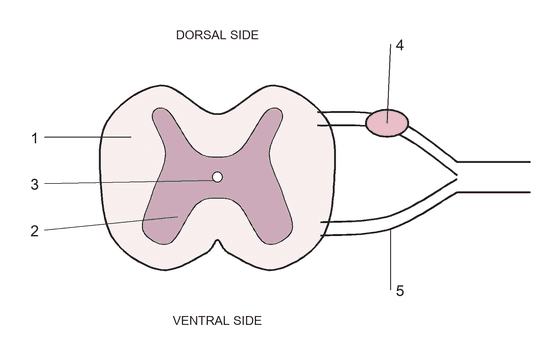
(i) Which three structures of the spinal cord do the numbers 1, 2 and 3 point to ? Write them in that order.
(ii) Name the swelling numbered 4. Which kind of nerve fibres — sensory or motor — run through the root that bears part 4, and which kind through the root numbered 5 ?
(iii) How does the arrangement of parts 1 and 2 in the spinal cord differ from their arrangement in the cerebrum ? Name the fluid that fills part 3.
- 411 mark
Question 41
Class 10 Sample Paper 1 · Section A
Correct the following statement:
Dendrons are the structural and functional units of the nervous system.
- 421 mark
Question 42
Class 10 Sample Paper 1 · Section A
Correct the following statement:
Pia mater is the outermost layer of the meninges.
- 431 mark
Question 43
Class 10 Sample Paper 1 · Section A
Name the following:
A part of the brain that connects the right and left cerebral hemispheres.
- 442 marks
Question 44
Class 10 Sample Paper 1 · Section B
What is the difference between a voluntary action and an involuntary action?
- 452 marks
Question 45
Class 10 Sample Paper 1 · Section B
What does the nervous system consist of?
- 461 mark
Question 46
Class 10 Sample Paper 2 · Section A
Correct the following statement:
The medulla oblongata controls the voluntary activities of the body.
- 471 mark
Question 47
Class 10 Sample Paper 2 · Section A
Name the following:
The part of the brain to which learning is related.
- 481 mark
Question 48
Class 10 Sample Paper 2 · Section A
Choose the odd one out:
Sneezing, Blinking, Coughing, Typing, Digestion