
Opening your dashboard
Class 8 Physics Chapter 4 Chemical Effects Of Electric Current: Practice Questions
27 questions on Chapter 4, each worked through on its own page with the AI tutor. Class 8 Physics, CBSE 2026-27.
27 questions
1–5 marks · Hard difficulty
- 11 mark
Question 1
An electric current can produce:
- 21 mark
Question 2
Boojho and Paheli performed experiments taking similar bulbs and cells but two different solutions and as shown in figure.
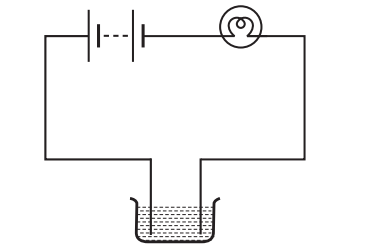
They found that the bulb in the setup A glows more brightly as compared to that of the setup . You would conclude that
- 31 mark
Question 3
Boojho's uncle has set up an electroplating factory near his village. He should dispose of the waste of the factory
- 41 mark
Question 4
Which of the following metals is used in electroplating to make objects appear shining?
- 51 mark
Question 5
Which of the following solutions will not make the bulb in figure glow?

- 61 mark
Question 6
____________ is a compound which in aqueous solution that allows an electric current to pass through it while __________ are the metal rods which are dipped in electrolyte and attached to an external power source.
- 73 marks
Question 7
Boojho made the entire circuit given in figure and observed that the bulb did not glow. On Paheli's suggestion, he added one more cell in the circuit. The bulb now glows. Explain.
- 83 marks
Question 8
Paheli set up an experiment using liquid in the beaker as shown in figure. She observed that the bulb glows then she replaced the liquid A by another liquid B. This time the bulb did not glow. Boojho suggested replacing the bulb by an LED. They observed that the LED glows. Explain.

A

B

- 93 marks
Question 9
Paheli wants to deposit silver on an iron spoon. She takes silver nitrate solution in a beaker and sets up a simple circuit for electroplating. Which terminal of the battery should the spoon be connected to? What material should the other electrode be made of?
- 102 marks
Question 10
Why is tin electroplated on iron to make cans used for storing food?
- 112 marks
Question 11
Observe the following circuits carefully. In which circuit will the bulb glow. Write 'Yes' or 'No' in the blank space provided along each of the circuits given in fig.


(c) Eraser

(a) Piece of coal
(b) Iron nail
(c) Eraser
(d) Steel Spoon
- 122 marks
Question 12
Why sometimes the bulb in the electric tester in a complete circuit does not glow even if liquid is a good conductor of electricity?
- 132 marks
Question 13
(a) Why tin is used to coat iron food cans?
(b) Chromium is highly shiny and rust resistance metal. Even though is it not used to make bathroom fittings or cycle parts. Why?
- 142 marks
Question 14
What is the most common industrial usage of chemical effects of electric current? (Medium)
- 152 marks
Question 15
Will an electric device work if we place the positive terminal of a battery towards the negative point of the device? Explain your answer
- 162 marks
Question 16
Which of these is true about electroplating?
Circle 'Yes' or 'No' for the correct response.

- 172 marks
Question 17
Sumit replaced all the bulbs in his home with LEDs. After a month, he noticed that the electricity bill had decreased. What was the most likely reason for the decrease in electricity bill?
- 182 marks
Question 18
Distilled water is a bad conductor of electricity. Why does rainwater conduct electricity?
- 192 marks
Question 19
Will an electric device work if we place the positive terminal of a battery towards the negative point of the device? Explain your answer.
- 205 marks
Question 20
An electric current is passed through a conducting solution. List any three possible observations.
- 215 marks
Question 21
In the circuit given as figure. Boojho observed that copper is deposited on the electrode connected to the negative terminal of the battery. Paheli tried to repeat the same experiment. But she could find only one copper plate. Therefore, she took a carbon rod as negative electrode. Will copper be still deposited on the carbon rod? Explain your answer

- 225 marks
Question 22
Observe the following circuit given in figure.
Current does not flow in the circuit if there is a gap between the two wires. Does it indicate that air is a poor conductor of electricity? Does air never conduct electricity? Explain.
- 235 marks
Question 23
Boojho made the circuit as shown in figure. He wanted to observe what happens when an electric current is passed through water. But he forgot to add a few drops of lemon juice to water. Will it make any difference to his observation? Explain.
- 245 marks
Question 24
Observing that the bulb does not glow in the circuit shown in Fig. A, Boojho changed the circuit as shown in Fig. B. He observed deflection in the magnetic compass.

(i) What does the deflection in a magnetic compass indicate?
(ii) Why did the bulb not glow in Fig. A?
(iii) What would be the effect of an increase in the number or turns in the coil around the magnetic compass in Fig. B?
(iv) What will be observed if a number of cells are increased in the circuit shown in Fig. B?
- 255 marks
Question 25
You are provided with a magnetic compass, an empty matchbox, a battery of two cells and connecting wires. Using these objects how will you make a tester for testing an electric circuit? Draw the necessary circuit diagram and explain.
- 261 mark
Question 26
Electrolysis is defined as a process of decomposing ionic compounds into their elements by passing a direct electric current through the compound in a fluid form. The cations are reduced at cathode and anions are oxidised at the anode. The main components that are required for conducting electrolysis are an electrolyte, electrodes, and some form of external power source is also needed. Electrolysis is usually done in a vessel named 'electrolytic cell' containing two electrodes (cathode and anode) connected to a direct current source and an electrolyte which is an ionic compound undergoing decomposition. In the process of electrolysis, there is an interchange of ions and atoms due to the addition or removal of electrons from the external circuit. Basically, on passing current, cations move to the cathode, take electrons from the cathode (given by the supply source-battery), and is discharged into the neutral atom. The neutral atom, if solid, is deposited on the cathode and if gas, move upwards. This is a reduction process and the cation is, reduced at the cathode. At the same time anions, give up their extra electrons to the anode and is oxidised to neutral atoms at the anode. Electrons released by the anions travel across the electrical circuit and reach the cathode completing the circuit. Electrolysis involves a simultaneous oxidation reaction at anode and a reduction reaction at the cathode.
Which most commonly used liquid is decomposed by the process of electrolysis?
- 271 mark
Question 27
Electrolysis is defined as a process of decomposing ionic compounds into their elements by passing a direct electric current through the compound in a fluid form. The cations are reduced at cathode and anions are oxidised at the anode The main components that are required for conducting electrolysis are an electrolyte, electrodes, and some form of external power source is also needed. Electrolysis is usually done in a vessel named 'electrolytic cell' containing two electrodes (cathode and anode) connected to a direct current source and an electrolyte which is an ionic compound undergoing decomposition. In the process of electrolysis, there is an interchange of ions and atoms due to the addition or removal of electrons from the external circuit. Basically, on passing current, cations move to the cathode, take electrons from the cathode (given by the supply source-battery), and is discharged into the neutral atom. The neutral atom, if solid, is deposited on the cathode and if gas, move upwards. This is a reduction process and the cation is, reduced at the cathode. At the same time anions, give up their extra electrons to the anode and is oxidised to neutral atoms at the anode. Electrons released by the anions travel across the electrical circuit and reach the cathode completing the circuit. Electrolysis involves a simultaneous oxidation reaction at anode and a reduction reaction at the cathode.
Which of the following process is based on the principles of electrolysis?