Question 151 markMCQMedium
Given below are two statements, an Assertion (A) and a Reason (R).
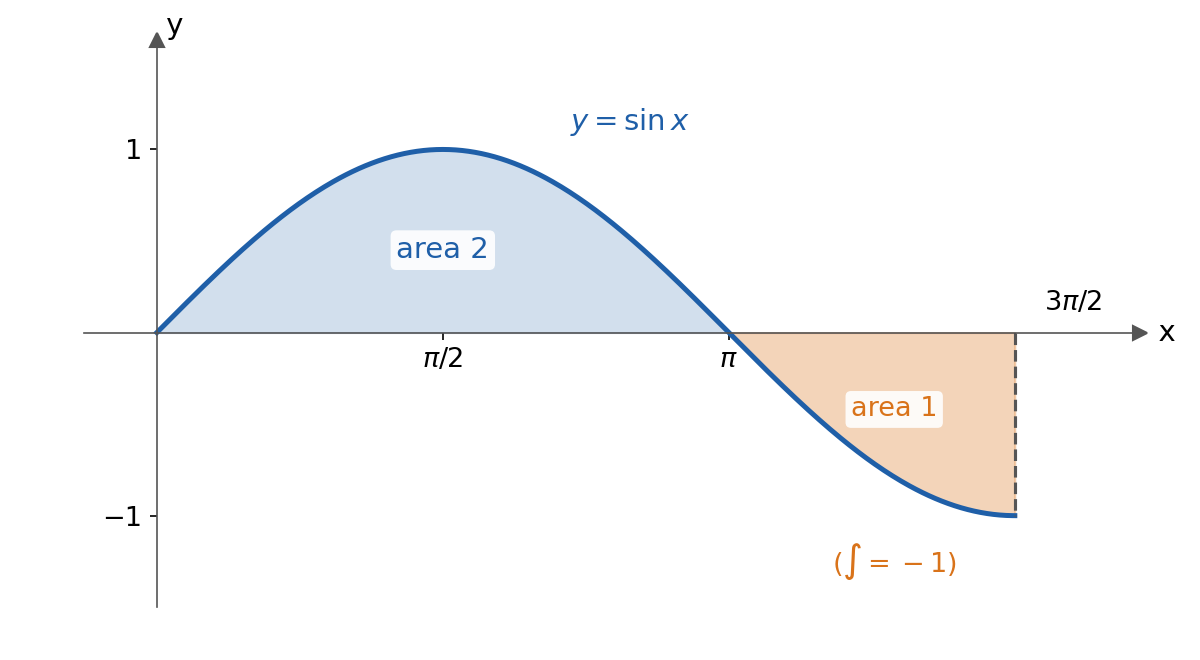
Assertion (A): The area of the region bounded by the curve , the -axis and the ordinates and is sq units.
Reason (R): .
Choose the correct option.
Confirming your payment
Practice Questions · Question 15 of 30
Given below are two statements, an Assertion (A) and a Reason (R).
Assertion (A): The area of the region bounded by the curve , the -axis and the ordinates and is sq units.
Reason (R): .
Choose the correct option.
(A) Both Assertion (A) and Reason (R) are true and Reason (R) is the correct explanation of Assertion (A)
(B) Both Assertion (A) and Reason (R) are true but Reason (R) is not the correct explanation of Assertion (A)
(C) Assertion (A) is true but Reason (R) is false.
(D) Assertion (A) is false but Reason (R) is true.
Option (B) is correct.
Checking the Reason.
So (R) is true.
Checking the Assertion. On , and the curve is above the -axis; on , and the curve is below it. Split the interval at :
The area is sq units, so (A) is true.