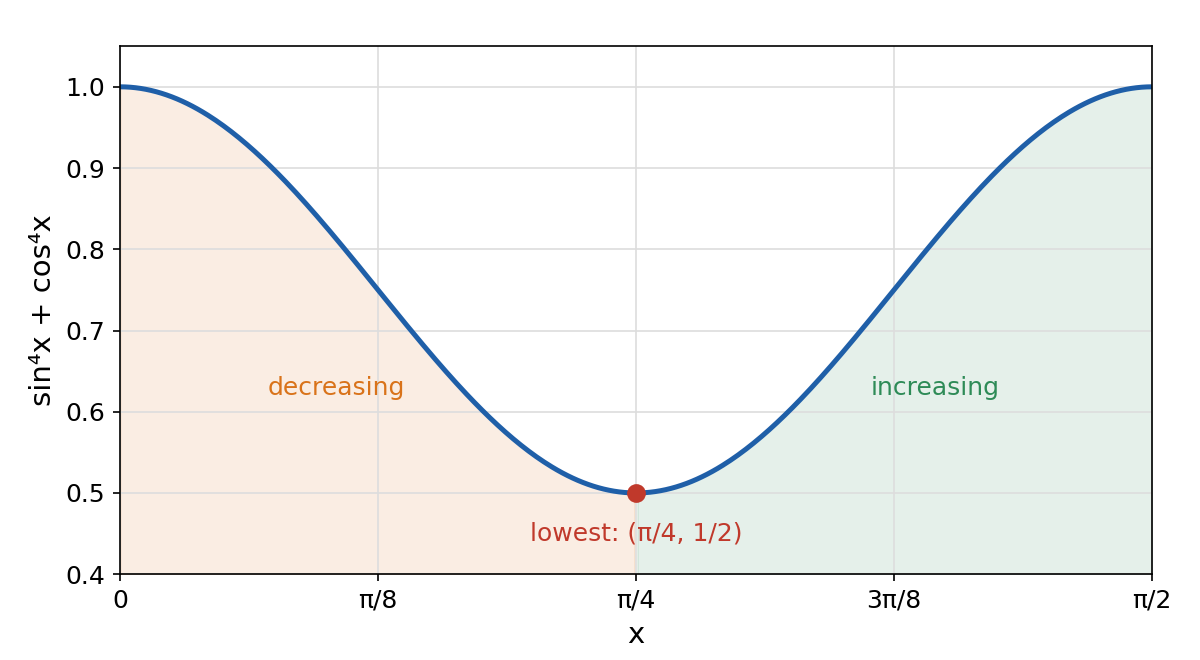
Concept. On an interval, f′(x)>0 gives strictly increasing and f′(x)<0 gives strictly decreasing; at the end points, continuity lets us include them.
Given: f(x)=sin4x+cos4x on [0,2π].
To find: where f is strictly increasing and strictly decreasing.
Step 1 — Differentiate.
f′(x)=4sin3xcosx−4cos3xsinx=−4sinxcosx(cos2x−sin2x)
Using 2sinxcosx=sin2x and cos2x−sin2x=cos2x,
f′(x)=−2sin2xcos2x=−sin4x
Step 2 — Critical points in the interval. sin4x=0 for 4x∈{0,π,2π}, i.e. x=0,4π,2π. The only interior one is x=4π.
Step 3 — Sign of f′.
| interval | 4x lies in | sin4x | f′(x)=−sin4x | f is |
|---|
| (0,4π) | (0,π) | >0 | <0 | strictly decreasing |
| (4π,2π) | (π,2π) | <0 | >0 | strictly increasing |