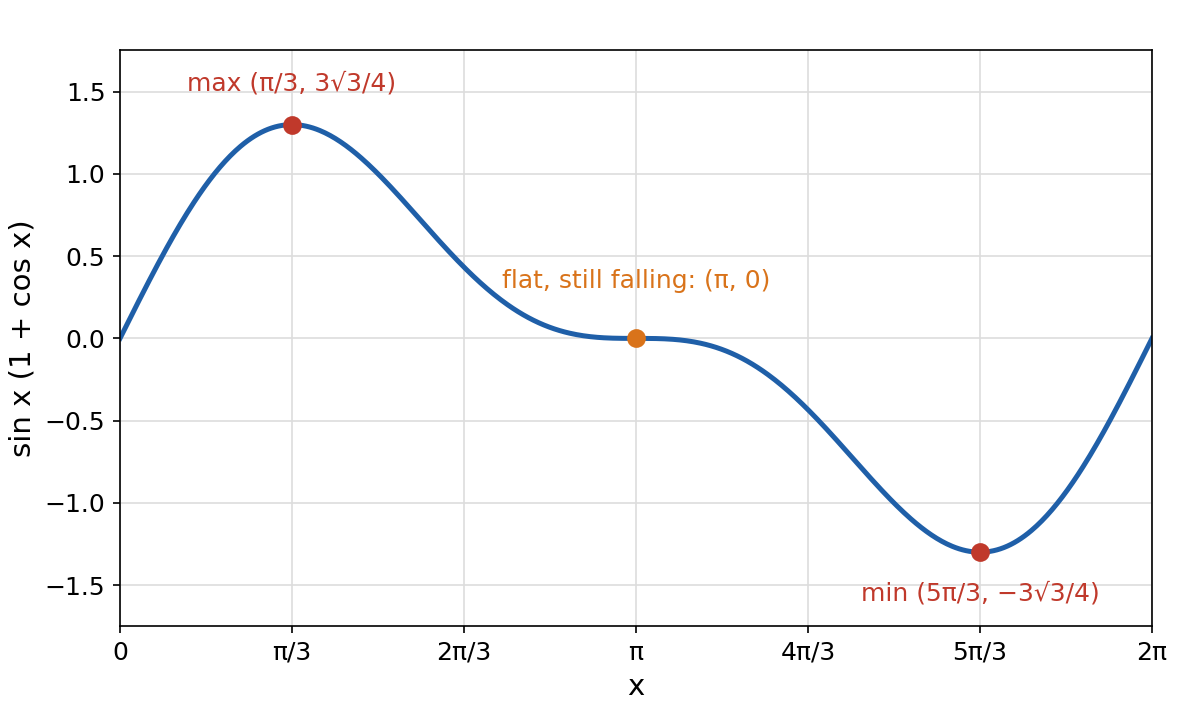
(ii) Find the intervals in which f is strictly increasing and those in which it is strictly decreasing.
(iii) f′(π)=0. Explain why x=π does not split the interval of decrease into two parts.
(iv) Hence find the greatest and the least values of f on [0,2π].
Concept. The sign of f′ decides where f increases or decreases. A zero of f′ matters only if f′ changes sign there.
Given:f(x)=sinx(1+cosx) on [0,2π].
To find: the intervals of increase and decrease, and the greatest and least values.
Step 1 — Differentiate (part (i)). By the product rule,
f′(x)=cosx(1+cosx)+sinx(−sinx)=cosx+cos2x−sin2x
Using sin2x=1−cos2x,
f′(x)=2cos2x+cosx−1=(2cosx−1)(cosx+1)
Step 2 — Zeros of f′ in [0,2π].2cosx−1=0 gives x=3π,35π; cosx+1=0 gives x=π.
Step 3 — Sign of f′. The factor cosx+1≥0 always, and it is zero only at x=π. So, away from x=π, the sign of f′ is the sign of 2cosx−1.
interval
2cosx−1
cosx+1
f′(x)
f is
(0,3π)
+
+
+
increasing
(3π,π)
−
+
−
decreasing
(π,35π)
−
+
−
decreasing
(35π,2π)
+
+
+
increasing
So (part (ii)) f is strictly increasing on [0,3π] and on [35π,2π], and strictly decreasing on [3π,35π].
Step 4 — Why x=π does not split it (part (iii)).f′ is negative on both sides of π and zero only at the single point π, so f′ does not change sign there. If 3π≤x1<π<x2≤35π, then f(x1)>f(π)>f(x2), because f is strictly decreasing on each of [3π,π] and [π,35π]. So f is strictly decreasing on the whole of [3π,35π]. By the first derivative test, x=π is neither a local maximum nor a local minimum; it is a point of inflexion, where the graph is momentarily flat.
Step 5 — Greatest and least values (part (iv)).f is continuous on the closed interval, so compare its values at the critical points and the end points:
x
0
3π
π
35π
2π
f(x)
0
23⋅23=433
0
−23⋅23=−433
0
Answer: (ii) Strictly increasing on [0,3π] and [35π,2π]; strictly decreasing on [3π,35π]. (iii) f′ keeps the same (negative) sign on both sides of π, so π is a point of inflexion, not a turning point. (iv) The greatest value is 433 at x=3π, and the least value is −433 at x=35π.