(i) R is an equivalence relation.
Reflexive. For every real a, a−a=0, which is an integer. So (a,a)∈R.
Symmetric. If (a,b)∈R, then a−b=n for some integer n. So b−a=−n, which is also an integer, and (b,a)∈R.
Transitive. If (a,b)∈R and (b,c)∈R, then a−b=m and b−c=n for some integers m and n. Adding,
a−c=(a−b)+(b−c)=m+n
which is an integer. So (a,c)∈R.
Hence R is an equivalence relation.
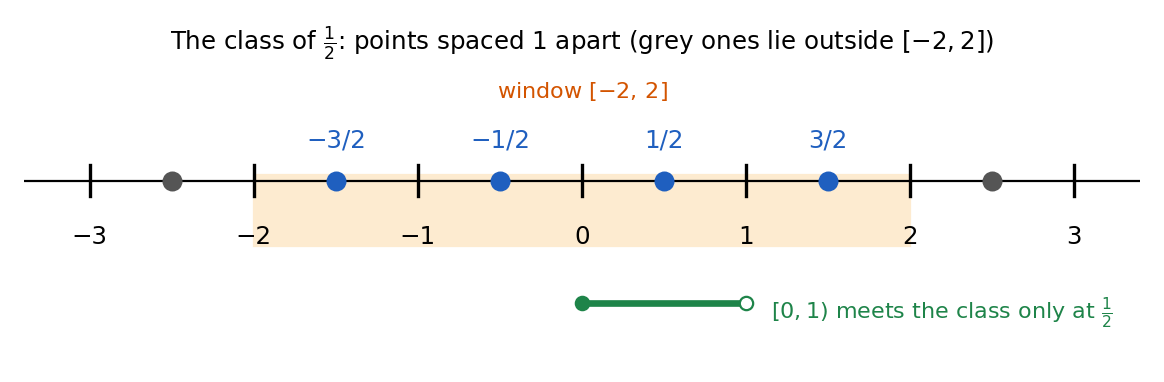
(ii) The class of 21. A real number b is in [21] exactly when b−21=n for some integer n, that is, b=n+21. So
[21]={n+21:n∈Z}={…,−23,−21,21,23,25,…}
For a member in [−2,2] we need
−2≤n+21≤2⟺−25≤n≤23
so n=−2,−1,0,1. The members of [21] in [−2,2] are
−23,−21,21,23
![A number line from -3 to 3 marking the points -5/2, -3/2, -1/2, 1/2, 3/2 and 5/2 of the class of 1/2, with the four inside the window [-2, 2] highlighted, and the interval 0, 1) meeting the class only at 1/2
(iii) [a]=[a+5]. Take any x∈[a], so x−a is an integer. Then
x−(a+5)=(x−a)−5
is also an integer, so x∈[a+5]. Conversely, take any x∈[a+5], so x−(a+5) is an integer. Then
x−a=(x−(a+5))+5
is also an integer, so x∈[a]. Each class is contained in the other, so [a]=[a+5].
(iv) Exactly one member in [0,1). Take any class [a].
At least one. Let n be the greatest integer with n≤a. Then n≤a<n+1. Put t=a−n. Then 0≤t<1, and a−t=n is an integer, so t∈[a]. For example, for a=7.3 we get n=7 and t=0.3; for a=−2.25 we get n=−3 and t=0.75.
At most one. Suppose t1 and t2 are both in [a] and both in [0,1). Then
t1−t2=(t1−a)−(t2−a)
is an integer. But both numbers lie in [0,1), so −1<t1−t2<1. The only integer strictly between −1 and 1 is 0, so t1=t2.
Hence every equivalence class contains exactly one number from [0,1). So the classes can be labelled by the numbers of [0,1), one class for each number. For example, [21] is the class labelled 21.