Question 135 marksEasy
Show that the relation defined in the set of all polygons as
is an equivalence relation. What is the set of all elements in related to the right angle triangle with sides and ?
Confirming your payment
Exercise 1.1 · Question 13 of 16
Show that the relation defined in the set of all polygons as
is an equivalence relation. What is the set of all elements in related to the right angle triangle with sides and ?
For a polygon write for its number of sides, a positive integer with . In this notation
so compares two polygons by one number and nothing else.
Part 1: is an equivalence relationReflexive. For any polygon , , so . Hence is reflexive.
Symmetric. If then , hence and . Hence is symmetric.
Transitive. If and then and , so and . Hence is transitive.
Being reflexive, symmetric and transitive, is an equivalence relation on .
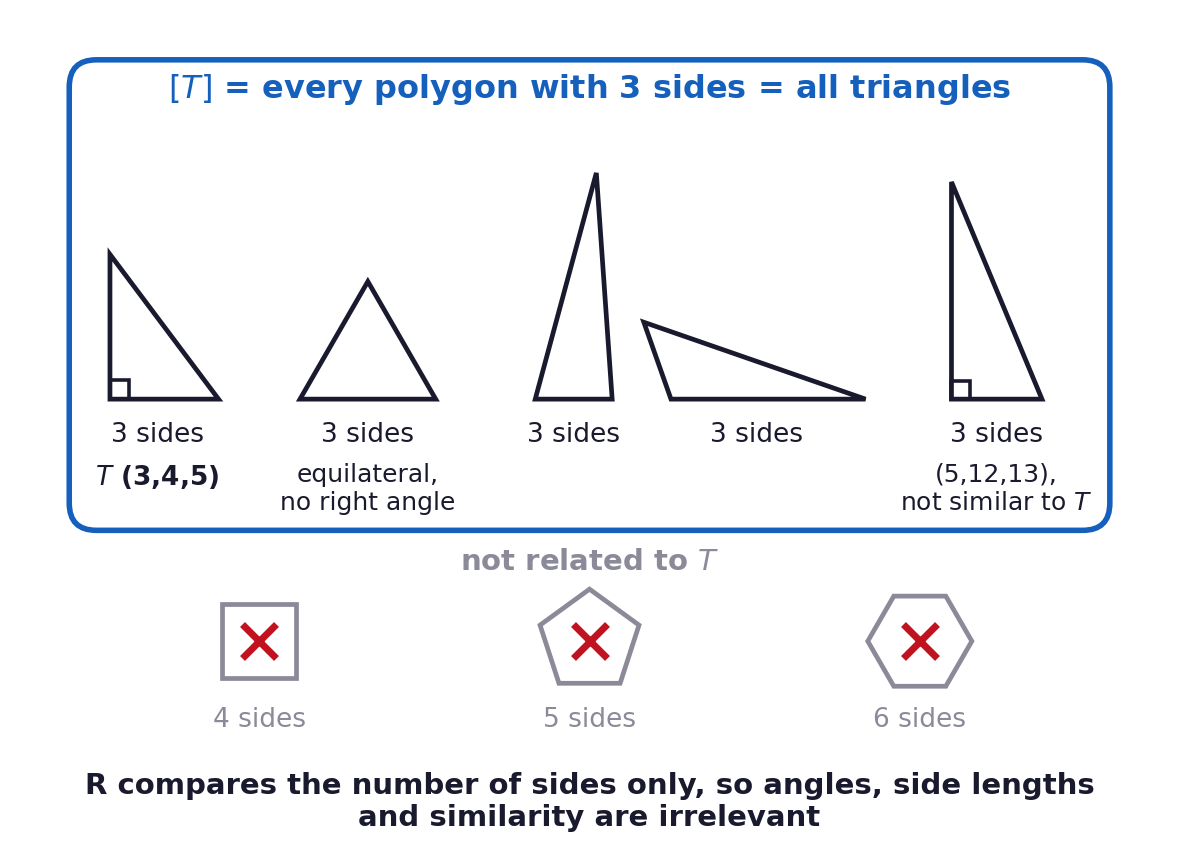
Part 2: the set of all elements related toThe triangle with sides has . So
A polygon has three sides exactly when it is a triangle. Therefore
the set of all elements of related to is the set of all triangles.
Every triangle belongs to it, whatever its size, its side lengths or its angles: equilateral, isosceles and scalene triangles; acute, right-angled and obtuse triangles. No quadrilateral, pentagon or any other polygon belongs to it, because such a polygon has sides, not .