
Confirming your payment

Skip to content

Sign up now and get .

Opening your dashboard

Class 9 Maths Chapter 23: Trigonometrical Ratios of Standard Angles Solutions

51 textbook questions with step-by-step answers, free to read, for ICSE 2026-27.

AI Tutor

Get talked through Ch 23, not just shown the answer

Reading a finished solution is not the same as being able to do it. The AI tutor takes one question at a time and works it with you, in your own words, until you can.

  • Ask it out loud, in your own words
  • It gives you the next step, not the answer
  • Stuck on part (ii)? Start there
Ch 23 solutions

51 questions with solutions

1–3 marks · Mixed difficulty

The first 13 solutions are on this page. This chapter is a long one, so the rest open on their own page to keep this one quick to load.

  1. 1

    Question 1

    2tan⁡30°1+tan⁡230°\dfrac{2\tan 30°}{1 + \tan^2 30°} is equal to :

    MCQEasy
    1 mark
    Solve with AI
    Answer
    • (A) sin 60°

      Correct
    • (B) cos 60°

    • (C) sec 60°

    • (D) cosec 60°

    Answer: (A) sin 60°

    Concept: The standard values are: sin⁡30∘=12\sin 30^\circ = \dfrac{1}{2}, sin⁡45∘=12\sin 45^\circ = \dfrac{1}{\sqrt{2}}, sin⁡60∘=32\sin 60^\circ = \dfrac{\sqrt{3}}{2}; cos⁡30∘=32\cos 30^\circ = \dfrac{\sqrt{3}}{2}, cos⁡45∘=12\cos 45^\circ = \dfrac{1}{\sqrt{2}}, cos⁡60∘=12\cos 60^\circ = \dfrac{1}{2}; tan⁡30∘=13\tan 30^\circ = \dfrac{1}{\sqrt{3}}, tan⁡45∘=1\tan 45^\circ = 1, tan⁡60∘=3\tan 60^\circ = \sqrt{3}; the other ratios are their reciprocals: cosec⁡θ=1sin⁡θ\operatorname{cosec}\theta = \dfrac{1}{\sin\theta}, sec⁡θ=1cos⁡θ\sec\theta = \dfrac{1}{\cos\theta} and cot⁡θ=1tan⁡θ\cot\theta = \dfrac{1}{\tan\theta}.

    Step 1 — Put in the value of tan 30°.

    We replace tan⁡30∘\tan 30^\circ by 13\dfrac{1}{\sqrt{3}}, so tan⁡230∘=13\tan^2 30^\circ = \dfrac{1}{3}.

    2tan⁡30∘1+tan⁡230∘=2×131+13=2343=23×34=323=32\begin{aligned} \dfrac{2\tan 30^\circ}{1 + \tan^2 30^\circ} &= \dfrac{2 \times \dfrac{1}{\sqrt{3}}}{1 + \dfrac{1}{3}} \\ &= \dfrac{\dfrac{2}{\sqrt{3}}}{\dfrac{4}{3}} \\ &= \dfrac{2}{\sqrt{3}} \times \dfrac{3}{4} \\ &= \dfrac{3}{2\sqrt{3}} \\ &= \dfrac{\sqrt{3}}{2} \end{aligned}

    Step 2 — Match the value.

    The value 32\dfrac{\sqrt{3}}{2} is sin⁡60∘\sin 60^\circ.

    Watch out: Dividing by 43\dfrac{4}{3} means multiplying by 34\dfrac{3}{4}.

    Why the other options are wrong:

    • (B) cos 60°: cos⁡60∘=12\cos 60^\circ = \dfrac{1}{2}, not 32\dfrac{\sqrt{3}}{2}.
    • (C) sec 60°: sec⁡60∘=2\sec 60^\circ = 2.
    • (D) cosec 60°: cosec⁡60∘=23\operatorname{cosec} 60^\circ = \dfrac{2}{\sqrt{3}}, which is the reciprocal of the value.

    Therefore, the expression equals sin 60°, option (A).

  2. 2

    Question 2

    If tan⁡3A−3=0\tan 3A - \sqrt{3} = 0 and 0 ≤ 3A ≤ 90° ; the measure of angle A is :

    MCQEasy
    1 mark
    Solve with AI
    Answer
    • (A) 15°

    • (B) 20°

      Correct
    • (C) 30°

    • (D) 10°

    Answer: (B) 20°

    Concept: To solve a trigonometric equation, first make the ratio stand alone. Then find the standard angle (from 0° to 90°) that has this value, and finally solve for the unknown angle.

    The standard values are: sin⁡30∘=12\sin 30^\circ = \dfrac{1}{2}, sin⁡45∘=12\sin 45^\circ = \dfrac{1}{\sqrt{2}}, sin⁡60∘=32\sin 60^\circ = \dfrac{\sqrt{3}}{2}; cos⁡30∘=32\cos 30^\circ = \dfrac{\sqrt{3}}{2}, cos⁡45∘=12\cos 45^\circ = \dfrac{1}{\sqrt{2}}, cos⁡60∘=12\cos 60^\circ = \dfrac{1}{2}; tan⁡30∘=13\tan 30^\circ = \dfrac{1}{\sqrt{3}}, tan⁡45∘=1\tan 45^\circ = 1, tan⁡60∘=3\tan 60^\circ = \sqrt{3}; the other ratios are their reciprocals: cosec⁡θ=1sin⁡θ\operatorname{cosec}\theta = \dfrac{1}{\sin\theta}, sec⁡θ=1cos⁡θ\sec\theta = \dfrac{1}{\cos\theta} and cot⁡θ=1tan⁡θ\cot\theta = \dfrac{1}{\tan\theta}.

    Step 1 — Make tan 3A stand alone.

    We add 3\sqrt{3} to both sides.

    tan⁡3A=3tan⁡3A=tan⁡60∘\begin{aligned} \tan 3A &= \sqrt{3} \\ \tan 3A &= \tan 60^\circ \end{aligned}

    Step 2 — Find A.

    Since 0∘≤3A≤90∘0^\circ \le 3A \le 90^\circ, the only angle with tangent 3\sqrt{3} is 60°.

    3A=60∘A=20∘\begin{aligned} 3A &= 60^\circ \\ A &= 20^\circ \end{aligned}

    Watch out: 60° is the value of 3A; divide by 3 to get A.

    Why the other options are wrong:

    • (A) 15°: Then 3A = 45°, and tan⁡45∘=1\tan 45^\circ = 1, not 3\sqrt{3}.
    • (C) 30°: Then 3A = 90°, and tan⁡90∘\tan 90^\circ is not defined.
    • (D) 10°: Then 3A = 30°, and tan⁡30∘=13\tan 30^\circ = \dfrac{1}{\sqrt{3}}.

    Therefore, angle A measures 20°, option (B).

  3. 3

    Question 3

    If cot A = tan A and 0 ≤ A ≤ 90°, the measure of angle A is :

    MCQEasy
    1 mark
    Solve with AI
    Answer
    • (A) 30°

    • (B) 60°

    • (C) 45°

      Correct
    • (D) 90°

    Answer: (C) 45°

    Concept: The standard values are: sin⁡30∘=12\sin 30^\circ = \dfrac{1}{2}, sin⁡45∘=12\sin 45^\circ = \dfrac{1}{\sqrt{2}}, sin⁡60∘=32\sin 60^\circ = \dfrac{\sqrt{3}}{2}; cos⁡30∘=32\cos 30^\circ = \dfrac{\sqrt{3}}{2}, cos⁡45∘=12\cos 45^\circ = \dfrac{1}{\sqrt{2}}, cos⁡60∘=12\cos 60^\circ = \dfrac{1}{2}; tan⁡30∘=13\tan 30^\circ = \dfrac{1}{\sqrt{3}}, tan⁡45∘=1\tan 45^\circ = 1, tan⁡60∘=3\tan 60^\circ = \sqrt{3}; the other ratios are their reciprocals: cosec⁡θ=1sin⁡θ\operatorname{cosec}\theta = \dfrac{1}{\sin\theta}, sec⁡θ=1cos⁡θ\sec\theta = \dfrac{1}{\cos\theta} and cot⁡θ=1tan⁡θ\cot\theta = \dfrac{1}{\tan\theta}.

    At the end angles: sin⁡0∘=0\sin 0^\circ = 0, cos⁡0∘=1\cos 0^\circ = 1, tan⁡0∘=0\tan 0^\circ = 0; sin⁡90∘=1\sin 90^\circ = 1, cos⁡90∘=0\cos 90^\circ = 0, and tan⁡90∘\tan 90^\circ is not defined.

    Step 1 — Write cot A in terms of tan A.

    Since cot⁡A=1tan⁡A\cot A = \dfrac{1}{\tan A}, the equation becomes 1tan⁡A=tan⁡A\dfrac{1}{\tan A} = \tan A.

    tan⁡2A=1tan⁡A=1\begin{aligned} \tan^2 A &= 1 \\ \tan A &= 1 \end{aligned}

    For 0∘<A<90∘0^\circ < A < 90^\circ the tangent is positive, so we take tan⁡A=1\tan A = 1.

    Step 2 — Find A.

    The standard value tan⁡45∘=1\tan 45^\circ = 1 tells us that A is 45°.

    Watch out: From tan⁡2A=1\tan^2 A = 1 we keep only the positive root, because an angle from 0° to 90° has a positive tangent.

    Why the other options are wrong:

    • (A) 30°: tan⁡30∘=13\tan 30^\circ = \dfrac{1}{\sqrt{3}}, while its cotangent is 3\sqrt{3}, so they are not equal.
    • (B) 60°: tan⁡60∘=3\tan 60^\circ = \sqrt{3}, while its cotangent is 13\dfrac{1}{\sqrt{3}}, so they are not equal.
    • (D) 90°: tan⁡90∘\tan 90^\circ is not defined, while cot⁡90∘=0\cot 90^\circ = 0.

    Therefore, angle A measures 45°, option (C).

  4. 4

    Question 4

    The value of cos⁡260°−2sin⁡330°+3cot⁡445°\cos^2 60° - 2\sin^3 30° + 3\cot^4 45° is :

    MCQEasy
    1 mark
    Solve with AI
    Answer
    • (A) 1

    • (B) –2

    • (C) 3

      Correct
    • (D) 2

    Answer: (C) 3

    Concept: The standard values are: sin⁡30∘=12\sin 30^\circ = \dfrac{1}{2}, sin⁡45∘=12\sin 45^\circ = \dfrac{1}{\sqrt{2}}, sin⁡60∘=32\sin 60^\circ = \dfrac{\sqrt{3}}{2}; cos⁡30∘=32\cos 30^\circ = \dfrac{\sqrt{3}}{2}, cos⁡45∘=12\cos 45^\circ = \dfrac{1}{\sqrt{2}}, cos⁡60∘=12\cos 60^\circ = \dfrac{1}{2}; tan⁡30∘=13\tan 30^\circ = \dfrac{1}{\sqrt{3}}, tan⁡45∘=1\tan 45^\circ = 1, tan⁡60∘=3\tan 60^\circ = \sqrt{3}; the other ratios are their reciprocals: cosec⁡θ=1sin⁡θ\operatorname{cosec}\theta = \dfrac{1}{\sin\theta}, sec⁡θ=1cos⁡θ\sec\theta = \dfrac{1}{\cos\theta} and cot⁡θ=1tan⁡θ\cot\theta = \dfrac{1}{\tan\theta}.

    Step 1 — Put in the values.

    We use cos⁡60∘=12\cos 60^\circ = \dfrac{1}{2}, sin⁡30∘=12\sin 30^\circ = \dfrac{1}{2} and cot⁡45∘=1\cot 45^\circ = 1.

    cos⁡260∘−2sin⁡330∘+3cot⁡445∘=(12)2−2(12)3+3(1)4=14−2×18+3=14−14+3=3\begin{aligned} \cos^2 60^\circ - 2\sin^3 30^\circ + 3\cot^4 45^\circ &= \left(\dfrac{1}{2}\right)^2 - 2\left(\dfrac{1}{2}\right)^3 + 3(1)^4 \\ &= \dfrac{1}{4} - 2 \times \dfrac{1}{8} + 3 \\ &= \dfrac{1}{4} - \dfrac{1}{4} + 3 \\ &= 3 \end{aligned}

    Watch out: Raise the value to the power first, then multiply by the number in front.

    Why the other options are wrong:

    • (A) 1: 1 is what we get by dropping the factor 3 in 3cot⁡445∘3\cot^4 45^\circ.
    • (B) –2: The first two terms cancel and the last term is +3, so the value cannot be negative.
    • (D) 2: 2 would need the first two terms to add up to −1, but they cancel to 0.

    Therefore, the value is 3, option (C).

  5. 5

    Question 5

    The value of cos⁡60°−cos⁡0°+2sin⁡90°cot⁡60°×cot⁡30°\dfrac{\cos 60° - \cos 0° + 2\sin 90°}{\cot 60° \times \cot 30°} is :

    MCQEasy
    1 mark
    Solve with AI
    Answer
    • (A) 1121\dfrac{1}{2}

      Correct
    • (B) 23\dfrac{2}{3}

    • (C) –2

    • (D) 1

    Answer: (A) 1121\dfrac{1}{2}

    Concept: The standard values are: sin⁡30∘=12\sin 30^\circ = \dfrac{1}{2}, sin⁡45∘=12\sin 45^\circ = \dfrac{1}{\sqrt{2}}, sin⁡60∘=32\sin 60^\circ = \dfrac{\sqrt{3}}{2}; cos⁡30∘=32\cos 30^\circ = \dfrac{\sqrt{3}}{2}, cos⁡45∘=12\cos 45^\circ = \dfrac{1}{\sqrt{2}}, cos⁡60∘=12\cos 60^\circ = \dfrac{1}{2}; tan⁡30∘=13\tan 30^\circ = \dfrac{1}{\sqrt{3}}, tan⁡45∘=1\tan 45^\circ = 1, tan⁡60∘=3\tan 60^\circ = \sqrt{3}; the other ratios are their reciprocals: cosec⁡θ=1sin⁡θ\operatorname{cosec}\theta = \dfrac{1}{\sin\theta}, sec⁡θ=1cos⁡θ\sec\theta = \dfrac{1}{\cos\theta} and cot⁡θ=1tan⁡θ\cot\theta = \dfrac{1}{\tan\theta}.

    At the end angles: sin⁡0∘=0\sin 0^\circ = 0, cos⁡0∘=1\cos 0^\circ = 1, tan⁡0∘=0\tan 0^\circ = 0; sin⁡90∘=1\sin 90^\circ = 1, cos⁡90∘=0\cos 90^\circ = 0, and tan⁡90∘\tan 90^\circ is not defined.

    Step 1 — Simplify the numerator.

    We use cos⁡60∘=12\cos 60^\circ = \dfrac{1}{2}, cos⁡0∘=1\cos 0^\circ = 1 and sin⁡90∘=1\sin 90^\circ = 1.

    cos⁡60∘−cos⁡0∘+2sin⁡90∘=12−1+2=32\begin{aligned} \cos 60^\circ - \cos 0^\circ + 2\sin 90^\circ &= \dfrac{1}{2} - 1 + 2 \\ &= \dfrac{3}{2} \end{aligned}

    Step 2 — Simplify the denominator.

    We use cot⁡60∘=13\cot 60^\circ = \dfrac{1}{\sqrt{3}} and cot⁡30∘=3\cot 30^\circ = \sqrt{3}.

    cot⁡60∘×cot⁡30∘=13×3=1\begin{aligned} \cot 60^\circ \times \cot 30^\circ &= \dfrac{1}{\sqrt{3}} \times \sqrt{3} \\ &= 1 \end{aligned}

    Step 3 — Divide.

    Dividing 32\dfrac{3}{2} by 1 leaves 32\dfrac{3}{2}. As a mixed number this is 1121\dfrac{1}{2}.

    Watch out: cos⁡0∘\cos 0^\circ is 1, not 0.

    Why the other options are wrong:

    • (B) 23\dfrac{2}{3}: 23\dfrac{2}{3} is the reciprocal of the value.
    • (C) –2: The numerator is 32\dfrac{3}{2} and the denominator is 1, so the value is positive.
    • (D) 1: The numerator is 32\dfrac{3}{2}, not 1.

    Therefore, the value is 1121\dfrac{1}{2}, option (A).

  6. 6

    Question 6

    Find the value of :

    (i) sin 30° cos 30°

    (ii) tan 30° tan 60°

    (iii) cos⁡260°+sin⁡230°\cos^2 60° + \sin^2 30°

    (iv) cosec⁡260°−tan⁡230°\operatorname{cosec}^2 60° - \tan^2 30°

    (v) sin⁡230°+cos⁡230°+cot⁡245°\sin^2 30° + \cos^2 30° + \cot^2 45°

    (vi) cos⁡260°+sec⁡230°+tan⁡245°\cos^2 60° + \sec^2 30° + \tan^2 45°

    Easy
    3 marks
    Solve with AI
    Written solution

    Solution:

    Concept: The standard values are: sin⁡30∘=12\sin 30^\circ = \dfrac{1}{2}, sin⁡45∘=12\sin 45^\circ = \dfrac{1}{\sqrt{2}}, sin⁡60∘=32\sin 60^\circ = \dfrac{\sqrt{3}}{2}; cos⁡30∘=32\cos 30^\circ = \dfrac{\sqrt{3}}{2}, cos⁡45∘=12\cos 45^\circ = \dfrac{1}{\sqrt{2}}, cos⁡60∘=12\cos 60^\circ = \dfrac{1}{2}; tan⁡30∘=13\tan 30^\circ = \dfrac{1}{\sqrt{3}}, tan⁡45∘=1\tan 45^\circ = 1, tan⁡60∘=3\tan 60^\circ = \sqrt{3}; the other ratios are their reciprocals: cosec⁡θ=1sin⁡θ\operatorname{cosec}\theta = \dfrac{1}{\sin\theta}, sec⁡θ=1cos⁡θ\sec\theta = \dfrac{1}{\cos\theta} and cot⁡θ=1tan⁡θ\cot\theta = \dfrac{1}{\tan\theta}.

    Step 1 — Part (i).

    We multiply the two values.

    sin⁡30∘cos⁡30∘=12×32=34\begin{aligned} \sin 30^\circ \cos 30^\circ &= \dfrac{1}{2} \times \dfrac{\sqrt{3}}{2} \\ &= \dfrac{\sqrt{3}}{4} \end{aligned}

    Step 2 — Part (ii).

    The two tangents are reciprocals of each other.

    tan⁡30∘tan⁡60∘=13×3=1\begin{aligned} \tan 30^\circ \tan 60^\circ &= \dfrac{1}{\sqrt{3}} \times \sqrt{3} \\ &= 1 \end{aligned}

    Step 3 — Part (iii).

    Both squares equal one-quarter.

    cos⁡260∘+sin⁡230∘=14+14=12\begin{aligned} \cos^2 60^\circ + \sin^2 30^\circ &= \dfrac{1}{4} + \dfrac{1}{4} \\ &= \dfrac{1}{2} \end{aligned}

    Step 4 — Part (iv).

    Here cosec⁡60∘=23\operatorname{cosec} 60^\circ = \dfrac{2}{\sqrt{3}}, so its square is 43\dfrac{4}{3}.

    cosec⁡260∘−tan⁡230∘=43−13=1\begin{aligned} \operatorname{cosec}^2 60^\circ - \tan^2 30^\circ &= \dfrac{4}{3} - \dfrac{1}{3} \\ &= 1 \end{aligned}

    Step 5 — Part (v).

    We square each value; cot⁡45∘=1\cot 45^\circ = 1.

    sin⁡230∘+cos⁡230∘+cot⁡245∘=14+34+1=2\begin{aligned} \sin^2 30^\circ + \cos^2 30^\circ + \cot^2 45^\circ &= \dfrac{1}{4} + \dfrac{3}{4} + 1 \\ &= 2 \end{aligned}

    Step 6 — Part (vi).

    Here sec⁡30∘=23\sec 30^\circ = \dfrac{2}{\sqrt{3}}, so its square is 43\dfrac{4}{3}. We add using the common denominator 12.

    cos⁡260∘+sec⁡230∘+tan⁡245∘=14+43+1=3+16+1212=3112\begin{aligned} \cos^2 60^\circ + \sec^2 30^\circ + \tan^2 45^\circ &= \dfrac{1}{4} + \dfrac{4}{3} + 1 \\ &= \dfrac{3 + 16 + 12}{12} \\ &= \dfrac{31}{12} \end{aligned}

    As a mixed number this is 27122\dfrac{7}{12}.

    Watch out: sin⁡230∘\sin^2 30^\circ means (sin⁡30∘)2(\sin 30^\circ)^2; square the value, not the angle.

    Therefore, (i) 34\dfrac{\sqrt{3}}{4}; (ii) 1; (iii) 12\dfrac{1}{2}; (iv) 1; (v) 2; (vi) 27122\dfrac{7}{12}.

  7. 7

    Question 7

    Find the value of :

    (i) tan⁡230°+tan⁡245°+tan⁡260°\tan^2 30° + \tan^2 45° + \tan^2 60°

    (ii) tan⁡45°cosec⁡30°+sec⁡60°cot⁡45°−5sin⁡90°2cos⁡0°\dfrac{\tan 45°}{\operatorname{cosec} 30°} + \dfrac{\sec 60°}{\cot 45°} - \dfrac{5\sin 90°}{2\cos 0°}

    (iii) 3sin⁡230°+2tan⁡260°−5cos⁡245°3\sin^2 30° + 2\tan^2 60° - 5\cos^2 45°

    Easy
    3 marks
    Solve with AI
    Written solution

    Solution:

    Concept: The standard values are: sin⁡30∘=12\sin 30^\circ = \dfrac{1}{2}, sin⁡45∘=12\sin 45^\circ = \dfrac{1}{\sqrt{2}}, sin⁡60∘=32\sin 60^\circ = \dfrac{\sqrt{3}}{2}; cos⁡30∘=32\cos 30^\circ = \dfrac{\sqrt{3}}{2}, cos⁡45∘=12\cos 45^\circ = \dfrac{1}{\sqrt{2}}, cos⁡60∘=12\cos 60^\circ = \dfrac{1}{2}; tan⁡30∘=13\tan 30^\circ = \dfrac{1}{\sqrt{3}}, tan⁡45∘=1\tan 45^\circ = 1, tan⁡60∘=3\tan 60^\circ = \sqrt{3}; the other ratios are their reciprocals: cosec⁡θ=1sin⁡θ\operatorname{cosec}\theta = \dfrac{1}{\sin\theta}, sec⁡θ=1cos⁡θ\sec\theta = \dfrac{1}{\cos\theta} and cot⁡θ=1tan⁡θ\cot\theta = \dfrac{1}{\tan\theta}.

    At the end angles: sin⁡0∘=0\sin 0^\circ = 0, cos⁡0∘=1\cos 0^\circ = 1, tan⁡0∘=0\tan 0^\circ = 0; sin⁡90∘=1\sin 90^\circ = 1, cos⁡90∘=0\cos 90^\circ = 0, and tan⁡90∘\tan 90^\circ is not defined.

    Step 1 — Part (i).

    We square each tangent and add.

    tan⁡230∘+tan⁡245∘+tan⁡260∘=13+1+3=133\begin{aligned} \tan^2 30^\circ + \tan^2 45^\circ + \tan^2 60^\circ &= \dfrac{1}{3} + 1 + 3 \\ &= \dfrac{13}{3} \end{aligned}

    As a mixed number this is 4134\dfrac{1}{3}.

    Step 2 — Part (ii).

    We use cosec⁡30∘=2\operatorname{cosec} 30^\circ = 2, sec⁡60∘=2\sec 60^\circ = 2, cot⁡45∘=1\cot 45^\circ = 1, sin⁡90∘=1\sin 90^\circ = 1 and cos⁡0∘=1\cos 0^\circ = 1.

    tan⁡45∘cosec⁡30∘+sec⁡60∘cot⁡45∘−5sin⁡90∘2cos⁡0∘=12+21−52=0\begin{aligned} \dfrac{\tan 45^\circ}{\operatorname{cosec} 30^\circ} + \dfrac{\sec 60^\circ}{\cot 45^\circ} - \dfrac{5\sin 90^\circ}{2\cos 0^\circ} &= \dfrac{1}{2} + \dfrac{2}{1} - \dfrac{5}{2} \\ &= 0 \end{aligned}

    Step 3 — Part (iii).

    We square each value and multiply by the number in front.

    3sin⁡230∘+2tan⁡260∘−5cos⁡245∘=3×14+2×3−5×12=34+6−52=174\begin{aligned} 3\sin^2 30^\circ + 2\tan^2 60^\circ - 5\cos^2 45^\circ &= 3 \times \dfrac{1}{4} + 2 \times 3 - 5 \times \dfrac{1}{2} \\ &= \dfrac{3}{4} + 6 - \dfrac{5}{2} \\ &= \dfrac{17}{4} \end{aligned}

    As a mixed number this is 4144\dfrac{1}{4}.

    Watch out: cosec⁡30∘\operatorname{cosec} 30^\circ is 2, the reciprocal of sin⁡30∘\sin 30^\circ.

    Therefore, (i) 4134\dfrac{1}{3}; (ii) 0; (iii) 4144\dfrac{1}{4}.

  8. 8

    Question 8

    Prove that :

    (i) sin 60° cos 30° + cos 60°. sin 30° = 1

    (ii) cos 30°. cos 60° – sin 30°. sin 60° = 0

    (iii) cosec⁡245°−cot⁡245°=1\operatorname{cosec}^2 45° - \cot^2 45° = 1

    (iv) cos⁡230°−sin⁡230°=cos⁡60°\cos^2 30° - \sin^2 30° = \cos 60°

    (v) (tan⁡60°+1tan⁡60°−1)2=1+cos⁡30°1−cos⁡30°\left(\dfrac{\tan 60° + 1}{\tan 60° - 1}\right)^2 = \dfrac{1 + \cos 30°}{1 - \cos 30°}

    (vi) 3cosec⁡260°−2cot⁡230°+sec⁡245°=03\operatorname{cosec}^2 60° - 2\cot^2 30° + \sec^2 45° = 0.

    Easy
    3 marks
    Solve with AI
    Written solution

    Solution:

    Concept: To prove an identity for given angles, put in the standard values and simplify each side separately; when both sides give the same number, the result is proved.

    The standard values are: sin⁡30∘=12\sin 30^\circ = \dfrac{1}{2}, sin⁡45∘=12\sin 45^\circ = \dfrac{1}{\sqrt{2}}, sin⁡60∘=32\sin 60^\circ = \dfrac{\sqrt{3}}{2}; cos⁡30∘=32\cos 30^\circ = \dfrac{\sqrt{3}}{2}, cos⁡45∘=12\cos 45^\circ = \dfrac{1}{\sqrt{2}}, cos⁡60∘=12\cos 60^\circ = \dfrac{1}{2}; tan⁡30∘=13\tan 30^\circ = \dfrac{1}{\sqrt{3}}, tan⁡45∘=1\tan 45^\circ = 1, tan⁡60∘=3\tan 60^\circ = \sqrt{3}; the other ratios are their reciprocals: cosec⁡θ=1sin⁡θ\operatorname{cosec}\theta = \dfrac{1}{\sin\theta}, sec⁡θ=1cos⁡θ\sec\theta = \dfrac{1}{\cos\theta} and cot⁡θ=1tan⁡θ\cot\theta = \dfrac{1}{\tan\theta}.

    Step 1 — Part (i).

    We work out the left-hand side and compare it with 1.

    LHS=32×32+12×12=34+14=1\begin{aligned} \text{LHS} &= \dfrac{\sqrt{3}}{2} \times \dfrac{\sqrt{3}}{2} + \dfrac{1}{2} \times \dfrac{1}{2} \\ &= \dfrac{3}{4} + \dfrac{1}{4} \\ &= 1 \end{aligned} RHS=1\begin{aligned} \text{RHS} &= 1 \end{aligned}

    So LHS = RHS.

    Step 2 — Part (ii).

    The two products are equal, so their difference is 0.

    LHS=32×12−12×32=34−34=0\begin{aligned} \text{LHS} &= \dfrac{\sqrt{3}}{2} \times \dfrac{1}{2} - \dfrac{1}{2} \times \dfrac{\sqrt{3}}{2} \\ &= \dfrac{\sqrt{3}}{4} - \dfrac{\sqrt{3}}{4} \\ &= 0 \end{aligned} RHS=0\begin{aligned} \text{RHS} &= 0 \end{aligned}

    So LHS = RHS.

    Step 3 — Part (iii).

    We use cosec⁡45∘=2\operatorname{cosec} 45^\circ = \sqrt{2} and cot⁡45∘=1\cot 45^\circ = 1.

    LHS=(2)2−12=2−1=1\begin{aligned} \text{LHS} &= (\sqrt{2})^2 - 1^2 \\ &= 2 - 1 \\ &= 1 \end{aligned} RHS=1\begin{aligned} \text{RHS} &= 1 \end{aligned}

    So LHS = RHS.

    Step 4 — Part (iv).

    We find each side separately.

    LHS=34−14=12\begin{aligned} \text{LHS} &= \dfrac{3}{4} - \dfrac{1}{4} \\ &= \dfrac{1}{2} \end{aligned} RHS=12\begin{aligned} \text{RHS} &= \dfrac{1}{2} \end{aligned}

    So LHS = RHS.

    Step 5 — Part (v), left-hand side.

    We put tan⁡60∘=3\tan 60^\circ = \sqrt{3}, square the fraction, and rationalise by multiplying the top and bottom by 3+1\sqrt{3} + 1.

    (tan⁡60∘+1tan⁡60∘−1)2=(3+13−1)2=((3+1)23−1)2=(4+232)2=(2+3)2=7+43\begin{aligned} \left(\dfrac{\tan 60^\circ + 1}{\tan 60^\circ - 1}\right)^2 &= \left(\dfrac{\sqrt{3} + 1}{\sqrt{3} - 1}\right)^2 \\ &= \left(\dfrac{(\sqrt{3} + 1)^2}{3 - 1}\right)^2 \\ &= \left(\dfrac{4 + 2\sqrt{3}}{2}\right)^2 \\ &= (2 + \sqrt{3})^2 \\ &= 7 + 4\sqrt{3} \end{aligned}

    Step 6 — Part (v), right-hand side.

    We put cos⁡30∘=32\cos 30^\circ = \dfrac{\sqrt{3}}{2}, clear the halves by multiplying the top and bottom by 2, and rationalise with 2+32 + \sqrt{3}.

    1+cos⁡30∘1−cos⁡30∘=1+321−32=2+32−3=(2+3)24−3=7+43\begin{aligned} \dfrac{1 + \cos 30^\circ}{1 - \cos 30^\circ} &= \dfrac{1 + \dfrac{\sqrt{3}}{2}}{1 - \dfrac{\sqrt{3}}{2}} \\ &= \dfrac{2 + \sqrt{3}}{2 - \sqrt{3}} \\ &= \dfrac{(2 + \sqrt{3})^2}{4 - 3} \\ &= 7 + 4\sqrt{3} \end{aligned}

    Both sides equal 7+437 + 4\sqrt{3}, so LHS = RHS.

    Step 7 — Part (vi).

    We use cosec⁡60∘=23\operatorname{cosec} 60^\circ = \dfrac{2}{\sqrt{3}}, cot⁡30∘=3\cot 30^\circ = \sqrt{3} and sec⁡45∘=2\sec 45^\circ = \sqrt{2}.

    LHS=3×43−2×3+2=4−6+2=0\begin{aligned} \text{LHS} &= 3 \times \dfrac{4}{3} - 2 \times 3 + 2 \\ &= 4 - 6 + 2 \\ &= 0 \end{aligned} RHS=0\begin{aligned} \text{RHS} &= 0 \end{aligned}

    So LHS = RHS.

    Watch out: Work on each side separately; do not move terms across the equals sign in a proof.

    Therefore, all six results are proved.

  9. 9

    Question 9

    Prove that :

    (i) sin⁡(2×30°)=2tan⁡30°1+tan⁡230°\sin(2 \times 30°) = \dfrac{2\tan 30°}{1 + \tan^2 30°}

    (ii) cos⁡(2×30°)=1−tan⁡230°1+tan⁡230°\cos(2 \times 30°) = \dfrac{1 - \tan^2 30°}{1 + \tan^2 30°}

    (iii) tan⁡(2×30°)=2tan⁡30°1−tan⁡230°\tan(2 \times 30°) = \dfrac{2\tan 30°}{1 - \tan^2 30°}

    Easy
    3 marks
    Solve with AI
    Written solution

    Solution:

    Concept: Here 2×30∘=60∘2 \times 30^\circ = 60^\circ. Put in the standard values and simplify each side separately.

    The standard values are: sin⁡30∘=12\sin 30^\circ = \dfrac{1}{2}, sin⁡45∘=12\sin 45^\circ = \dfrac{1}{\sqrt{2}}, sin⁡60∘=32\sin 60^\circ = \dfrac{\sqrt{3}}{2}; cos⁡30∘=32\cos 30^\circ = \dfrac{\sqrt{3}}{2}, cos⁡45∘=12\cos 45^\circ = \dfrac{1}{\sqrt{2}}, cos⁡60∘=12\cos 60^\circ = \dfrac{1}{2}; tan⁡30∘=13\tan 30^\circ = \dfrac{1}{\sqrt{3}}, tan⁡45∘=1\tan 45^\circ = 1, tan⁡60∘=3\tan 60^\circ = \sqrt{3}; the other ratios are their reciprocals: cosec⁡θ=1sin⁡θ\operatorname{cosec}\theta = \dfrac{1}{\sin\theta}, sec⁡θ=1cos⁡θ\sec\theta = \dfrac{1}{\cos\theta} and cot⁡θ=1tan⁡θ\cot\theta = \dfrac{1}{\tan\theta}.

    Step 1 — Part (i).

    The left side is sin⁡60∘\sin 60^\circ. On the right we put tan⁡30∘=13\tan 30^\circ = \dfrac{1}{\sqrt{3}}.

    LHS=32\begin{aligned} \text{LHS} &= \dfrac{\sqrt{3}}{2} \end{aligned} RHS=231+13=23×34=32\begin{aligned} \text{RHS} &= \dfrac{\dfrac{2}{\sqrt{3}}}{1 + \dfrac{1}{3}} \\ &= \dfrac{2}{\sqrt{3}} \times \dfrac{3}{4} \\ &= \dfrac{\sqrt{3}}{2} \end{aligned}

    So LHS = RHS.

    Step 2 — Part (ii).

    The left side is cos⁡60∘\cos 60^\circ.

    LHS=12\begin{aligned} \text{LHS} &= \dfrac{1}{2} \end{aligned} RHS=1−131+13=23×34=12\begin{aligned} \text{RHS} &= \dfrac{1 - \dfrac{1}{3}}{1 + \dfrac{1}{3}} \\ &= \dfrac{2}{3} \times \dfrac{3}{4} \\ &= \dfrac{1}{2} \end{aligned}

    So LHS = RHS.

    Step 3 — Part (iii).

    The left side is tan⁡60∘\tan 60^\circ.

    LHS=3\begin{aligned} \text{LHS} &= \sqrt{3} \end{aligned} RHS=231−13=23×32=3\begin{aligned} \text{RHS} &= \dfrac{\dfrac{2}{\sqrt{3}}}{1 - \dfrac{1}{3}} \\ &= \dfrac{2}{\sqrt{3}} \times \dfrac{3}{2} \\ &= \sqrt{3} \end{aligned}

    So LHS = RHS.

    Watch out: sin⁡(2×30∘)\sin(2 \times 30^\circ) is sin⁡60∘\sin 60^\circ, not 2sin⁡30∘2\sin 30^\circ.

    Therefore, all three results are proved.

  10. 10

    Question 10

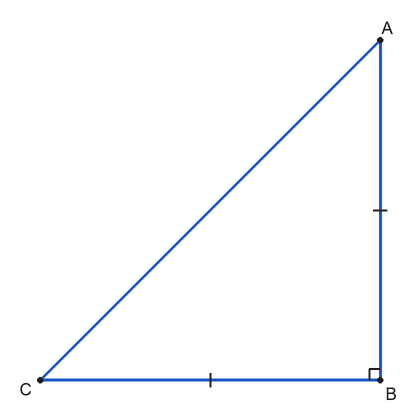
    ABC is an isosceles right-angled triangle. Assuming AB = BC = x, find the value of each of the following trigonometric ratios :

    (i) sin 45°

    (ii) cos 45°

    (iii) tan 45°
    Class 9 Maths Trigonometrical Ratios of Standard Angles

    Easy
    3 marks
    Solve with AI
    Written solution

    Solution:

    Concept: In a right triangle, for an acute angle: sine = perpendicular ÷ hypotenuse, cosine = base ÷ hypotenuse, tangent = perpendicular ÷ base. The two acute angles of a right triangle add up to 90°.

    Given: ABC is right-angled at B, and AB and BC both equal xx.

    Step 1 — Find the hypotenuse.

    The right angle is at B, and AB and BC both equal xx. By Pythagoras' theorem:

    AC=x2+x2=2x2=x2\begin{aligned} \text{AC} &= \sqrt{x^2 + x^2} \\ &= \sqrt{2x^2} \\ &= x\sqrt{2} \end{aligned}

    Step 2 — Find the angle at C.

    Triangle ABC is isosceles with AB = BC, so ∠A = ∠C. These two angles add up to 90°, so each is 45°.

    Step 3 — Write the ratios for angle C.

    For angle C, the perpendicular is AB, the base is BC and the hypotenuse is AC.

    sin⁡45∘=ABAC=xx2=12\begin{aligned} \sin 45^\circ &= \dfrac{\text{AB}}{\text{AC}} \\ &= \dfrac{x}{x\sqrt{2}} \\ &= \dfrac{1}{\sqrt{2}} \end{aligned} cos⁡45∘=BCAC=xx2=12\begin{aligned} \cos 45^\circ &= \dfrac{\text{BC}}{\text{AC}} \\ &= \dfrac{x}{x\sqrt{2}} \\ &= \dfrac{1}{\sqrt{2}} \end{aligned} tan⁡45∘=ABBC=xx=1\begin{aligned} \tan 45^\circ &= \dfrac{\text{AB}}{\text{BC}} \\ &= \dfrac{x}{x} \\ &= 1 \end{aligned}

    Watch out: The hypotenuse is the side opposite the right angle, here AC.

    Therefore, (i) sin⁡45∘=12\sin 45^\circ = \dfrac{1}{\sqrt{2}}; (ii) cos⁡45∘=12\cos 45^\circ = \dfrac{1}{\sqrt{2}}; (iii) tan⁡45∘=1\tan 45^\circ = 1.

  11. 11

    Question 11

    Prove that :

    (i) sin 60° = 2 sin 30° cos 30°.

    (ii) 4(sin⁡430°+cos⁡460°)−3(cos⁡245°−sin⁡290°)=24(\sin^4 30° + \cos^4 60°) - 3(\cos^2 45° - \sin^2 90°) = 2

    Easy
    3 marks
    Solve with AI
    Written solution

    Solution:

    Concept: The standard values are: sin⁡30∘=12\sin 30^\circ = \dfrac{1}{2}, sin⁡45∘=12\sin 45^\circ = \dfrac{1}{\sqrt{2}}, sin⁡60∘=32\sin 60^\circ = \dfrac{\sqrt{3}}{2}; cos⁡30∘=32\cos 30^\circ = \dfrac{\sqrt{3}}{2}, cos⁡45∘=12\cos 45^\circ = \dfrac{1}{\sqrt{2}}, cos⁡60∘=12\cos 60^\circ = \dfrac{1}{2}; tan⁡30∘=13\tan 30^\circ = \dfrac{1}{\sqrt{3}}, tan⁡45∘=1\tan 45^\circ = 1, tan⁡60∘=3\tan 60^\circ = \sqrt{3}; the other ratios are their reciprocals: cosec⁡θ=1sin⁡θ\operatorname{cosec}\theta = \dfrac{1}{\sin\theta}, sec⁡θ=1cos⁡θ\sec\theta = \dfrac{1}{\cos\theta} and cot⁡θ=1tan⁡θ\cot\theta = \dfrac{1}{\tan\theta}.

    At the end angles: sin⁡0∘=0\sin 0^\circ = 0, cos⁡0∘=1\cos 0^\circ = 1, tan⁡0∘=0\tan 0^\circ = 0; sin⁡90∘=1\sin 90^\circ = 1, cos⁡90∘=0\cos 90^\circ = 0, and tan⁡90∘\tan 90^\circ is not defined.

    Step 1 — Part (i).

    The left side is sin⁡60∘\sin 60^\circ; on the right we use sin⁡30∘\sin 30^\circ and cos⁡30∘\cos 30^\circ.

    LHS=32\begin{aligned} \text{LHS} &= \dfrac{\sqrt{3}}{2} \end{aligned} RHS=2×12×32=32\begin{aligned} \text{RHS} &= 2 \times \dfrac{1}{2} \times \dfrac{\sqrt{3}}{2} \\ &= \dfrac{\sqrt{3}}{2} \end{aligned}

    So LHS = RHS.

    Step 2 — Part (ii).

    We use sin⁡30∘=12\sin 30^\circ = \dfrac{1}{2}, cos⁡60∘=12\cos 60^\circ = \dfrac{1}{2}, cos⁡45∘=12\cos 45^\circ = \dfrac{1}{\sqrt{2}} and sin⁡90∘=1\sin 90^\circ = 1.

    LHS=4(116+116)−3(12−1)=4×18−3×(−12)=12+32=2\begin{aligned} \text{LHS} &= 4\left(\dfrac{1}{16} + \dfrac{1}{16}\right) - 3\left(\dfrac{1}{2} - 1\right) \\ &= 4 \times \dfrac{1}{8} - 3 \times \left(-\dfrac{1}{2}\right) \\ &= \dfrac{1}{2} + \dfrac{3}{2} \\ &= 2 \end{aligned} RHS=2\begin{aligned} \text{RHS} &= 2 \end{aligned}

    So LHS = RHS.

    Watch out: −3×(−12)-3 \times \left(-\dfrac{1}{2}\right) is +32+\dfrac{3}{2}; watch the signs.

    Therefore, both results are proved.

  12. 12

    Question 12

    If sin x = cos x and x is acute, state the value of x.

    Easy
    3 marks
    Solve with AI
    Written solution

    Solution:

    Concept: tan⁡x=sin⁡xcos⁡x\tan x = \dfrac{\sin x}{\cos x}.

    The standard values are: sin⁡30∘=12\sin 30^\circ = \dfrac{1}{2}, sin⁡45∘=12\sin 45^\circ = \dfrac{1}{\sqrt{2}}, sin⁡60∘=32\sin 60^\circ = \dfrac{\sqrt{3}}{2}; cos⁡30∘=32\cos 30^\circ = \dfrac{\sqrt{3}}{2}, cos⁡45∘=12\cos 45^\circ = \dfrac{1}{\sqrt{2}}, cos⁡60∘=12\cos 60^\circ = \dfrac{1}{2}; tan⁡30∘=13\tan 30^\circ = \dfrac{1}{\sqrt{3}}, tan⁡45∘=1\tan 45^\circ = 1, tan⁡60∘=3\tan 60^\circ = \sqrt{3}; the other ratios are their reciprocals: cosec⁡θ=1sin⁡θ\operatorname{cosec}\theta = \dfrac{1}{\sin\theta}, sec⁡θ=1cos⁡θ\sec\theta = \dfrac{1}{\cos\theta} and cot⁡θ=1tan⁡θ\cot\theta = \dfrac{1}{\tan\theta}.

    Step 1 — Divide by cos x.

    For an acute angle cos⁡x≠0\cos x \ne 0, so we can divide both sides by cos⁡x\cos x.

    sin⁡xcos⁡x=1tan⁡x=1\begin{aligned} \dfrac{\sin x}{\cos x} &= 1 \\ \tan x &= 1 \end{aligned}

    Step 2 — Find x.

    The standard value tan⁡45∘=1\tan 45^\circ = 1 tells us that x is 45°.

    Therefore, x=45∘x = 45^\circ.

  13. 13

    Question 13

    If sec A = cosec A and 0° ≤ A ≤ 90°, state the value of A.

    Easy
    3 marks
    Solve with AI
    Written solution

    Solution:

    Concept: The standard values are: sin⁡30∘=12\sin 30^\circ = \dfrac{1}{2}, sin⁡45∘=12\sin 45^\circ = \dfrac{1}{\sqrt{2}}, sin⁡60∘=32\sin 60^\circ = \dfrac{\sqrt{3}}{2}; cos⁡30∘=32\cos 30^\circ = \dfrac{\sqrt{3}}{2}, cos⁡45∘=12\cos 45^\circ = \dfrac{1}{\sqrt{2}}, cos⁡60∘=12\cos 60^\circ = \dfrac{1}{2}; tan⁡30∘=13\tan 30^\circ = \dfrac{1}{\sqrt{3}}, tan⁡45∘=1\tan 45^\circ = 1, tan⁡60∘=3\tan 60^\circ = \sqrt{3}; the other ratios are their reciprocals: cosec⁡θ=1sin⁡θ\operatorname{cosec}\theta = \dfrac{1}{\sin\theta}, sec⁡θ=1cos⁡θ\sec\theta = \dfrac{1}{\cos\theta} and cot⁡θ=1tan⁡θ\cot\theta = \dfrac{1}{\tan\theta}.

    At the end angles: sin⁡0∘=0\sin 0^\circ = 0, cos⁡0∘=1\cos 0^\circ = 1, tan⁡0∘=0\tan 0^\circ = 0; sin⁡90∘=1\sin 90^\circ = 1, cos⁡90∘=0\cos 90^\circ = 0, and tan⁡90∘\tan 90^\circ is not defined.

    Step 1 — Change to sine and cosine.

    We write sec⁡A=1cos⁡A\sec A = \dfrac{1}{\cos A} and cosec⁡A=1sin⁡A\operatorname{cosec} A = \dfrac{1}{\sin A}. Equal reciprocals come from equal numbers.

    1cos⁡A=1sin⁡Asin⁡A=cos⁡Atan⁡A=1\begin{aligned} \dfrac{1}{\cos A} &= \dfrac{1}{\sin A} \\ \sin A &= \cos A \\ \tan A &= 1 \end{aligned}

    Step 2 — Find A.

    The standard value tan⁡45∘=1\tan 45^\circ = 1 tells us that A is 45°. (The end angles 0° and 90° do not work, because cosec 0° and sec 90° are not defined.)

    Therefore, A=45∘A = 45^\circ.

  14. 14

    Question 14

    If tan θ = cot θ and 0° ≤ θ ≤ 90°, state the value of θ.

    Easy
    3 marks
  15. 15

    Question 15

    If sin x = cos y; write the relation between x and y, if both the angles x and y are acute.

    Easy
    3 marks
  16. 16

    Question 16

    If sin x = cos y, then x + y = 45°; write true or false.

    Easy
    3 marks
  17. 17

    Question 17

    sec θ. cot θ = cosec θ; write true or false.

    Easy
    3 marks
  18. 18

    Question 18

    For any angle θ, state the value of :

    sin⁡2θ+cos⁡2θ\sin^2 \theta + \cos^2 \theta.

    Easy
    3 marks
  19. 19

    Question 19

    State for any acute angle θ whether :

    (i) sin θ increases or decreases as θ increases.

    (ii) cos θ increases or decreases as θ increases.

    (iii) tan θ increases or decreases as θ decreases.

    Easy
    3 marks
  20. 20

    Question 20

    If A = 30°, then sin⁡2A1−cos⁡2A\dfrac{\sin 2A}{1 - \cos 2A} is equal to :

    MCQEasy
    1 mark
  21. 21

    Question 21

    If A = 60° and B = 30°; the value of sin A cos B + cos A sin B is equal to :

    MCQEasy
    1 mark
  22. 22

    Question 22

    If A = 30° ; 3sin⁡A−4sin⁡3A3\sin A - 4\sin^3 A is equal to:

    MCQEasy
    1 mark
  23. 23

    Question 23

    If A = 30°, then cos⁡4A−sin⁡4A\cos^4 A - \sin^4 A is equal to:

    MCQEasy
    1 mark
  24. 24

    Question 24

    If A = 45° ; then 2 sin A cos A is equal to:

    MCQEasy
    1 mark
  25. 25

    Question 25

    Given A = 60° and B = 30°, prove that :

    (i) sin (A + B) = sin A cos B + cos A sin B

    (ii) cos (A + B) = cos A cos B – sin A sin B

    (iii) cos (A – B) = cos A cos B + sin A sin B

    (iv) tan⁡(A−B)=tan⁡A−tan⁡B1+tan⁡A⋅tan⁡B\tan(A - B) = \dfrac{\tan A - \tan B}{1 + \tan A \cdot \tan B}

    Easy
    3 marks
  26. 26

    Question 26

    If A = 30°, then prove that :

    (i) sin⁡2A=2sin⁡Acos⁡A=2tan⁡A1+tan⁡2A\sin 2A = 2\sin A \cos A = \dfrac{2\tan A}{1 + \tan^2 A}

    (ii) cos⁡2A=cos⁡2A−sin⁡2A=1−tan⁡2A1+tan⁡2A\cos 2A = \cos^2 A - \sin^2 A = \dfrac{1 - \tan^2 A}{1 + \tan^2 A}

    (iii) 2cos⁡2A−1=1−2sin⁡2A2\cos^2 A - 1 = 1 - 2\sin^2 A

    (iv) sin⁡3A=3sin⁡A−4sin⁡3A\sin 3A = 3\sin A - 4\sin^3 A

    Easy
    3 marks
  27. 27

    Question 27

    If A = B = 45°, show that :

    (i) sin (A – B) = sin A cos B – cos A sin B

    (ii) cos (A + B) = cos A cos B – sin A sin B

    Easy
    3 marks
  28. 28

    Question 28

    If 2sin A – 1 = 0 and A is an acute angle, the measure of angle A is :

    MCQEasy
    1 mark
  29. 29

    Question 29

    If cos A (cos A – 1) = 0; the measure of angle A is :

    MCQEasy
    1 mark
  30. 30

    Question 30

    If tan⁡4A−1=0\tan^4 A - 1 = 0 and angle A is acute, then A is :

    MCQEasy
    1 mark
  31. 31

    Question 31

    If 2sin 3A – 1 = 0 ; the value of angle A is :

    MCQEasy
    1 mark
  32. 32

    Question 32

    If 3tan⁡2A−1=03\tan^2 A - 1 = 0 and angle A is acute, the measure of angle A is :

    MCQEasy
    1 mark
  33. 33

    Question 33

    Solve the following equations for A, if :

    (i) 2 sin A = 1

    (ii) 2 cos 2 A = 1

    (iii) sin⁡3A=32\sin 3A = \dfrac{\sqrt{3}}{2}

    (iv) sec 2 A = 2

    (v) 3tan⁡A=1\sqrt{3}\tan A = 1

    (vi) tan 3 A = 1

    (vii) 2 sin 3 A = 1

    (viii) 3cot⁡2A=1\sqrt{3}\cot 2A = 1

    Easy
    3 marks
  34. 34

    Question 34

    Calculate the value of A, if :

    (i) (sin A – 1) (2 cos A – 1) = 0

    (ii) (tan⁡A−1)(cosec⁡3A−1)=0(\tan A - 1)(\operatorname{cosec} 3A - 1) = 0

    (iii) (sec⁡2A−1)(cosec⁡3A−1)=0(\sec 2A - 1)(\operatorname{cosec} 3A - 1) = 0

    (iv) cos 3A. (2 sin 2A – 1) = 0

    (v) (cosec⁡2A−2)(cot⁡3A−1)=0(\operatorname{cosec} 2A - 2)(\cot 3A - 1) = 0

    Easy
    3 marks
  35. 35

    Question 35

    If 2 sin x° – 1 = 0 and x° is an acute angle; find:

    (i) sin x° (ii) x° (iii) cos x° and tan x°.

    Easy
    3 marks
  36. 36

    Question 36

    If 4cos⁡2x°−1=04\cos^2 x° - 1 = 0 and 0 ≤ x° ≤ 90°, find:

    (i) x°

    (ii) sin⁡2x°+cos⁡2x°\sin^2 x° + \cos^2 x°

    (iii) 1cos⁡2x°−tan⁡2x°\dfrac{1}{\cos^2 x°} - \tan^2 x°

    Easy
    3 marks
  37. 37

    Question 37

    If 4sin⁡2θ−1=04\sin^2 \theta - 1 = 0 and angle θ is less than 90°, find the value of θ and hence the value of cos⁡2θ+tan⁡2θ\cos^2 \theta + \tan^2 \theta.

    Easy
    3 marks
  38. 38

    Question 38

    If sin 3A = 1 and 0 ≤ A ≤ 90°, find :

    (i) sin A (ii) cos 2 A

    (iii) tan⁡2A−1cos⁡2A\tan^2 A - \dfrac{1}{\cos^2 A}

    Easy
    3 marks
  39. 39

    Question 39

    If 2cos⁡2A=32\cos 2A = \sqrt{3} and A is acute, find :

    (i) A (ii) sin 3A

    (iii) sin⁡2(75°−A)+cos⁡2(45°+A)\sin^2(75° - A) + \cos^2(45° + A)

    Easy
    3 marks
  40. 40

    Question 40

    If 3\sqrt{3} = 1·732, find (correct to two decimal places) the value of each of the following :

    (i) sin 60°

    (ii) 2tan⁡30°\dfrac{2}{\tan 30°}

    Easy
    3 marks
  41. 41

    Question 41

    Evaluate :

    (i) cos⁡3A−2cos⁡4Asin⁡3A+2sin⁡4A\dfrac{\cos 3A - 2\cos 4A}{\sin 3A + 2\sin 4A}, when A = 15°.

    (ii) 3sin⁡3B+2cos⁡(2B+5°)2cos⁡3B−sin⁡(2B−10°)\dfrac{3\sin 3B + 2\cos(2B + 5°)}{2\cos 3B - \sin(2B - 10°)}; when B = 20°.

    Medium
    3 marks
  42. 42

    Question 42

    If A = 30°; show that :

    (i) sin 3 A = 4 sin A sin (60° – A) sin (60° + A)

    (ii) (sin⁡A−cos⁡A)2=1−sin⁡2A(\sin A - \cos A)^2 = 1 - \sin 2A

    (iii) cos⁡2A=cos⁡4A−sin⁡4A\cos 2A = \cos^4 A - \sin^4 A

    (iv) 1−cos⁡2Asin⁡2A=tan⁡A\dfrac{1 - \cos 2A}{\sin 2A} = \tan A

    (v) 1+sin⁡2A+cos⁡2Asin⁡A+cos⁡A=2cos⁡A\dfrac{1 + \sin 2A + \cos 2A}{\sin A + \cos A} = 2\cos A.

    (vi) 4 cos A cos (60° – A). cos (60° + A) = cos 3A

    (vii) cos⁡3A−cos⁡3Acos⁡A+sin⁡3A+sin⁡3Asin⁡A=3\dfrac{\cos^3 A - \cos 3A}{\cos A} + \dfrac{\sin^3 A + \sin 3A}{\sin A} = 3

    Medium
    3 marks
  43. 43

    Question 43

    If sin x + cos y = 1 and x = 30°, find the value of y.

    Easy
    3 marks
  44. 44

    Question 44

    If 3tan⁡A−5cos⁡B=33\tan A - 5\cos B = \sqrt{3} and B = 90°, find the value of A.

    Easy
    3 marks
  45. 45

    Question 45

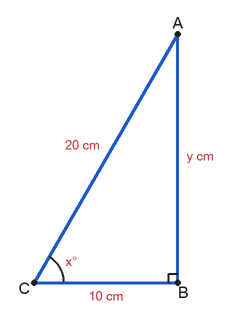
    From the given figure, find :

    (i) cos x°

    (ii) x°

    (iii) 1tan⁡2x°−1sin⁡2x°\dfrac{1}{\tan^2 x°} - \dfrac{1}{\sin^2 x°}

    (iv) Use tan x°, to find the value of y.
    Class 9 Maths Trigonometrical Ratios of Standard Angles

    Easy
    3 marks
  46. 46

    Question 46

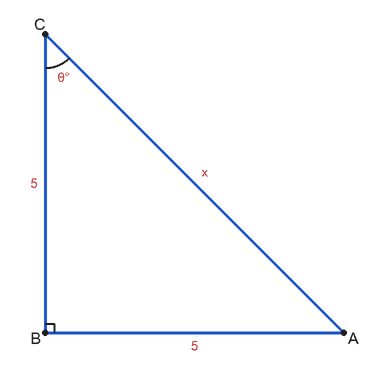
    Use the given figure to find :

    (i) tan θ° (ii) θ°

    (iii) sin⁡2θ°−cos⁡2θ°\sin^2 \theta° - \cos^2 \theta°

    (iv) Use sin θ° to find the value of x.
    Class 9 Maths Trigonometrical Ratios of Standard Angles

    Easy
    3 marks
  47. 47

    Question 47

    Find the magnitude of angle A, if :

    (i) 2 sin A cos A – cos A – 2 sin A + 1 = 0

    (ii) tan A–2 cos A tan A + 2 cos A – 1 = 0

    (iii) 2cos⁡2A−3cos⁡A+1=02\cos^2 A - 3\cos A + 1 = 0

    (iv) 2 tan 3A cos 3A – tan 3A + 1 = 2 cos 3A

    Medium
    3 marks
  48. 48

    Question 48

    Solve for x :

    (i) 2 cos 3x – 1 = 0

    (ii) cos⁡x3−1=0\cos \dfrac{x}{3} - 1 = 0

    (iii) sin⁡(x+10°)=12\sin(x + 10°) = \dfrac{1}{2}

    (iv) cos (2x – 30°) = 0

    (v) 2 cos (3x – 15°) = 1

    (vi) tan⁡2(x−5°)=3\tan^2(x - 5°) = 3

    (vii) 3tan⁡2(2x−20°)=13\tan^2(2x - 20°) = 1

    (viii) cos⁡(x2+10°)=32\cos\left(\dfrac{x}{2} + 10°\right) = \dfrac{\sqrt{3}}{2}

    (ix) sin⁡2x+sin⁡230°=1\sin^2 x + \sin^2 30° = 1

    (x) cos⁡230°+cos⁡2x=1\cos^2 30° + \cos^2 x = 1

    (xi) cos⁡230°+sin⁡22x=1\cos^2 30° + \sin^2 2x = 1

    (xii) sin⁡260°+cos⁡2(3x−9°)=1\sin^2 60° + \cos^2(3x - 9°) = 1

    Easy
    3 marks
  49. 49

    Question 49

    If 4cos⁡2x=34\cos^2 x = 3 and x is an acute angle; find the value of :

    (i) x (ii) cos⁡2x+cot⁡2x\cos^2 x + \cot^2 x

    (iii) cos 3x (iv) sin 2x

    Easy
    3 marks
  50. 50

    Question 50

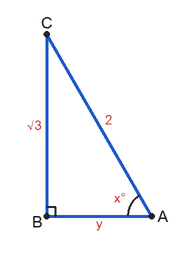
    In Δ ABC, ∠B = 90°, AB = y units, BC = 3\sqrt{3} units, AC = 2 units and angle A = x°, find :
    Class 9 Maths Trigonometrical Ratios of Standard Angles

    (i) sin x° (ii) x° (iii) tan x°

    (iv) use cos x° to find the value of y.

    Easy
    3 marks
  51. 51

    Question 51

    If 2 cos (A + B) = 2 sin (A – B) = 1; find the values of A and B.

    Easy
    3 marks
Inside Ch 23

What Class 9 Maths Ch 23 covers

The sections of the chapter, in the order the book takes them. Every question above comes from one of these.

  1. 01Trigonometrical Ratios of Angles 30° and 60°
  2. 02Trigonometrical Ratios of Angle 45°
  3. 03Solving a Trigonometric Equation
Common questions

Class 9 Maths Ch 23 questions students ask

How many questions are there in Class 9 Maths Ch 23?

51 questions. Every one is solved step by step on this page.

Are these Class 9 Maths solutions free?

Yes. Every question and its full working is free to read, with no account needed.

Can I download the Class 9 Maths Ch 23 solutions as a PDF?

There is no PDF to download. Every solution is on this page instead, which means it is searchable, always the current syllabus, and readable on a phone. Use your browser's print option if you want it on paper.