Solution:
Concept: Cartilage has cells in fluid-filled spaces (lacunae) scattered in a firm, non-porous matrix; bone has its cells arranged in rings round a central canal, with hard concentric layers (lamellae) of matrix.
Step 1 — (a) Identify A and B.
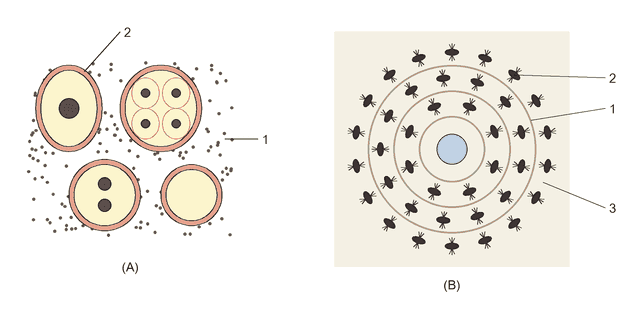
A is cartilage: cells, singly or in small groups, lie in capsules in a plain matrix. B is bone: concentric rings of matrix with bone cells between them surround a central canal.
Step 2 — (b) Label the guidelines.
In A: 1 the matrix; 2 a cartilage cell (in its capsule, the lacuna). In B: 1 the concentric lamellae; 2 a bone cell; 3 the matrix.
Step 3 — (c) One common function.
Both are supporting connective tissues: they give support and shape to the body.
Step 4 — (d) One functional difference.
Bone is hard and rigid; it forms the skeleton that bears the body's weight. Cartilage is flexible and elastic, so it allows bending, as in the ear.
Step 5 — (e) One location of each.
A, cartilage: the tip of the nose or the external ear. B, bone: the thigh bone (femur) or the skull.
Therefore, (a) A cartilage, B bone; (b) A: 1 matrix, 2 cartilage cell; B: 1 concentric lamellae, 2 bone cell, 3 matrix; (c) both support the body; (d) bone is rigid, cartilage flexible; (e) nose tip and femur.