Solution:
Concept: Phloem is the food-conducting tissue: wide sieve tubes joined end to end through perforated sieve plates, each with a narrow companion cell, and phloem parenchyma around them.
Step 1 — (a) Identify the tissue.
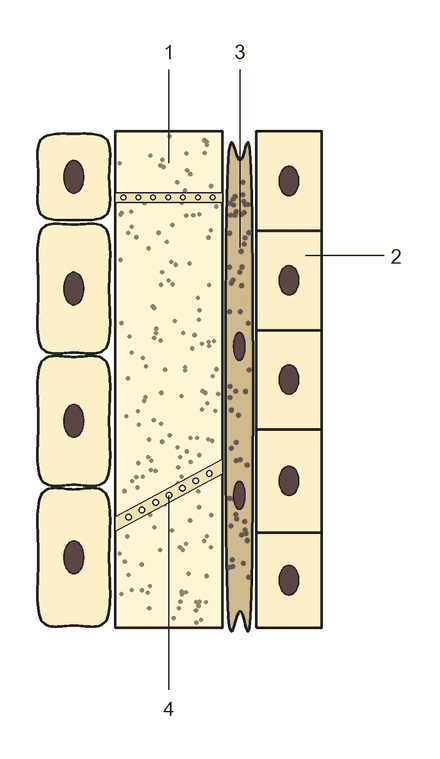
It is phloem, seen in longitudinal section. The reason is that it shows sieve tubes with perforated sieve plates and narrow companion cells beside them, which are found only in phloem.
Step 2 — (b) Name the parts.
Reading the labels: 1 is the sieve tube, 2 a phloem parenchyma cell, 3 the companion cell, and 4 the sieve plate.
Step 3 — (c) Where it is found.
Phloem lies in the vascular bundles of stems and roots and in the veins of leaves.
Step 4 — (d) Functions of the parts.
Each part has its own job:
- 1, sieve tube: conducts food from the leaves to the storage organs and other parts;
- 2, phloem parenchyma: stores food such as starch and fats;
- 3, companion cell: a living cell with a nucleus that controls and supports the working of the sieve tube (the mature sieve tube has no nucleus);
- 4, sieve plate: its pores let food pass from one sieve-tube cell to the next.
Watch out: Phloem moves food both up and down the plant; it is xylem that carries water only upwards.
Therefore, (a) phloem (sieve tubes with sieve plates and companion cells); (b) 1 sieve tube, 2 phloem parenchyma, 3 companion cell, 4 sieve plate; (c) vascular bundles and leaf veins; (d) as listed.