
Question 333 marksMedium
Find x in the following cases :
(i)
(ii)
(iii)
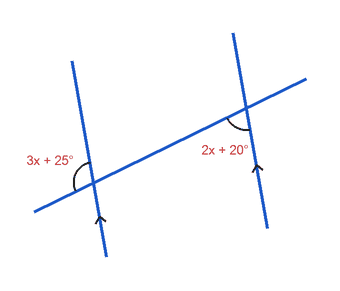
(iv)
(v)
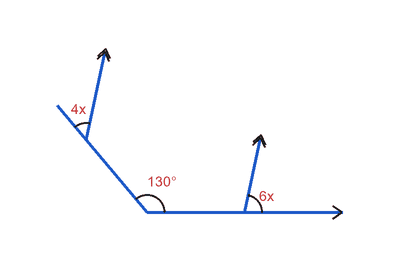
(vi)
Confirming your payment
Sign up now and get 250 free tokens.
Lines and Angles · Question 33 of 48
Find x in the following cases :
(i)
(ii)
(iii)
(iv)
(v)
(vi)
Solution:
Concept: When a transversal cuts two parallel lines, corresponding angles are equal, alternate angles (interior or exterior) are equal, and co-interior (allied) angles add up to 180°. When two straight lines cross, the vertically opposite angles (the angles facing each other) are equal. When a bend lies between two parallel lines, we draw a third line through the bend, parallel to them. The angle at the bend then splits into two parts, and each part is found from the parallel lines.
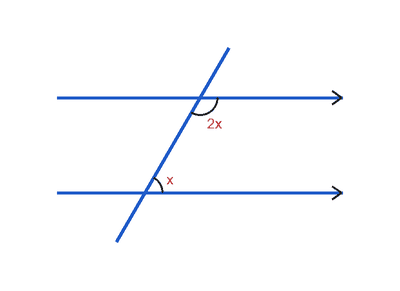
Step 1 — Figure (i).
2x and x lie between the parallel lines on the same side of the transversal, so they are co-interior.
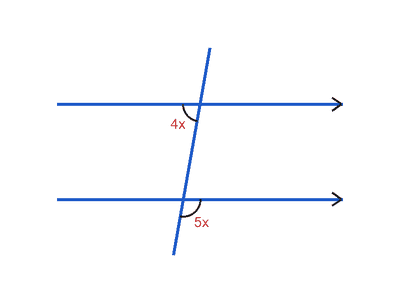
Step 2 — Figure (ii).
The angle facing 5x is also 5x (vertically opposite angles), and it is co-interior with 4x.
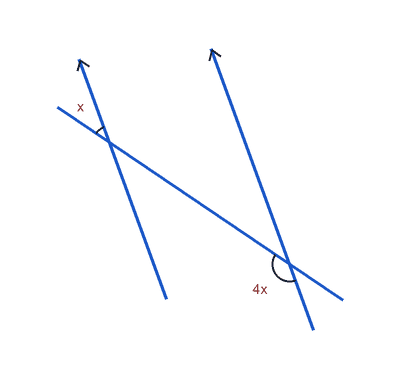
Step 3 — Figure (iii).
The angle facing x is also x (vertically opposite angles); it lies between the parallel lines on the same side of the transversal as 4x, so the two are co-interior.
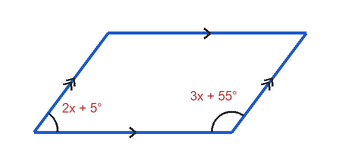
Step 4 — Figure (iv).
The bottom side cuts the two parallel slanting sides, so the angles at its two ends are co-interior.
Step 5 — Figure (v).
The angle facing (3x + 25°) has the same size, and it is co-interior with (2x + 20°).
Step 6 — Figure (vi).
Through the vertex of the 130° angle we draw a line parallel to the two directed rays. It splits 130° into two parts: the part next to the horizontal line equals 6x and the part next to the slanting line equals 4x (corresponding angles).
Watch out: Co-interior angles add up to 180°; they are not equal (unless both are 90°).
Therefore, (i) x = 60°; (ii) x = 20°; (iii) x = 36°; (iv) x = 24°; (v) x = 27°; (vi) x = 13°.