
Question 283 marksEasy
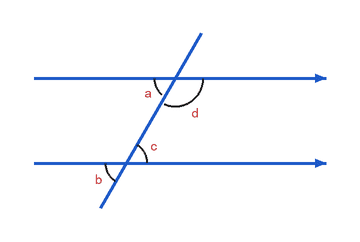
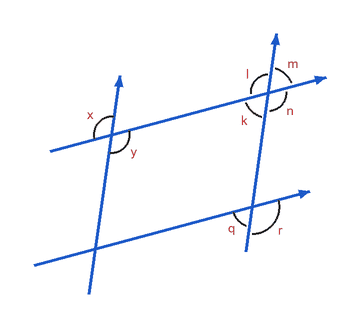
In the following figures, the arrows indicate parallel lines. State which angles are equal. Give reasons.
(i)
(ii)
Confirming your payment
Sign up now and get 250 free tokens.
Lines and Angles · Question 28 of 48
In the following figures, the arrows indicate parallel lines. State which angles are equal. Give reasons.
(i)
(ii)
Solution:
Concept: When a transversal cuts two parallel lines, corresponding angles are equal, alternate angles (interior or exterior) are equal, and co-interior (allied) angles add up to 180°. When two straight lines cross, the vertically opposite angles (the angles facing each other) are equal.
Step 1 — Figure (i).
The two horizontal lines are parallel. ∠a and ∠c lie between them on opposite sides of the transversal, so ∠a = ∠c (alternate angles). ∠c and ∠b face each other at the lower point, so ∠c = ∠b (vertically opposite angles). ∠d is not equal to them: it forms a linear pair with ∠a.
Step 2 — Figure (ii).
Both pairs of lines are parallel. We link the angles one pair at a time.
∠x and ∠y face each other at the left point, so they are equal (vertically opposite angles).
∠y and ∠l lie between the two steep parallel lines, on opposite sides of the upper sloping line, so they are equal (alternate angles).
∠l and ∠n face each other at the upper right point, so they are equal (vertically opposite angles).
∠n and ∠r sit in the same position where the right-hand steep line cuts the two sloping parallel lines, so they are equal (corresponding angles).
Step 3 — Figure (ii): the other angles.
The angles ∠k and ∠m face each other, so they are equal (vertically opposite angles). ∠k and ∠q sit in the same position on the right-hand steep line, so they are equal too (corresponding angles).
Watch out: The angle ∠d forms a linear pair with ∠a, so it could equal ∠a only if both were 90°; here it does not.
Therefore, (i) ∠a, ∠b and ∠c are equal; (ii) ∠x, ∠y, ∠l, ∠n and ∠r are equal, and ∠k, ∠m and ∠q are equal.