
Opening your dashboard
Class 7 Chemistry Chapter 6: Metals and Non-metals Solutions
34 textbook questions with step-by-step answers, free to read, for ICSE 2026-27.
Get talked through Ch 6, not just shown the answer
Reading a finished solution is not the same as being able to do it. The AI tutor takes one question at a time and works it with you, in your own words, until you can.
- Ask it out loud, in your own words
- It gives you the next step, not the answer
- Stuck on part (ii)? Start there
34 questions with solutions
1–5 marks · Mixed difficulty
- 11 mark
Question 1
Which is the second most abundant metal in the earth's crust ?
Solve with AIWritten solution
Solution:
Concept: By mass, the earth's crust is about 46.6 % oxygen, 27.7 % silicon, 8.1 % aluminium, 5.0 % iron, 3.6 % calcium, 2.8 % sodium, 2.6 % potassium and 2.1 % magnesium. Oxygen and silicon are not metals, so the metals in this list start with aluminium.
Step 1 — Pick out the metals in order.
Leaving out oxygen (a non-metal) and silicon (a metalloid), the metals in order are aluminium (8.1 %), iron (5.0 %), calcium (3.6 %) and so on.
Step 2 — Name the second one.
Aluminium is the most abundant metal, so the second most abundant metal is iron.
Watch out: The question asks for the second METAL, not the second element (which is silicon).
Therefore, the second most abundant metal in the earth's crust is iron.
- 21 mark
Question 2
Which is the second most abundant element in the earth's crust ?
Solve with AIWritten solution
Solution:
Concept: By mass, the earth's crust is about 46.6 % oxygen, 27.7 % silicon, 8.1 % aluminium, 5.0 % iron, 3.6 % calcium, 2.8 % sodium, 2.6 % potassium and 2.1 % magnesium. Here every element is counted, metal or not.
Step 1 — Put the elements in order.
Oxygen (46.6 %) comes first and silicon (27.7 %) second, far ahead of aluminium (8.1 %).
Step 2 — Name the second one.
So the second most abundant element is silicon, a metalloid found mostly as silica (sand) and silicates in rocks.
Watch out: Aluminium is the most abundant METAL, but as an element it comes only third.
Therefore, the second most abundant element in the earth's crust is silicon.
- 31 mark
Question 3
Which are the gaseous non-metals present in free state in air ?
Solve with AIWritten solution
Solution:
Concept: An element is in the free state when it is present as the element itself, not combined with other elements. By volume, dry air is about 78.08 % nitrogen, 20.95 % oxygen and 0.93 % argon, with traces of other gases.
Step 1 — Find the free non-metals.
Nitrogen and oxygen are present in air as free molecules ( and ). The noble gases, chiefly argon, with small amounts of neon, helium, krypton and xenon, are also present free.
Step 2 — Leave out the combined ones.
Carbon in carbon dioxide and hydrogen in water vapour are in the combined state, so they do not count.
Watch out: Carbon dioxide and water vapour are compounds; only uncombined elements are in the free state.
Therefore, nitrogen and oxygen are the main gaseous non-metals present free in air, along with argon and the other noble gases.
- 41 mark
Question 4
The most abundant metal present in the earth's crust is :
Solve with AIAnswer
(A) Iron
(B) Calcium
- Correct
(C) Aluminium
(D) Potassium
Answer: (C) Aluminium
Concept: By mass, the earth's crust is about 46.6 % oxygen, 27.7 % silicon, 8.1 % aluminium, 5.0 % iron, 3.6 % calcium, 2.8 % sodium, 2.6 % potassium and 2.1 % magnesium.
Step 1 — Leave out the non-metals.
Oxygen and silicon are the two most abundant elements, but neither is a metal.
Step 2 — Pick the first metal.
The next element, aluminium (about 8.1 %), is therefore the most abundant metal.
Why the other options are wrong:
- (A) Iron: This is the second most abundant metal (about 5.0 %), not the first.
- (B) Calcium: This makes up only about 3.6 % of the crust, less than aluminium.
- (D) Potassium: This makes up only about 2.6 % of the crust, less than aluminium.
Therefore, the most abundant metal in the earth's crust is aluminium, option (C).
- 51 mark
Question 5
The most abundant non-metal present in earth's crust is :
Solve with AIAnswer
- Correct
(A) Oxygen
(B) Nitrogen
(C) Carbon
(D) Hydrogen
Answer: (A) Oxygen
Concept: By mass, the earth's crust is about 46.6 % oxygen, 27.7 % silicon, 8.1 % aluminium, 5.0 % iron, 3.6 % calcium, 2.8 % sodium, 2.6 % potassium and 2.1 % magnesium.
Step 1 — Find the top element.
Oxygen, about 46.6 % of the crust by mass, is the most abundant of all elements. It is present combined, in rocks, sand (silica) and water.
Step 2 — Check that it is a non-metal.
Oxygen is a non-metal, so it is the most abundant non-metal in the crust.
Watch out: Nitrogen is the most abundant gas in AIR, but the question is about the earth's crust.
Why the other options are wrong:
- (B) Nitrogen: This is plentiful in air but makes up only a tiny fraction of the crust.
- (C) Carbon: This is present in the crust only in small amounts, in coal, carbonates and living matter.
- (D) Hydrogen: This is present in the crust only in small amounts, mainly combined in water and minerals.
Therefore, the most abundant non-metal in the earth's crust is oxygen, option (A).
- 61 mark
Question 6
A metal found in a free state is :
Solve with AIAnswer
(A) Copper
(B) Zinc
(C) Sodium
- Correct
(D) Gold
Answer: (D) Gold
Concept: A metal that is not reactive does not combine easily with oxygen, water or other substances, so it can be found in nature in the free (native) state.
Step 1 — Compare the reactivities.
Sodium and zinc are reactive metals; copper is less reactive; gold is one of the least reactive metals.
Step 2 — Pick the metal found free.
Gold is found almost entirely in the free state, as grains and nuggets.
Why the other options are wrong:
- (A) Copper: This is found free only now and then; most copper is mined from its compounds (ores), so gold is the better answer.
- (B) Zinc: This is a reactive metal and is always found combined, for example as zinc blende.
- (C) Sodium: This is a very reactive metal and is never found free; it occurs in compounds such as common salt.
Therefore, a metal found in a free state is gold, option (D).
- 71 mark
Question 7
A non-metal occurring in the solid state is:
Solve with AIAnswer
(A) Bromine
- Correct
(B) Phosphorus
(C) Chlorine
(D) Nitrogen
Answer: (B) Phosphorus
Concept: Non-metals occur in all three states at room temperature: some are gases (nitrogen, oxygen, chlorine), one is a liquid (bromine) and some are solids (carbon, sulphur, phosphorus, iodine).
Step 1 — Find the state of each option.
Bromine is a liquid; chlorine and nitrogen are gases; phosphorus is a solid.
Step 2 — Pick the solid.
So the solid non-metal is phosphorus.
Why the other options are wrong:
- (A) Bromine: This is the only non-metal that is a liquid at room temperature.
- (C) Chlorine: This is a greenish-yellow gas at room temperature.
- (D) Nitrogen: This is a colourless gas at room temperature.
Therefore, a non-metal occurring in the solid state is phosphorus, option (B).
- 81 mark
Question 8
Which of the following metals exists as a liquid under normal conditions ?
Solve with AIAnswer
- Correct
(A) Mercury
(B) Bromine
(C) Magnesium
(D) Lithium
Answer: (A) Mercury
Concept: Almost all metals are solids at normal room temperature (about 25 °C). Mercury is the only metal that is a liquid; it melts at about −39 °C.
Step 1 — Keep only the metals.
Bromine is a non-metal, so it is left out. Mercury, magnesium and lithium are metals.
Step 2 — Pick the liquid metal.
Magnesium and lithium are solids, so the liquid metal is mercury.
Watch out: Bromine is also a liquid, but it is a non-metal.
Why the other options are wrong:
- (B) Bromine: This is a liquid, but it is a non-metal, not a metal.
- (C) Magnesium: This is a solid metal at room temperature.
- (D) Lithium: This is a solid (soft) metal at room temperature.
Therefore, the metal that exists as a liquid under normal conditions is mercury, option (A).
- 91 mark
Question 9
A metal with melting point less than 50°C is :
Solve with AIAnswer
- Correct
(A) Gallium
(B) Iron
(C) Gold
(D) Aluminium
Answer: (A) Gallium
Concept: Most metals have high melting points. Gallium is an exception: it melts at about 30 °C, so it melts even when held in the hand.
Step 1 — Compare the melting points.
Gallium melts at about 30 °C, aluminium at about 660 °C, gold at about 1064 °C and iron at about 1538 °C.
Step 2 — Pick the one below 50 °C.
Only gallium melts below 50 °C.
Why the other options are wrong:
- (B) Iron: This melts at about 1538 °C, far above 50 °C.
- (C) Gold: This melts at about 1064 °C, far above 50 °C.
- (D) Aluminium: This melts at about 660 °C, far above 50 °C.
Therefore, the metal with a melting point less than 50 °C is gallium, option (A).
- 101 mark
Question 10
A metal which is neither ductile nor malleable is :
Solve with AIAnswer
(A) Copper
(B) Silver
- Correct
(C) Zinc
(D) Aluminium
Answer: (C) Zinc
Concept: Malleable means it can be beaten into thin sheets; ductile means it can be drawn into wires. Most metals are both, but zinc is brittle at room temperature.
Step 1 — Check each metal.
Copper, silver and aluminium are all malleable and ductile. Zinc breaks into pieces when beaten at room temperature.
Step 2 — Pick the exception.
So the metal that is neither ductile nor malleable (at room temperature) is zinc.
Watch out: Zinc becomes malleable and ductile when warmed to about 100–150 °C, which is how zinc sheets are rolled; the answer holds at room temperature.
Why the other options are wrong:
- (A) Copper: This is highly ductile and malleable, which is why it is drawn into electric wires.
- (B) Silver: This is one of the most malleable and ductile metals.
- (D) Aluminium: This is malleable and ductile; it is rolled into foil and drawn into wires.
Therefore, the metal which is neither ductile nor malleable is zinc, option (C).
- 111 mark
Question 11
The colour of rust which is a hydrated oxide of iron is :
Solve with AIAnswer
- Correct
(A) Reddish-brown
(B) Green
(C) White
(D) Black
Answer: (A) Reddish-brown
Concept: Rust is hydrated iron(III) oxide, . It forms as a flaky layer when iron is exposed to air and moisture.
Step 1 — Recall what rust looks like.
Rust on iron gates, nails and old tools is a reddish-brown flaky coating.
Step 2 — Match with the options.
So the colour of rust is reddish-brown.
Why the other options are wrong:
- (B) Green: This is the colour of the coating on copper (basic copper carbonate), not of rust.
- (C) White: This is the colour of the coating that forms on zinc, not of rust.
- (D) Black: This is the colour of the tarnish on silver (silver sulphide), not of rust.
Therefore, the colour of rust is reddish-brown, option (A).
- 121 mark
Question 12
Aluminium is not used to make :
Solve with AIAnswer
(A) Foils
(B) Wires
- Correct
(C) Fireworks
(D) Utensils
Answer: (C) Fireworks
Concept: Aluminium is light, malleable, ductile and a good conductor, so its everyday uses are foils, wires (cables) and utensils. The metal the chapter names for fireworks is magnesium, which burns with a dazzling white light.
Step 1 — Check the three everyday uses.
Aluminium is rolled into foils (it is malleable), drawn into wires (ductile, good conductor) and made into utensils (light, good conductor of heat).
Step 2 — Pick the odd one.
Fireworks are not among the uses of aluminium given in the chapter, so the intended answer is fireworks.
Note: Fine aluminium powder is in fact used in many fireworks and sparklers for bright white sparks. So aluminium is used in fireworks too; (C) is kept because foils, wires and utensils are its main uses taught here.
Why the other options are wrong:
- (A) Foils: This is a common use: aluminium foil is used to wrap food.
- (B) Wires: This is a common use: aluminium wires are used in overhead power cables.
- (D) Utensils: This is a common use: many cooking pots are made of aluminium.
Therefore, the intended answer is fireworks, option (C).
- 131 mark
Question 13
A metalloid used in the manufacture of computer microchips is :
Solve with AIAnswer
(A) Antimony
(B) Germanium
- Correct
(C) Silicon
(D) Arsenic
Answer: (C) Silicon
Concept: Metalloids have some properties of metals and some of non-metals. Several are semiconductors, and very pure silicon is the material from which computer microchips are made.
Step 1 — Recall the use of each metalloid.
Silicon is the base material of microchips, transistors and solar cells. Germanium is also a semiconductor, but it is used far less.
Step 2 — Pick the microchip material.
So the metalloid used to make computer microchips is silicon.
Why the other options are wrong:
- (A) Antimony: This is used mainly to harden lead (for example in battery plates), not to make microchips.
- (B) Germanium: This is a semiconductor used in some transistors and infrared devices, but microchips are made of silicon.
- (D) Arsenic: This is added only in tiny amounts to silicon to change how it conducts; it is not the chip material.
Therefore, the metalloid used in computer microchips is silicon, option (C).
- 141 mark
Question 14
A metalloid used to make glass is :
Solve with AIAnswer
(A) Sulphur
(B) Germanium
- Correct
(C) Silicon
(D) Antimony
Answer: (C) Silicon
Concept: Glass is made mainly from sand, which is silicon dioxide (silica, ), melted with soda and limestone.
Step 1 — Find the element in sand.
Sand is an oxide of silicon, a metalloid.
Step 2 — Pick the metalloid.
So the metalloid used to make glass is silicon (as sand).
Why the other options are wrong:
- (A) Sulphur: This is a non-metal, not a metalloid, and it is not a raw material of glass.
- (B) Germanium: This is a semiconductor metalloid, not a raw material of ordinary glass.
- (D) Antimony: This is added (as its oxide) to some glass only in small amounts; glass is made mainly from silica.
Therefore, the metalloid used to make glass is silicon, option (C).
- 151 mark
Question 15
Assertion (A) : Most of the metals can be beaten into sheets without breaking.
Reason (R) : Most of the metals are malleable.
Solve with AIAnswer
- Correct
(A) Both A and R are true and R is the correct explanation of A.
(B) Both A and R are true but R is not the correct explanation of A.
(C) A is true but R is false.
(D) A is false but R is true.
Answer: (A) Both A and R are true and R is the correct explanation of A.
Concept: Judge the Assertion (A) first, then the Reason (R), and only then decide whether R explains A. Malleability is the property of being beaten into thin sheets without breaking.
Step 1 — Judge the Assertion.
Most metals, such as gold, silver, copper and aluminium, can be beaten into thin sheets. So A is true.
Step 2 — Judge the Reason.
Most metals are malleable (zinc at room temperature is an exception). So R is true.
Step 3 — Decide whether R explains A.
Being malleable means exactly being able to be beaten into sheets, so R correctly explains A.
Why the other options are wrong:
- (B): This says R does not explain A, but malleability is exactly the property described in A.
- (C): This says R is false, but most metals are malleable.
- (D): This says A is false, but most metals can be beaten into sheets.
Therefore, both A and R are true and R is the correct explanation of A, option (A).
- 161 mark
Question 16
Assertion (A) : Mercury is used as a thermometric liquid.
Reason (R) : Mercury can expand and contract only at high temperatures.
Solve with AIAnswer
(A) Both A and R are true and R is the correct explanation of A.
(B) Both A and R are true but R is not the correct explanation of A.
- Correct
(C) A is true but R is false.
(D) A is false but R is true.
Answer: (C) A is true but R is false.
Concept: Judge the Assertion (A) first, then the Reason (R), and only then decide whether R explains A. A good thermometric liquid must expand and contract evenly over the whole range of temperatures to be measured.
Step 1 — Judge the Assertion.
Mercury has long been used in thermometers: it is a liquid from about −39 °C to 357 °C, it is shiny and easy to see, it does not wet the glass, and it expands evenly. So A is true.
Step 2 — Judge the Reason.
R says mercury expands and contracts only at high temperatures. In fact it expands and contracts at all temperatures in its liquid range, including room and body temperature. So R is false.
Step 3 — Decide.
A true assertion with a false reason fits "A is true but R is false".
Watch out: The word "only" is what makes R false.
Note: Because mercury is poisonous, mercury thermometers are now being phased out under the Minamata Convention; digital and alcohol thermometers are used instead.
Why the other options are wrong:
- (A): This needs R to be true, but R is false.
- (B): This also needs R to be true, which it is not.
- (D): This says A is false, but mercury is used as a thermometric liquid.
Therefore, A is true but R is false, option (C).
- 171 mark
Question 17
Assertion (A) : Non-metals have low melting and boiling points.
Reason (R) : Diamond and graphite are lustrous solids.
Solve with AIAnswer
(A) Both A and R are true and R is the correct explanation of A.
- Correct
(B) Both A and R are true but R is not the correct explanation of A.
(C) A is true but R is false.
(D) A is false but R is true.
Answer: (B) Both A and R are true but R is not the correct explanation of A.
Concept: Judge the Assertion (A) first, then the Reason (R), and only then decide whether R explains A.
Step 1 — Judge the Assertion.
Most non-metals, such as oxygen, nitrogen, sulphur and phosphorus, have low melting and boiling points. So A is true as a general rule (diamond and graphite are exceptions).
Step 2 — Judge the Reason.
Diamond and graphite, two forms of carbon, are lustrous (shiny) solids, unlike most non-metals, which are dull. So R is true.
Step 3 — Decide whether R explains A.
R is about lustre, while A is about melting and boiling points. The shine of diamond and graphite has nothing to do with why non-metals melt and boil easily, so R does not explain A.
Why the other options are wrong:
- (A): This says R explains A, but lustre has no link with melting and boiling points.
- (C): This says R is false, but diamond and graphite really are lustrous.
- (D): This says A is false, but most non-metals do have low melting and boiling points.
Therefore, both A and R are true but R is not the correct explanation of A, option (B).
- 181 mark
Question 18
Assertion (A) : The second most abundant non-metal in the earth's crust is silicon in the form of sand.
Reason (R) : A compound of silicon called silicon carbide is the hardest substance prepared by man.
Solve with AIAnswer
(A) Both A and R are true and R is the correct explanation of A.
- Correct
(B) Both A and R are true but R is not the correct explanation of A.
(C) A is true but R is false.
(D) A is false but R is true.
Answer: (B) Both A and R are true but R is not the correct explanation of A.
Concept: Judge the Assertion (A) first, then the Reason (R), and only then decide whether R explains A. By mass, the earth's crust is about 46.6 % oxygen, 27.7 % silicon, 8.1 % aluminium, 5.0 % iron, 3.6 % calcium, 2.8 % sodium, 2.6 % potassium and 2.1 % magnesium.
Step 1 — Judge the Assertion.
Silicon (27.7 %) is second only to oxygen in the crust, and it occurs as sand (silica, ). In the sense of the book, which counts it here among the non-metals, A is true.
Step 2 — Judge the Reason.
Silicon carbide (carborundum) is an extremely hard man-made compound, used for grinding and cutting. The book takes R as true.
Step 3 — Decide whether R explains A.
The hardness of silicon carbide says nothing about how much silicon there is in the crust, so R does not explain A.
Note: Strictly, silicon is a metalloid, and silicon carbide is no longer the hardest substance made by people: synthetic diamond and cubic boron nitride are harder. On those strict readings A and R are both doubtful; the printed answer (B) is kept because the two statements are unrelated either way.
Why the other options are wrong:
- (A): This says R explains A, but hardness has no link with abundance.
- (C): This says R is false; as the book intends it, R is taken as true.
- (D): This says A is false; in the book's sense silicon is the second most abundant non-metal.
Therefore, both A and R are true but R is not the correct explanation of A, option (B).
- 191 mark
Question 19
Assertion (A) : Helium is used for filling up weather observation balloons.
Reason (R) : The inert gas helium is the second lightest element known to humans.
Solve with AIAnswer
- Correct
(A) Both A and R are true and R is the correct explanation of A.
(B) Both A and R are true but R is not the correct explanation of A.
(C) A is true but R is false.
(D) A is false but R is true.
Answer: (A) Both A and R are true and R is the correct explanation of A.
Concept: Judge the Assertion (A) first, then the Reason (R), and only then decide whether R explains A. A balloon rises when the gas inside it is much lighter (less dense) than air.
Step 1 — Judge the Assertion.
Weather observation balloons are filled with helium. So A is true.
Step 2 — Judge the Reason.
Helium is an inert (noble) gas and, after hydrogen, the second lightest element. So R is true.
Step 3 — Decide whether R explains A.
Because helium is so light (about one-seventh as dense as air), a balloon filled with it rises. Being inert, it also cannot catch fire. So R explains A.
Watch out: Hydrogen is lighter still, but it burns easily; helium is chosen because it is light AND does not burn.
Note: Some weather services still fill their balloons with hydrogen, which is cheaper, with strict safety rules.
Why the other options are wrong:
- (B): This says R does not explain A, but helium's lightness is exactly why the balloon rises.
- (C): This says R is false, but helium really is the second lightest element.
- (D): This says A is false, but helium is used in weather balloons.
Therefore, both A and R are true and R is the correct explanation of A, option (A).
- 205 marks
Question 20
Fill in the blanks :
(a) The most ductile metal is ________ .
(b) A metal stored in kerosene oil is ________
(c) Tungsten metal is a good conductor of ________ .
(d) ________ is a soft metal.
(e) ________ is the hardest compound known to us.
(f) A non-metal used to purify water is ________ .
(g) A metal that gives dazzling effect to crackers when they explode is ________
(h) A chemical compound that makes up the striking heads of match sticks is ________ .
Solve with AIWritten solution
Solution:
Concept: Each blank is a special property or use of a metal or non-metal named in this chapter.
Step 1 — (a) Most ductile metal.
Gold can be drawn into the finest wires of all metals, so the most ductile metal is gold.
Step 2 — (b) Metal kept in kerosene.
Sodium (or potassium) reacts quickly with air and water, so it is stored under kerosene oil.
Step 3 — (c) Tungsten conducts.
Tungsten metal is a good conductor of electricity (and of heat), which is why it is used as a lamp filament.
Step 4 — (d) A soft metal.
Sodium (or potassium) is soft enough to be cut with a knife.
Step 5 — (e) Hardest compound.
The chapter names silicon carbide (carborundum) as the hardest compound.
Step 6 — (f) Non-metal that purifies water.
Chlorine kills germs in drinking water.
Step 7 — (g) Metal for dazzling crackers.
Magnesium burns with a dazzling white light.
Step 8 — (h) Compound in match heads.
The chapter's answer is phosphorus sulphide, used in the heads of "strike-anywhere" matches.
Watch out: In (c), tungsten is not a poor conductor; it glows in a bulb because of its very high melting point, not because it resists current more than other metals.
Note: In (e), cubic boron nitride, also made by people, is now known to be harder than silicon carbide. In (h), the heads of ordinary safety matches contain antimony sulphide and potassium chlorate, and the red phosphorus is on the side of the box.
Therefore, (a) gold, (b) sodium, (c) electricity, (d) sodium, (e) silicon carbide, (f) chlorine, (g) magnesium, (h) phosphorus sulphide.
- 215 marks
Question 21
Write 'true' or 'false' for the following statements :
(a) Silver is used to make electric cables.
(b) Iodine acts as an antiseptic in the form of tincture of iodine.
(c) Sodium can be cut with a knife.
(d) Antimony is a metal.
(e) Sand is an oxide of silicon.
Solve with AIWritten solution
Solution:
Concept: Check each statement against the properties and uses of the element named.
Step 1 — (a) Silver in electric cables.
This is false. Silver is the best conductor, but it is far too costly; cables are made of copper or aluminium.
Step 2 — (b) Tincture of iodine.
This is true. Iodine dissolved in alcohol (tincture of iodine) is used as an antiseptic on minor cuts.
Step 3 — (c) Cutting sodium.
This is true. Sodium is a soft metal and can be cut with a knife.
Step 4 — (d) Antimony.
This is false. Antimony is a metalloid, not a metal.
Step 5 — (e) Sand.
This is true. Sand is silicon dioxide, , an oxide of silicon.
Watch out: A property alone (silver conducts best) does not decide a use; cost matters too.
Therefore, (a) false, (b) true, (c) true, (d) false, (e) true.
- 225 marks
Question 22
Match the following :
Column A Column B (a) Helium (1) Electric bulb (b) Neon (2) Thermometer (c) Argon (3) Semiconductor (d) Germanium (4) Weather observation balloons (e) Mercury (5) Advertising signboards Solve with AIWritten solution
Solution:
Concept: Each element is used because of one special property.
Step 1 — (a) Helium.
Helium is very light and does not burn, so (a) matches (4) Weather observation balloons.
Step 2 — (b) Neon.
Neon glows with a bright orange-red light when electricity is passed through it at low pressure, so (b) matches (5) Advertising signboards.
Step 3 — (c) Argon.
Argon is unreactive and stops the hot filament from burning away, so (c) matches (1) Electric bulb.
Step 4 — (d) Germanium.
Germanium is a metalloid that conducts electricity partly, so (d) matches (3) Semiconductor.
Step 5 — (e) Mercury.
Mercury is a liquid metal that expands evenly on heating, so (e) matches (2) Thermometer.
Note: Mercury thermometers are now being phased out because mercury is poisonous.
Therefore, (a) matches (4), (b) matches (5), (c) matches (1), (d) matches (3) and (e) matches (2).
- 235 marks
Question 23
Name a metal which is :
(a) the most malleable,
(b) brittle,
(c) as precious as gold,
(d) easily cut with a knife,
(e) used in making electric cables,
(f) used as a thermometric liquid,
(g) the best conductor of electricity.
Solve with AIWritten solution
Solution:
Concept: Each part asks for a metal with a special property or use described in the chapter.
Step 1 — (a) The most malleable.
Gold can be beaten into the thinnest sheets (gold leaf).
Step 2 — (b) Brittle.
Zinc breaks into pieces when beaten at room temperature.
Step 3 — (c) As precious as gold.
Platinum is a rare, costly metal used in jewellery.
Step 4 — (d) Easily cut with a knife.
Sodium (or potassium) is soft enough to cut with a knife.
Step 5 — (e) Used in electric cables.
Copper (or aluminium) is a very good conductor and is ductile.
Step 6 — (f) Used as a thermometric liquid.
Mercury is a liquid metal that expands evenly on heating.
Step 7 — (g) The best conductor of electricity.
Silver conducts electricity better than any other metal.
Therefore, (a) gold, (b) zinc, (c) platinum, (d) sodium, (e) copper, (f) mercury, (g) silver.
- 245 marks
Question 24
Name a non-metal which is :
(a) a good conductor of heat and electricity,
(b) the hardest naturally occurring substance,
(c) used to kill germs in water,
(d) lustrous,
(e) used for filling into electric bulbs,
(f) used for cancer therapy,
(g) liquid at room temperature.
Solve with AIWritten solution
Solution:
Concept: Most non-metals are dull, brittle and poor conductors, but there are exceptions. Noble (inert) gases such as helium, neon, argon and radon are non-metals that hardly react, so they are used where an unreactive gas or a coloured glow is needed.
Step 1 — (a) Good conductor of heat and electricity.
Graphite (a form of carbon) conducts electricity well, unlike other non-metals.
Step 2 — (b) Hardest natural substance.
Diamond (a form of carbon) is the hardest naturally occurring substance.
Step 3 — (c) Kills germs in water.
Chlorine is added to drinking water to kill germs.
Step 4 — (d) Lustrous.
Iodine crystals are shiny (graphite and diamond are lustrous too).
Step 5 — (e) Filled into electric bulbs.
Argon, an unreactive gas, is filled into bulbs (nitrogen is also used).
Step 6 — (f) Cancer therapy.
Radon, a radioactive noble gas, is the chapter's answer.
Step 7 — (g) Liquid at room temperature.
Bromine is the only liquid non-metal.
Note: Radon was used in the past for cancer treatment; today other radioactive sources are used, and radon gas in homes is a known health hazard.
Therefore, (a) graphite, (b) diamond, (c) chlorine, (d) iodine, (e) argon, (f) radon, (g) bromine.
- 255 marks
Question 25
Choose the odd one out and give reason for your answer.
(a) Gold, silver, copper, sodium
(b) Iron, aluminium, silicon, tin
(c) Silver, copper, aluminium, zinc
(d) Sulphur, phosphorus, carbon, bromine
(e) Brass, bronze, steel, iron
Solve with AIWritten solution
Solution:
Concept: In each group, find the property that three members share; the fourth member, which lacks it, is the odd one out.
Step 1 — (a) Gold, silver, copper, sodium.
Gold, silver and copper are less reactive metals that can be found free and are used for jewellery and coins. Sodium is a very reactive, soft metal that is never found free and is stored under kerosene.
Step 2 — (b) Iron, aluminium, silicon, tin.
Iron, aluminium and tin are metals. Silicon is a metalloid.
Step 3 — (c) Silver, copper, aluminium, zinc.
Silver, copper and aluminium are malleable and ductile metals used for wires. Zinc is brittle at room temperature.
Step 4 — (d) Sulphur, phosphorus, carbon, bromine.
Sulphur, phosphorus and carbon are solid non-metals. Bromine is a liquid non-metal.
Step 5 — (e) Brass, bronze, steel, iron.
Brass, bronze and steel are alloys (mixtures of a metal with other metals or with carbon). Iron is a pure metal (an element).
Watch out: Steel is an alloy of iron with a little carbon, so it is not the same as iron.
Therefore, the odd ones out are (a) sodium, (b) silicon, (c) zinc, (d) bromine and (e) iron.
- 265 marks
Question 26
Name the metals present in the following alloys:
(a) Brass
(b) Bronze
(c) Duralumin
(d) Stainless steel
Solve with AIWritten solution
Solution:
Concept: An alloy is a homogeneous mixture of two or more metals, or of a metal with a non-metal such as carbon. Alloys are made to be harder, stronger or more resistant to corrosion than the pure metal.
Step 1 — (a) Brass.
Brass is made of copper and zinc.
Step 2 — (b) Bronze.
Bronze is made of copper and tin.
Step 3 — (c) Duralumin.
Duralumin is mostly aluminium, with about 4 % copper and small amounts of magnesium and manganese.
Step 4 — (d) Stainless steel.
Stainless steel is iron with chromium and nickel (and a little carbon, a non-metal).
Watch out: Brass (copper + zinc) and bronze (copper + tin) are easily mixed up; both contain copper.
Therefore, (a) copper and zinc, (b) copper and tin, (c) aluminium, copper, magnesium and manganese, (d) iron, chromium and nickel.
- 275 marks
Question 27
Mention two uses of the following metals and non-metals :
(a) Iron
(b) Aluminium
(c) Gold
(d) Oxygen
(e) Iodine
(f) Germanium
(g) Tungsten
Solve with AIWritten solution
Solution:
Concept: Each element is used because of its special properties.
Step 1 — (a) Iron.
Iron is strong and cheap, so it is used:
- to make pipes, nails, tools, railings and furniture;
- as steel, to build bridges, ships, machines and buildings.
Step 2 — (b) Aluminium.
Aluminium is light, conducts well and resists corrosion, so it is used:
- as a cheaper substitute for copper in electric cables;
- to make utensils, drink cans and foil for packing food.
Step 3 — (c) Gold.
Gold does not tarnish and conducts well, so it is used:
- to make jewellery and coins;
- in the contacts of computers, phones and other electronic devices.
Step 4 — (d) Oxygen.
Oxygen supports life and burning, so it is used:
- for breathing support of patients in hospitals, and by mountaineers and divers;
- for combustion, as in oxy-acetylene flames for welding and cutting metals.
Step 5 — (e) Iodine.
Iodine kills germs and is needed by the thyroid gland, so it is used:
- as tincture of iodine, an antiseptic;
- in iodised salt, to prevent goitre.
Step 6 — (f) Germanium.
Germanium is a semiconductor that lets infrared light through, so it is used:
- in semiconductor devices such as transistors and diodes;
- in infrared lenses (night-vision cameras) and optical fibres.
Step 7 — (g) Tungsten.
Tungsten has the highest melting point of all metals, so it is used:
- as the filament of electric (filament) bulbs;
- in welding electrodes and, as tungsten carbide, in hard cutting tools.
Watch out: Filament bulbs are now mostly replaced by LED lamps, which waste far less energy as heat.
Therefore, two uses of each are as listed above, for example iron in steel, aluminium in cables, gold in jewellery, oxygen for breathing, iodine as an antiseptic, germanium in semiconductors and tungsten in bulb filaments.
- 285 marks
Question 28
Give one use of the following inert gases :
(a) Helium
(b) Neon
(c) Argon
(d) Radon
Solve with AIWritten solution
Solution:
Concept: The inert (noble) gases hardly react with anything, so they are used where an unreactive gas or a coloured glow is needed.
Step 1 — (a) Helium.
Helium is very light and does not burn, so it is used to fill weather observation balloons.
Step 2 — (b) Neon.
Neon glows orange-red when electricity passes through it, so it is used in advertising signboards.
Step 3 — (c) Argon.
Argon is unreactive, so it is filled into electric bulbs to stop the hot filament from burning away.
Step 4 — (d) Radon.
Radon is radioactive; it was used in the treatment of cancer.
Note: Radon is no longer used for cancer treatment; other radioactive sources have replaced it.
Therefore, helium fills weather balloons, neon is used in advertising signs, argon fills electric bulbs, and radon was used in cancer treatment.
- 295 marks
Question 29
Give reasons :
(a) Magnesium is used in fireworks.
(b) Aluminium is used in making aircrafts.
(c) Copper is used in making electric cables.
(d) Graphite is used in the leads of pencils.
(e) Impure diamond is used to cut glass.
(f) Gold is mixed with copper and nickel.
(g) Tungsten is used in electric bulbs.
Solve with AIWritten solution
Solution:
Concept: Every use of a substance depends on one or more of its properties.
Step 1 — (a) Magnesium in fireworks.
Magnesium burns with a dazzling white light, so it gives fireworks their bright effect.
Step 2 — (b) Aluminium in aircraft.
Aluminium is light and is protected from corrosion by a thin oxide layer. As the alloy duralumin it is also strong, so aircraft bodies can be both light and strong.
Step 3 — (c) Copper in electric cables.
Copper is highly ductile (drawn into wires) and a very good conductor of electricity, and it is much cheaper than silver.
Step 4 — (d) Graphite in pencil leads.
Graphite is soft and slippery; its layers rub off and leave a dark mark on paper.
Step 5 — (e) Impure diamond to cut glass.
Diamond is the hardest natural substance, so it scratches and cuts glass. Impure diamonds are cheap, so they are used instead of gem-quality ones.
Step 6 — (f) Gold mixed with copper and nickel.
Pure gold is very soft. Mixing it with copper and nickel makes it harder, so ornaments keep their shape and wear less, and it also makes them cheaper.
Step 7 — (g) Tungsten in electric bulbs.
Tungsten has the highest melting point of all metals (about 3422 °C), so its thin filament can glow white-hot without melting.
Watch out: Aluminium does not "rust" (only iron rusts); its protective oxide film stops further corrosion.
Therefore, each use follows from a property: bright burning (magnesium), lightness and strength (aluminium), conductivity and ductility (copper), softness (graphite), hardness (diamond), hardening of soft gold, and a very high melting point (tungsten).
- 305 marks
Question 30
Give four differences between metals and non-metals with reference to their :
(a) Melting point and boiling point,
(b) Conductivity of heat and electricity,
(c) Malleability
(d) Solubility in water
Solve with AIWritten solution
Solution:
Concept: Metals and non-metals differ in their physical properties; each rule has a few exceptions.
Step 1 — Compare the four properties.
The table compares metals and non-metals for each property asked.
Property Metals Non-metals (a) Melting and boiling points Generally high (low for sodium, potassium and gallium; mercury is a liquid) Generally low (diamond and graphite are very high) (b) Conduction of heat and electricity Good conductors; silver is the best Poor conductors (graphite conducts electricity; diamond conducts heat well) (c) Malleability Malleable: can be beaten into sheets (zinc is brittle at room temperature) Not malleable: solid non-metals are brittle (d) Solubility in water Insoluble (sodium and potassium react with water instead of dissolving) Mostly insoluble; a few, such as chlorine, dissolve to some extent Watch out: The exceptions (mercury, graphite, zinc) are often asked, so learn them with the rule.
Therefore, metals have high melting points, conduct well and are malleable, while non-metals have low melting points, conduct poorly and are brittle; in water metals are insoluble and only a few non-metals dissolve.
- 315 marks
Question 31
(a) What are metalloids ?
(b) Give two uses of :
(i) Silicon
(ii) Antimony
Solve with AIWritten solution
Solution:
Concept: Elements are grouped as metals, non-metals and metalloids, which lie between the two.
Step 1 — (a) Define metalloids.
Metalloids are elements that show some properties of metals and some properties of non-metals. They are all solids at room temperature. Examples are boron, silicon, germanium, arsenic and antimony.
Step 2 — (b)(i) Uses of silicon.
Silicon is a semiconductor and, as sand, a cheap raw material, so it is used:
- in very pure form, to make microchips for computers, transistors and solar cells;
- as sand (silica, ), to make glass, cement and concrete.
Step 3 — (b)(ii) Uses of antimony.
Antimony is hard and brittle and makes soft metals harder, so it is used:
- alloyed with lead to harden it, for example in lead storage battery plates;
- in some semiconductor devices, such as infrared detectors.
Watch out: A metalloid is not a mixture of a metal and a non-metal; it is a single element with mixed properties.
Therefore, metalloids show properties of both metals and non-metals; silicon is used in microchips and glass, and antimony in lead alloys and semiconductor devices.
- 325 marks
Question 32
(a) What is rusting ?
(b) What is the chemical formula of rust ?
(c) What happens to iron due to rusting ?
(d) State two methods by which rusting of iron can be prevented.
(e) Three test tubes A, B and C are shown ahead containing clean iron nails.
In test tube A iron nails are kept in boiled water.
In test tube B, iron nails are in contact with dry air only.
In test tube C nails are kept in tap water.
(i) Nails in which of the test tubes will get rusted ? Why ?
(ii) Why is there no rusting of iron nails in the other two test tubes ? Explain.
 Solve with AI
Written solution
Solution:
Concept: Iron rusts only when both air (oxygen) and water (moisture) are present. Remove either one and rusting stops.
Step 1 — (a) What rusting is.
Rusting is the slow reaction of iron with the oxygen of the air in the presence of moisture, forming a flaky, reddish-brown substance called rust:
Step 2 — (b) Formula of rust.
Rust is hydrated iron(III) oxide, , where x (the amount of water) can vary.
Step 3 — (c) Effect on iron.
The rust layer is porous and flaky. It falls off and exposes fresh iron, which rusts in turn, so the iron is slowly eaten away and becomes weak.
Step 4 — (d) Two ways to prevent rusting.
Each method keeps air and moisture away from the iron (any two):
- painting or applying oil or grease;
- galvanising: coating iron with zinc by dipping it in molten zinc;
- tin plating, or making an alloy such as stainless steel.
Step 5 — (e)(i) The tube in which nails rust.
The nails in test tube C rust, because they are in contact with both water and air: tap water has air dissolved in it, and air is also present above the water.
Step 6 — (e)(ii) Why the others do not rust.
In each of the other tubes, one of the two needs is missing:
- Test tube A: boiling drives out the air dissolved in the water, and the stopper keeps fresh air out. There is water but no air, so the nails do not rust.
- Test tube B: the drying agent (anhydrous calcium chloride) absorbs all the moisture, and the stopper keeps moist air out. There is air but no water, so the nails do not rust.
Watch out: In tube A, a layer of oil on the boiled water is often added to stop air from dissolving again.
Therefore, rusting is the reaction of iron with air and moisture to form , which weakens iron; painting or galvanising prevents it; only the nails in C rust, because only C has both air and water.
- 335 marks
Question 33
Solve the following crossword puzzle with the help of the given clues.
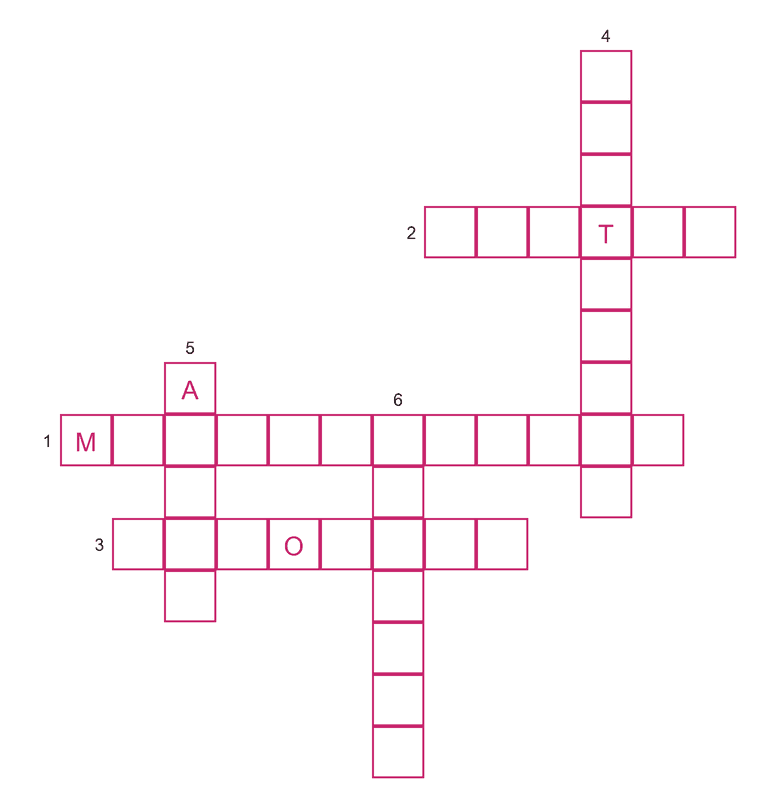
Across :
-
The property due to which a metal can be beaten into sheets.
-
This is the property due to which the metals shine.
-
The property due to which metals produce sound.
Down :
-
The property due to which a metal can be drawn into wires.
-
The substance formed when two or more metals are mixed together.
-
Non-metals are given this term because they can be easily broken down into pieces.
Solve with AIWritten solution
Solution:
Concept: Each clue names a property of metals or non-metals. The number of squares, the letters already printed (M, A, T, O) and the letters shared by crossing words confirm each answer.
Step 1 — Across 1.
Being beaten into sheets is malleability; MALLEABILITY has 12 letters and starts with the printed M.
Step 2 — Across 2.
The shine of metals is lustre; LUSTRE has 6 letters, and its T is the T printed in the grid.
Step 3 — Across 3.
Producing a ringing sound is sonority; SONORITY has 8 letters, with the printed O in its 4th square.
Step 4 — Down 4.
Being drawn into wires is ductility; DUCTILITY has 9 letters and shares T with LUSTRE and with MALLEABILITY.
Step 5 — Down 5.
A mixture of metals is an alloy; ALLOY has 5 letters, starts with the printed A and shares L with MALLEABILITY and O with SONORITY.
Step 6 — Down 6.
Breaking easily into pieces is being brittle; BRITTLE has 7 letters and shares B with MALLEABILITY and I with SONORITY.
Step 7 — Check the completed grid.
Every crossing square holds the same letter in both words, as the solved puzzle shows:

Watch out: The property is "lustre", not "lustrous"; only LUSTRE fits the six squares.
Therefore, Across: 1 malleability, 2 lustre, 3 sonority; Down: 4 ductility, 5 alloy, 6 brittle.
-
- 345 marks
Question 34
Pratham was looking at the silver trophy he had won in a school competition last year. He noticed that its shine had diminished. He went and asked his chemistry teacher why this would happen and he was told about corrosion of metals.
(a) Why does the shine of the silver trophy diminish after sometime ?
(b) Name the metal on which a green deposit is formed when exposed to air. What is that green deposit ?
(c) Why is it necessary to paint bridges, car bodies, telephone poles, etc. ?
Solve with AIWritten solution
Solution:
Concept: Corrosion is the slow eating away of a metal by gases and moisture in the air. It spoils the metal's shine and weakens it.
Step 1 — (a) Why the silver trophy loses its shine.
Silver reacts slowly with sulphur-containing gases such as hydrogen sulphide in the air, forming a thin black coating of silver sulphide that hides the shine (tarnishing):
Step 2 — (b) Metal with a green deposit.
Copper gets a green coating in moist air. The coating is basic copper carbonate, , formed from copper, moisture, carbon dioxide and oxygen:
Step 3 — (c) Why bridges and car bodies are painted.
Bridges, car bodies and poles are made of iron or steel, which rusts in moist air. A coat of paint keeps air and moisture away from the metal, so it prevents rusting and the structures stay strong for longer.
Watch out: Tarnished silver is not rusted; only iron rusts, while silver forms a black sulphide layer.
Therefore, (a) a black layer of silver sulphide forms, (b) copper, with a green coat of basic copper carbonate, (c) paint keeps air and moisture away and prevents rusting.
What Class 7 Chemistry Ch 6 covers
The sections of the chapter, in the order the book takes them. Every question above comes from one of these.
- 01Classification of Elements
- 02Metals
- 03Non-metals
- 04Comparison of General Properties of Metals and Non-metals
- 05Uses of Some Metals
- 06Uses of Some Non-metals
More ways to study this chapter
The same chapter asked three other ways. Practise it, revise it, and see what the board has set on Ch 6 before.
Class 7 Chemistry Ch 6 questions students ask
How many questions are there in Class 7 Chemistry Ch 6?
34 questions. Every one is solved step by step on this page.
Are these Class 7 Chemistry solutions free?
Yes. Every question and its full working is free to read, with no account needed.
Can I download the Class 7 Chemistry Ch 6 solutions as a PDF?
There is no PDF to download. Every solution is on this page instead, which means it is searchable, always the current syllabus, and readable on a phone. Use your browser's print option if you want it on paper.