
Opening your dashboard
Class 6 Maths Chapter 21: Perimeter and Area of Plane Figures Solutions
52 textbook questions with step-by-step answers, free to read, for ICSE 2026-27.
Get talked through Ch 21, not just shown the answer
Reading a finished solution is not the same as being able to do it. The AI tutor takes one question at a time and works it with you, in your own words, until you can.
- Ask it out loud, in your own words
- It gives you the next step, not the answer
- Stuck on part (ii)? Start there
52 questions with solutions
1–3 marks · Mixed difficulty
The first 37 solutions are on this page. This chapter is a long one, so the rest open on their own page to keep this one quick to load.
- 13 marks
Question 1
What do you understand by a plane closed figure ?
Solve with AIWritten solution
Solution:
Concept: A figure is described by where it lies (in a flat plane or in space) and by whether its boundary closes up.
Step 1 — Say what 'plane' means.
A plane is a flat surface, like a sheet of paper or the top of a table. A plane figure is drawn on such a flat surface, so it has length and breadth but no thickness.
Step 2 — Say what 'closed' means.
A figure is closed when its boundary, made of straight or curved lines, starts and ends at the same point and has no gap. An arc or the letter V is open, because its two ends do not meet.
Step 3 — Put the two ideas together.
A plane closed figure is a flat figure bounded all round by lines, so that it encloses a part of the plane. Triangles, rectangles, squares and circles are examples.
Watch out: A figure with even one small gap in its boundary is not closed.
Therefore, a plane closed figure is a figure that lies in a plane and is bounded by straight or curved lines, so that its boundary starts and ends at the same point; for example a triangle, a rectangle or a circle.
- 23 marks
Question 2
The interior of a figure is called the region of the figure. Is this statement true ?
Solve with AIWritten solution
Solution:
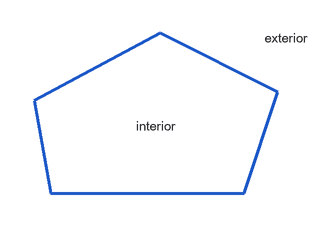
Concept: Every closed figure divides the plane into three parts: the points inside it (its interior), the points on it (its boundary) and the points outside it (its exterior).
Step 1 — Recall what the interior is.
The interior of a closed figure is only the part of the plane inside its boundary. The boundary itself is not part of the interior.
Step 2 — Recall what the region is.
The region of a figure is the interior together with the boundary, so it includes every point inside the figure and every point on its boundary.
Step 3 — Compare the statement with the definitions.
The statement calls the interior alone the region, so it leaves out the boundary. Hence the statement is not true.
Watch out: The words 'interior' and 'region' do not mean the same thing.
Therefore, no, the statement is not true; the interior of a figure together with its boundary is called the region of the figure.
- 33 marks
Question 3
Find the perimeter of each of the following closed figures :
(i)
(ii)
 Solve with AI
Written solution
Solution:
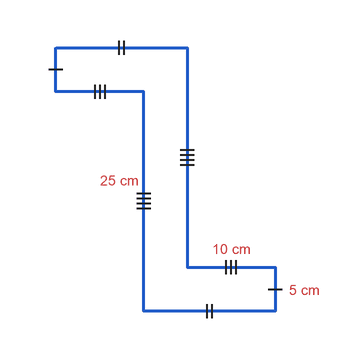
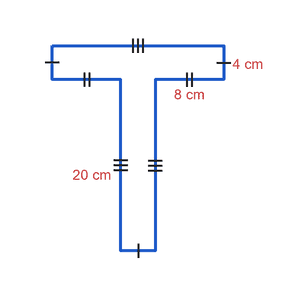
Concept: The perimeter of a closed figure is the total length of its boundary. We find it by adding the lengths of all its sides, every side in the same unit. Sides carrying the same marks are equal.
Step 1 — Read the sides of figure (i).
Sides with the same marks are equal. The one-mark sides are 5 cm, the three-mark sides are 10 cm and the four-mark sides are 25 cm.
The two-mark sides (the top and the bottom) are not labelled. The figure is drawn as a strip of the same width all along, and the end pieces (one mark) show that width is 5 cm; the drawing, which is to scale, agrees. So each two-mark side is a 10 cm piece plus the 5 cm width of the upright part.
Step 2 — Add all eight sides of figure (i).
Going once round the boundary, we meet two sides of each kind, so we add them all.
Step 3 — Read the sides of figure (ii).
In the T-shape, the one-mark sides are 4 cm, the two-mark sides are 8 cm and the three-mark sides are 20 cm.
We can check the top bar: it is made of an 8 cm piece, the 4 cm foot width of the stem and another 8 cm piece, which agrees with its three marks.
Step 4 — Add all eight sides of figure (ii).
The boundary has one top side (20 cm), two ends (4 cm each), two under-sides of the bar (8 cm each), two sides of the stem (20 cm each) and the foot (4 cm).
Watch out: Count every side of the boundary once, including the short end pieces; missing one of them is the usual slip.
Therefore, the perimeters are (i) 110 cm and (ii) 88 cm.
- 43 marks
Question 4
Find the perimeter of a rectangle whose :
(i) length = 40 cm and breadth = 35 cm
(ii) length = 10 m and breadth = 8 m
(iii) length = 8 m and breadth = 80 cm
(iv) length = 3·6 m and breadth = 2·4 m
Solve with AIWritten solution
Solution:
Concept: A rectangle has two equal lengths and two equal breadths, so its perimeter is , where is the length and is the breadth. Both must be in the same unit before we add them.
Step 1 — Part (i).
Here cm and cm, both in cm, so we use .
Step 2 — Part (ii).
Here m and m.
Step 3 — Part (iii).
The length is in metres and the breadth in centimetres, so we first change 80 cm into metres. Since 100 cm make 1 m, we divide by 100.
Now both sides are in metres.
In centimetres this is 17.6 × 100 cm.
Step 4 — Part (iv).
Here m and m.
Watch out: In part (iii), adding 8 and 80 directly mixes metres and centimetres and gives a wrong answer.
Therefore, the perimeters are (i) 150 cm, (ii) 36 m, (iii) 17.6 m (1760 cm) and (iv) 12 m.
- 53 marks
Question 5
If P denotes perimeter of a rectangle, l denotes its length and b denotes its breadth, find :
(i) l, if P = 38 cm and b = 7 cm
(ii) b, if P = 3·2 m and l = 100 cm
(iii) P, if l = 2 m and b = 75 cm
Solve with AIWritten solution
Solution:
Concept: A rectangle has two equal lengths and two equal breadths, so its perimeter is , where is the length and is the breadth. Both must be in the same unit before we add them. Read backwards, half the perimeter is , so and .
Step 1 — Part (i).
Half the perimeter is . Here cm and cm, so we subtract from half of 38.
Step 2 — Part (ii).
The perimeter is in metres and the length in centimetres. Since 100 cm make 1 m, 100 cm is 1 m. Then we subtract from half the perimeter.
In centimetres this is 0.6 × 100 cm.
Step 3 — Part (iii).
First we change 75 cm into metres by dividing by 100.
Now m and m, so we use .
In centimetres this is 5.5 × 100 cm.
Watch out: Halve the perimeter before subtracting; 38 − 7 = 31 is not the length.
Therefore, (i) l = 12 cm; (ii) b = 0.6 m (60 cm); (iii) P = 5.5 m (550 cm).
- 63 marks
Question 6
Find the perimeter of a square whose each side is 1·6 m.
Solve with AIWritten solution
Solution:
Concept: A square has four equal sides, so a square of side has perimeter . Read backwards, the side of a square is its perimeter divided by 4.
Step 1 — Multiply the side by 4.
A square has 4 equal sides of 1.6 m each, so we multiply 1.6 by 4.
Therefore, the perimeter of the square is 6.4 m.
- 73 marks
Question 7
Find the side of the square whose perimeter is 5 m.
Solve with AIWritten solution
Solution:
Concept: A square has four equal sides, so a square of side has perimeter . Read backwards, the side of a square is its perimeter divided by 4.
Step 1 — Divide the perimeter by 4.
The 5 m perimeter is shared equally by the 4 sides, so one side is 5 m divided by 4.
Therefore, each side of the square is 1.25 m (125 cm).
- 83 marks
Question 8
A square field has each side 70 m whereas a rectangular field has length = 50 m and breadth = 40 m. Which of the two fields has a greater perimeter and by how much ?
Solve with AIWritten solution
Solution:
Concept: A square has four equal sides, so a square of side has perimeter . Read backwards, the side of a square is its perimeter divided by 4. A rectangle has two equal lengths and two equal breadths, so its perimeter is , where is the length and is the breadth. Both must be in the same unit before we add them.
Step 1 — Find the perimeter of the square field.
The square field has 4 sides of 70 m each.
Step 2 — Find the perimeter of the rectangular field.
Its length is 50 m and its breadth is 40 m, so we use .
Step 3 — Compare the two perimeters.
The square field has the larger perimeter, and the difference is found by subtraction.
Therefore, the square field has the greater perimeter, by 100 m.
- 93 marks
Question 9
A rectangular field has length = 160 m and breadth = 120 m. Find :
(i) the perimeter of the field.
(ii) the length of the fence required to enclose the field.
(iii) the cost of fencing the field at the rate of ₹ 80 per metre.
Solve with AIWritten solution
Solution:
Concept: A rectangle has two equal lengths and two equal breadths, so its perimeter is , where is the length and is the breadth. Both must be in the same unit before we add them. A fence (or a walk once round) goes along the whole boundary, so its length is the perimeter. The cost is (length in metres) × (rate per metre).
Step 1 — Part (i): find the perimeter.
The field is a rectangle with m and m.
Step 2 — Part (ii): find the length of the fence.
The fence goes once round the field, so its length equals the perimeter, 560 m.
Step 3 — Part (iii): find the cost of fencing.
Each metre of fencing costs ₹ 80, so we multiply the 560 m of fencing by 80.
So the cost is ₹ 44,800.
Therefore, (i) the perimeter is 560 m; (ii) 560 m of fence is needed; (iii) the cost of fencing is ₹ 44,800.
- 103 marks
Question 10
Each side of a square plot of land is 55 m. Find the cost of fencing the plot at the rate of ₹ 32 per metre.
Solve with AIWritten solution
Solution:
Concept: A square has four equal sides, so a square of side has perimeter . Read backwards, the side of a square is its perimeter divided by 4. A fence (or a walk once round) goes along the whole boundary, so its length is the perimeter. The cost is (length in metres) × (rate per metre).
Step 1 — Find the length of fencing.
The fence goes round the square plot, so its length is the perimeter, 4 × 55 m.
Step 2 — Find the cost.
Each metre costs ₹ 32, so we multiply 220 by 32.
So the cost is ₹ 7,040.
Watch out: Multiply the rate by the perimeter (220 m), not by one side (55 m).
Therefore, the cost of fencing the plot is ₹ 7,040.
- 113 marks
Question 11
Each side of a square field is 70 m. How much distance will a boy walk in order to make :
(i) one complete round of this field ?
(ii) 8 complete rounds of this field ?
Solve with AIWritten solution
Solution:
Concept: A square has four equal sides, so a square of side has perimeter . Read backwards, the side of a square is its perimeter divided by 4. A fence (or a walk once round) goes along the whole boundary, so its length is the perimeter. The cost is (length in metres) × (rate per metre).
Step 1 — Part (i): one round.
One complete round is the perimeter of the square field, 4 × 70 m.
Step 2 — Part (ii): 8 rounds.
Each round is 280 m, so 8 rounds are 8 times as long.
This is the same as 2.24 km.
Therefore, the boy walks (i) 280 m in one round and (ii) 2240 m in 8 rounds.
- 123 marks
Question 12
A school playground is rectangular in shape with length = 120 m and breadth = 90 m. Some school boys run along the boundary of the playground and make 15 complete rounds in 45 minutes. How much distance did they run during this period ?
Solve with AIWritten solution
Solution:
Concept: A rectangle has two equal lengths and two equal breadths, so its perimeter is , where is the length and is the breadth. Both must be in the same unit before we add them. A fence (or a walk once round) goes along the whole boundary, so its length is the perimeter. The cost is (length in metres) × (rate per metre).
Step 1 — Find the distance in one round.
One round of the boundary is the perimeter of the playground, with m and m.
Step 2 — Find the distance in 15 rounds.
Each round is 420 m, so 15 rounds are 15 times as long. The time of 45 minutes is not needed for the distance.
This is the same as 6.3 km.
Watch out: The 45 minutes is extra information; it would be needed only for the speed, not for the distance.
Therefore, the boys ran 6300 m (6.3 km) in that period.
- 133 marks
Question 13
Mohit makes 8 full rounds of a rectangular field with length = 120 m and breadth = 75 m. John makes 10 full rounds of a square field with each side 100 m. Find who covers a larger distance and by how much ?
Solve with AIWritten solution
Solution:
Concept: A rectangle has two equal lengths and two equal breadths, so its perimeter is , where is the length and is the breadth. Both must be in the same unit before we add them. A square has four equal sides, so a square of side has perimeter . Read backwards, the side of a square is its perimeter divided by 4.
Step 1 — Find Mohit's distance.
One round of Mohit's field is its perimeter, with m and m.
He makes 8 rounds, so we multiply by 8.
Step 2 — Find John's distance.
One round of John's square field is 4 × 100 m.
He makes 10 rounds, so we multiply by 10.
Step 3 — Compare the distances.
John covers more, and the difference is found by subtraction.
Watch out: Compare the total distances, not the distances in one round.
Therefore, John covers the larger distance, by 880 m.
- 143 marks
Question 14
The length of a rectangle is twice its breadth. If its perimeter is 60 cm, find its length.
Solve with AIWritten solution
Solution:
Concept: A rectangle has two equal lengths and two equal breadths, so its perimeter is , where is the length and is the breadth. Both must be in the same unit before we add them.
Step 1 — Name the unknown.
Let the breadth be cm. The length is twice the breadth, so the length is cm.
Step 2 — Use the perimeter.
The perimeter is and it equals 60 cm, so we write an equation and solve it.
Step 3 — Find the length.
The breadth is 10 cm, and the length is twice it.
Step 4 — Check the answer.
A rectangle 20 cm by 10 cm has perimeter 2 × (20 + 10) = 60 cm, as given.
Watch out: The question asks for the length, so stop at 2x = 20 cm, not at x = 10 cm.
Therefore, the length of the rectangle is 20 cm.
- 153 marks
Question 15
Find the perimeter of :
(i) an equilateral triangle of side 9·8 cm.
(ii) an isosceles triangle with each equal side = 13 cm and the third side = 10 cm.
(iii) a regular pentagon of side 8·2 cm.
(iv) a regular hexagon of side 6·5 cm.
Solve with AIWritten solution
Solution:
Concept: A regular figure has all its sides equal, so its perimeter is (number of sides) × (length of one side). Read backwards, one side is the perimeter divided by the number of sides.
Step 1 — Part (i): equilateral triangle.
All 3 sides are 9.8 cm.
Step 2 — Part (ii): isosceles triangle.
Two sides are 13 cm each and the third side is 10 cm, so we add the three sides.
Step 3 — Part (iii): regular pentagon.
A pentagon has 5 equal sides of 8.2 cm.
Step 4 — Part (iv): regular hexagon.
A hexagon has 6 equal sides of 6.5 cm.
Watch out: A pentagon has 5 sides and a hexagon has 6; mixing them up is the common slip.
Therefore, the perimeters are (i) 29.4 cm, (ii) 36 cm, (iii) 41 cm and (iv) 39 cm.
- 163 marks
Question 16
An equilateral triangle and a square have equal perimeters. If the side of the triangle is 9·6 cm; what is the length of the side of the square ?
Solve with AIWritten solution
Solution:
Concept: When two figures have the same perimeter, we find the perimeter of the figure we know completely, and then use it for the other figure. A square has four equal sides, so a square of side has perimeter . Read backwards, the side of a square is its perimeter divided by 4.
Step 1 — Find the perimeter of the triangle.
An equilateral triangle has 3 equal sides of 9.6 cm.
Step 2 — Find the side of the square.
The square has the same perimeter, 28.8 cm, shared equally by its 4 sides.
Therefore, the side of the square is 7.2 cm.
- 173 marks
Question 17
A rectangle with length = 18 cm and breadth = 12 cm has the same perimeter as that of a regular pentagon. Find the side of the pentagon.
Solve with AIWritten solution
Solution:
Concept: When two figures have the same perimeter, we find the perimeter of the figure we know completely, and then use it for the other figure. A regular figure has all its sides equal, so its perimeter is (number of sides) × (length of one side). Read backwards, one side is the perimeter divided by the number of sides.
Step 1 — Find the perimeter of the rectangle.
The rectangle has cm and cm.
Step 2 — Find the side of the pentagon.
A regular pentagon with the same perimeter shares 60 cm equally among its 5 sides.
Therefore, each side of the pentagon is 12 cm.
- 183 marks
Question 18
A regular pentagon of each side 12 cm has the same perimeter as that of a regular hexagon. Find the length of each side of the hexagon.
Solve with AIWritten solution
Solution:
Concept: When two figures have the same perimeter, we find the perimeter of the figure we know completely, and then use it for the other figure. A regular figure has all its sides equal, so its perimeter is (number of sides) × (length of one side). Read backwards, one side is the perimeter divided by the number of sides.
Step 1 — Find the perimeter of the pentagon.
A regular pentagon has 5 equal sides of 12 cm.
Step 2 — Find the side of the hexagon.
The hexagon has the same perimeter, 60 cm, shared equally among its 6 sides.
Therefore, each side of the hexagon is 10 cm.
- 193 marks
Question 19
Each side of a square is 45 cm and a rectangle has length 50 cm. If the perimeters of both (square and rectangle) are the same, find the breadth of the rectangle.
Solve with AIWritten solution
Solution:
Concept: When two figures have the same perimeter, we find the perimeter of the figure we know completely, and then use it for the other figure. A rectangle has two equal lengths and two equal breadths, so its perimeter is , where is the length and is the breadth. Both must be in the same unit before we add them. Read backwards, half the perimeter is , so and .
Step 1 — Find the perimeter of the square.
The square has 4 sides of 45 cm each.
Step 2 — Find the breadth of the rectangle.
The rectangle has the same perimeter, 180 cm, so half of it is . Taking away the length 50 cm from half the perimeter leaves the breadth.
Step 3 — Check the answer.
A rectangle 50 cm by 40 cm has perimeter 2 × (50 + 40) = 180 cm, the same as the square.
Watch out: Subtract the length from half the perimeter (90 cm), not from the whole perimeter (180 cm).
Therefore, the breadth of the rectangle is 40 cm.
- 203 marks
Question 20
A wire is bent in the form of an equilateral triangle of each side 20 cm. If the same wire is bent in the form of a square, find the side of the square.
Solve with AIWritten solution
Solution:
Concept: When a wire is bent into a new shape, its length does not change. So the perimeter of the new shape equals the perimeter of the old one.
Step 1 — Find the length of the wire.
The wire first makes an equilateral triangle with 3 sides of 20 cm, so its length is the triangle's perimeter.
Step 2 — Find the side of the square.
The same 60 cm of wire now makes a square, so the 4 equal sides share 60 cm.
Therefore, each side of the square is 15 cm.
- 213 marks
Question 21
Find the area of a rectangle whose :
(i) length = 15 cm and breadth = 6·4 cm
(ii) length = 8·5 m and breadth = 5 m
(iii) length = 3·6 m and breadth = 90 cm
(iv) length = 24 cm and breadth = 180 mm
Solve with AIWritten solution
Solution:
Concept: The area of a figure is the amount of flat surface it covers, measured in square units (cm², m²). A rectangle of length and breadth has area ; a square of side has area . Both sides must be in the same unit.
Step 1 — Part (i).
Both sides are in cm: cm and cm.
Step 2 — Part (ii).
Both sides are in m: m and m.
Step 3 — Part (iii).
The breadth is in cm, so we first change 90 cm into metres by dividing by 100.
Now both sides are in metres.
Step 4 — Part (iv).
The breadth is in mm. Since 10 mm make 1 cm, we divide 180 by 10.
Now both sides are in centimetres.
Watch out: Change both sides to one unit first; 3.6 × 90 = 324 is neither m² nor cm² of this rectangle.
Therefore, the areas are (i) 96 cm², (ii) 42.5 m², (iii) 3.24 m² and (iv) 432 cm².
- 223 marks
Question 22
Find the area of a square, whose each side is :
(i) 7·2 cm
(ii) 4·5 m
(iii) 4·1 cm
Solve with AIWritten solution
Solution:
Concept: The area of a figure is the amount of flat surface it covers, measured in square units (cm², m²). A rectangle of length and breadth has area ; a square of side has area . Both sides must be in the same unit.
Step 1 — Part (i).
The side is 7.2 cm, so we multiply 7.2 by itself.
Step 2 — Part (ii).
The side is 4.5 m.
Step 3 — Part (iii).
The side is 4.1 cm.
Watch out: Area is side × side, not 4 × side (that is the perimeter).
Therefore, the areas are (i) 51.84 cm², (ii) 20.25 m² and (iii) 16.81 cm².
- 233 marks
Question 23
If A denotes area of a rectangle, l represents its length and b represents its breadth, find :
(i) l, if A = 48 cm² and b = 6 cm
(ii) b, if A = 88 m² and l = 11 m
Solve with AIWritten solution
Solution:
Concept: The area of a figure is the amount of flat surface it covers, measured in square units (cm², m²). A rectangle of length and breadth has area ; a square of side has area . Both sides must be in the same unit. Read backwards, and .
Step 1 — Part (i).
Since , the length is the area divided by the breadth.
Step 2 — Part (ii).
In the same way, the breadth is the area divided by the length.
Therefore, (i) l = 8 cm; (ii) b = 8 m.
- 243 marks
Question 24
Each side of a square is 3·6 m; find its
(i) perimeter
(ii) area.
Solve with AIWritten solution
Solution:
Concept: A square has four equal sides, so a square of side has perimeter . Read backwards, the side of a square is its perimeter divided by 4. The area of a figure is the amount of flat surface it covers, measured in square units (cm², m²). A rectangle of length and breadth has area ; a square of side has area . Both sides must be in the same unit.
Step 1 — Part (i): perimeter.
A square has 4 equal sides of 3.6 m.
Step 2 — Part (ii): area.
The area is side × side.
Watch out: Perimeter is a length (m) and area is a surface (m²); keep the units apart.
Therefore, (i) the perimeter is 14.4 m and (ii) the area is 12.96 m².
- 253 marks
Question 25
The perimeter of a square is 60 m, find :
(i) its each side
(ii) its area
(iii) its new area obtained on increasing each of its sides by 2 m.
Solve with AIWritten solution
Solution:
Concept: A square has four equal sides, so a square of side has perimeter . Read backwards, the side of a square is its perimeter divided by 4. The area of a figure is the amount of flat surface it covers, measured in square units (cm², m²). A rectangle of length and breadth has area ; a square of side has area . Both sides must be in the same unit.
Step 1 — Part (i): find the side.
The 60 m perimeter is shared equally by the 4 sides.
Step 2 — Part (ii): find the area.
The area is side × side.
Step 3 — Part (iii): find the new area.
Each side grows by 2 m, so the new side is 15 m + 2 m = 17 m. The new area is the new side times itself.
Watch out: Adding 2 m to each side does not add 2 m² or 4 m² to the area; work out the new area from the new side.
Therefore, (i) each side is 15 m; (ii) the area is 225 m²; (iii) the new area is 289 m².
- 263 marks
Question 26
Each side of a square is 7 m. If its each side be increased by 3 m, what will be the increase in its area ?
Solve with AIWritten solution
Solution:
Concept: The area of a figure is the amount of flat surface it covers, measured in square units (cm², m²). A rectangle of length and breadth has area ; a square of side has area . Both sides must be in the same unit. The increase in area is the new area minus the original area.
Step 1 — Find the original area.
Each side is 7 m.
Step 2 — Find the new area.
Each side grows by 3 m, so the new side is 7 m + 3 m = 10 m.
Step 3 — Find the increase.
The increase is the new area minus the original area.
Watch out: The increase is not 3 × 3 = 9 m²; the whole new square must be worked out.
Therefore, the area increases by 51 m².
- 273 marks
Question 27
The perimeter of a square field is numerically equal to its area. Find each side of the square.
Solve with AIWritten solution
Solution:
Concept: A square has four equal sides, so a square of side has perimeter . Read backwards, the side of a square is its perimeter divided by 4. The area of a figure is the amount of flat surface it covers, measured in square units (cm², m²). A rectangle of length and breadth has area ; a square of side has area . Both sides must be in the same unit.
Step 1 — Name the unknown.
Let each side of the square be units. Then its perimeter is units and its area is square units.
Step 2 — Make the two numbers equal.
The question says the two numbers are equal, so we write . A side cannot be 0, so we may divide both sides of the equation by .
Step 3 — Check the answer.
A square of side 4 units has perimeter 4 × 4 = 16 units and area 4 × 4 = 16 square units, so the two numbers are equal.
Watch out: The perimeter and the area are only numerically equal; 16 units and 16 square units are different kinds of quantity.
Therefore, each side of the square is 4 units.
- 283 marks
Question 28
A rectangular piece of paper has area = 24 cm² and length = 5 cm. Find its perimeter.
Solve with AIWritten solution
Solution:
Concept: The area of a figure is the amount of flat surface it covers, measured in square units (cm², m²). A rectangle of length and breadth has area ; a square of side has area . Both sides must be in the same unit. Read backwards, and . A rectangle has two equal lengths and two equal breadths, so its perimeter is , where is the length and is the breadth. Both must be in the same unit before we add them.
Step 1 — Find the breadth.
Since , the breadth is the area divided by the length.
Step 2 — Find the perimeter.
Now cm and cm, so we use .
Therefore, the perimeter of the paper is 19.6 cm.
- 293 marks
Question 29
Find the perimeter of a rectangle whose area = 2600 m² and breadth = 50 m.
Solve with AIWritten solution
Solution:
Concept: The area of a figure is the amount of flat surface it covers, measured in square units (cm², m²). A rectangle of length and breadth has area ; a square of side has area . Both sides must be in the same unit. Read backwards, and . A rectangle has two equal lengths and two equal breadths, so its perimeter is , where is the length and is the breadth. Both must be in the same unit before we add them.
Step 1 — Find the length.
The length is the area divided by the breadth.
Step 2 — Find the perimeter.
Now m and m.
Therefore, the perimeter of the rectangle is 204 m.
- 303 marks
Question 30
What will happen to the area of a rectangle, if both its length and breadth are tripled ?
Solve with AIWritten solution
Solution:
Concept: The area of a figure is the amount of flat surface it covers, measured in square units (cm², m²). A rectangle of length and breadth has area ; a square of side has area . Both sides must be in the same unit.
Step 1 — Write the original area.
Let the length be and the breadth be . The original area is .
Step 2 — Write the new area.
Tripling both sides makes the length and the breadth , so we multiply them.
Step 3 — Compare with the original area.
The new area is 9 times the original area. The increase is the new area minus the original area.
Watch out: Tripling both sides does not triple the area; the factor 3 is used twice, so the area is multiplied by 3 × 3 = 9.
Therefore, the area becomes 9 times the original area, that is, it increases by 8 times the original area.
- 313 marks
Question 31
Length of a rectangle is 30 m and its breadth is 20 m. Find the increase in its area if its length is increased by 10 m and its breadth is doubled.
Solve with AIWritten solution
Solution:
Concept: The area of a figure is the amount of flat surface it covers, measured in square units (cm², m²). A rectangle of length and breadth has area ; a square of side has area . Both sides must be in the same unit. The increase in area is the new area minus the original area.
Step 1 — Find the original area.
The rectangle is 30 m by 20 m.
Step 2 — Find the new sides.
The length grows by 10 m, so it becomes 30 m + 10 m = 40 m. The breadth is doubled, so it becomes 2 × 20 m = 40 m.
Step 3 — Find the new area.
The new figure is 40 m by 40 m.
Step 4 — Find the increase.
The increase is the new area minus the original area.
Therefore, the area increases by 1000 m².
- 323 marks
Question 32
The side of a square field is 16 m. What will be the increase in its area, if :
(i) each of its sides is increased by 4 m
(ii) each of its sides is doubled.
Solve with AIWritten solution
Solution:
Concept: The area of a figure is the amount of flat surface it covers, measured in square units (cm², m²). A rectangle of length and breadth has area ; a square of side has area . Both sides must be in the same unit. The increase in area is the new area minus the original area.
Step 1 — Find the original area.
Each side of the field is 16 m.
Step 2 — Part (i).
Each side grows by 4 m, so the new side is 16 m + 4 m = 20 m.
The increase is the new area minus the original area.
Step 3 — Part (ii).
Each side is doubled, so the new side is 2 × 16 m = 32 m.
We subtract the original area again.
Watch out: Doubling the side makes the area 4 times as large, so the increase is 3 times the old area, not equal to it.
Therefore, the increase in area is (i) 144 m² and (ii) 768 m².
- 333 marks
Question 33
Each rectangular tile is 40 cm long and 30 cm wide. How many tiles will be required to cover the floor of a room with length = 4·8 m and breadth = 2·4 m ?
Solve with AIWritten solution
Solution:
Concept: The number of tiles needed is (area of the floor) ÷ (area of one tile), with both areas in the same square unit.
Step 1 — Change the floor sides into cm.
The tile is measured in cm, so we change the floor's sides into cm by multiplying by 100.
Step 2 — Find the area of the floor.
The floor is a rectangle 480 cm by 240 cm.
Step 3 — Find the area of one tile.
Each tile is 40 cm by 30 cm.
Step 4 — Find the number of tiles.
We divide the floor area by the area of one tile.
Step 5 — Check the answer.
Along the 480 cm side, 12 tiles of 40 cm fit, and along the 240 cm side, 8 tiles of 30 cm fit, so 12 × 8 = 96 tiles cover the floor exactly.
Watch out: Do not divide square metres by square centimetres; change everything to one unit first.
Therefore, 96 tiles are required.
- 343 marks
Question 34
Each side of a square tile is 60 cm. How many tiles will be required to cover the floor of a hall with length = 50 m and breadth = 36 m ?
Solve with AIWritten solution
Solution:
Concept: The number of tiles needed is (area of the floor) ÷ (area of one tile), with both areas in the same square unit.
Step 1 — Find the area of the floor.
The hall is 50 m by 36 m.
Step 2 — Find the area of one tile in m².
The tile's side is 60 cm. Since 100 cm make 1 m, this is 0.6 m.
Step 3 — Find the number of tiles.
We divide the floor area by the area of one tile.
Step 4 — Check the answer.
We can also work in cm: the floor is 5000 cm by 3600 cm, an area of 1,80,00,000 cm², and one tile covers 3600 cm². Dividing gives 5000 tiles again (some tiles along the 50 m side have to be cut, because 50 m is not a whole number of 60 cm tiles).
Watch out: Change 60 cm to 0.6 m before squaring; 1800 ÷ 60 or 1800 ÷ 3600 is wrong.
Therefore, 5000 tiles are required.
- 353 marks
Question 35
The perimeter of a square plot = 360 m. Find :
(i) its area.
(ii) cost of fencing its boundary at the rate of ₹ 40 per metre.
(iii) cost of levelling the plot at ₹ 60 per square metre.
Solve with AIWritten solution
Solution:
Concept: A square has four equal sides, so a square of side has perimeter . Read backwards, the side of a square is its perimeter divided by 4. The area of a figure is the amount of flat surface it covers, measured in square units (cm², m²). A rectangle of length and breadth has area ; a square of side has area . Both sides must be in the same unit. Fencing is paid for by the metre of boundary (perimeter), while levelling, ploughing or flooring is paid for by the square metre of surface (area). Cost = quantity × rate.
Step 1 — Find the side.
The perimeter of 360 m is shared equally by the 4 sides.
Step 2 — Part (i): find the area.
The area is side × side.
Step 3 — Part (ii): find the cost of fencing.
Fencing goes along the 360 m boundary at ₹ 40 per metre.
So the fencing costs ₹ 14,400.
Step 4 — Part (iii): find the cost of levelling.
Levelling covers the 8100 m² surface at ₹ 60 per square metre.
So the levelling costs ₹ 4,86,000.
Watch out: Fencing uses the perimeter, but levelling uses the area.
Therefore, (i) the area is 8100 m²; (ii) fencing costs ₹ 14,400; (iii) levelling costs ₹ 4,86,000.
- 363 marks
Question 36
The perimeter of a rectangular field is 500 m and its length = 150 m. Find :
(i) its breadth.
(ii) its area.
(iii) cost of ploughing the field at the rate of ₹ 1.20 per square metre.
Solve with AIWritten solution
Solution:
Concept: A rectangle has two equal lengths and two equal breadths, so its perimeter is , where is the length and is the breadth. Both must be in the same unit before we add them. Read backwards, half the perimeter is , so and . The area of a figure is the amount of flat surface it covers, measured in square units (cm², m²). A rectangle of length and breadth has area ; a square of side has area . Both sides must be in the same unit. Fencing is paid for by the metre of boundary (perimeter), while levelling, ploughing or flooring is paid for by the square metre of surface (area). Cost = quantity × rate.
Step 1 — Part (i): find the breadth.
Half the perimeter is the length plus the breadth, so we take the length away from half of 500 m.
Step 2 — Part (ii): find the area.
The field is 150 m by 100 m.
Step 3 — Part (iii): find the cost of ploughing.
Ploughing covers the whole surface at ₹ 1.20 per square metre.
So ploughing costs ₹ 18,000.
Watch out: Ploughing is paid per square metre, so multiply the rate by the area, not by the perimeter.
Therefore, (i) the breadth is 100 m; (ii) the area is 15,000 m²; (iii) ploughing costs ₹ 18,000.
- 373 marks
Question 37
The cost of flooring a rectangular hall at ₹ 64 per square metre is ₹ 2,048. If the breadth of the hall is 5 m, find :
(i) its length.
(ii) its perimeter.
(iii) cost of fixing a border of very small width along its boundary at the rate of ₹ 60 per metre.
Solve with AIWritten solution
Solution:
Concept: The area of a figure is the amount of flat surface it covers, measured in square units (cm², m²). A rectangle of length and breadth has area ; a square of side has area . Both sides must be in the same unit. Read backwards, and . A rectangle has two equal lengths and two equal breadths, so its perimeter is , where is the length and is the breadth. Both must be in the same unit before we add them. Fencing is paid for by the metre of boundary (perimeter), while levelling, ploughing or flooring is paid for by the square metre of surface (area). Cost = quantity × rate.
Step 1 — Find the area of the hall.
The flooring cost is ₹ 64 for each square metre, so the number of square metres is the total cost divided by 64.
Step 2 — Part (i): find the length.
The length is the area divided by the breadth of 5 m.
Step 3 — Part (ii): find the perimeter.
Now m and m.
Step 4 — Part (iii): find the cost of the border.
The border runs along the whole boundary, so it is 22.8 m long, at ₹ 60 per metre.
So the border costs ₹ 1,368.
Watch out: The total cost of flooring gives the area, not the perimeter, because the rate is per square metre.
Therefore, (i) the length is 6.4 m; (ii) the perimeter is 22.8 m; (iii) the border costs ₹ 1,368.
- 383 marks
Question 38
The length of a rectangle is three times its breadth. If the area of the rectangle is 1875 sq. cm, find its perimeter.
- 391 mark
Question 39
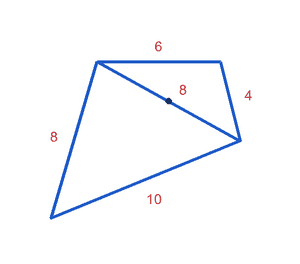
The perimeter of the given figure is :
- 401 mark
Question 40
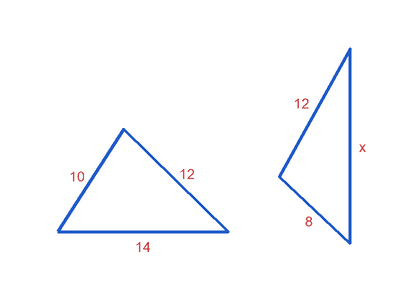
In the given figure, the perimeters of both the triangles are same. Then the value of x is :
- 411 mark
Question 41
If the perimeter of the given square is same as perimeter of the given triangle, the value of x is :

- 421 mark
Question 42
If one side of a regular pentagon is 20 cm, its perimeter is :
- 431 mark
Question 43
The perimeter of a regular hexagon is 120 cm, its each side is :
- 441 mark
Question 44
Area of a square = 16 cm² and its perimeter is 16 cm. Each side of the square is :
- 451 mark
Question 45
Area of a rectangle is 400 cm² and its length is 80 cm, then its width is :
- 461 mark
Question 46
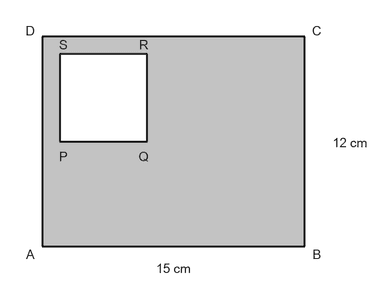
In the given figure, ABCD is a rectangle with sides 15 cm and 12 cm, whereas PQRS is a square with side 5 cm; area of the shaded portion is :
- 471 mark
Question 47
Sides of a triangle are 17 cm, 10 cm and 13 cm, its semi-perimeter is :
- 481 mark
Question 48
The area of a rectangle is 100 m² and its one side is 20 m, then its perimeter is :
- 491 mark
Question 49
Statement 1 : The sides of a triangle are in the ratio 3 : 4 : 5 and its perimeter is 240 m; then its longest side is 5 × 240 m.
Statement 2 : The longest side
Which of the following options is correct?
- 501 mark
Question 50
Statement 1 : The ratio between the area of a square of side 20 cm to the area of the square with side 4 cm is 5 : 1.
Statement 2 : Required ratio
Which of the following options is correct?
- 511 mark
Question 51
Choose your answer based on the codes given below :
(1) A is true, R is false. (2) A is false, R is true. (3) Both A and R are true. (4) Both A and R are false.
Assertion (A) : If each side of a rectangle is doubled, its area will become four times.
Reason (R) : Let originally area = l × b
Now area = (2 × l) × (2 × b)
= 4 × l × b = 4 × original area
- 521 mark
Question 52
Choose your answer based on the codes given below :
(1) A is true, R is false. (2) A is false, R is true. (3) Both A and R are true. (4) Both A and R are false.
Assertion (A) : Each side of an equilateral triangle is increased by 2 cm, its perimeter increases by 2 cm.
Reason (R) : Let each of the given side of the triangle is x cm
Its perimeter = 3x cm
Now, each side is (x + 2) cm
∴ Perimeter of resulting triangle
= 3 × (x + 2) cm = (3x + 6) cm
Increase in perimeter = (3x + 6 − 3x) cm
= 6 cm
What Class 6 Maths Ch 21 covers
The sections of the chapter, in the order the book takes them. Every question above comes from one of these.
- 01Closed Figure
- 02Concept of Perimeter
- 03Perimeter of a Rectangle
- 04Perimeter of a Square
- 05Perimeter of an Equilateral Triangle
- 06Shapes of Different Kinds with the Same Perimeter
More ways to study this chapter
The same chapter asked three other ways. Practise it, revise it, and see what the board has set on Ch 21 before.
Class 6 Maths Ch 21 questions students ask
How many questions are there in Class 6 Maths Ch 21?
52 questions. Every one is solved step by step on this page.
Are these Class 6 Maths solutions free?
Yes. Every question and its full working is free to read, with no account needed.
Can I download the Class 6 Maths Ch 21 solutions as a PDF?
There is no PDF to download. Every solution is on this page instead, which means it is searchable, always the current syllabus, and readable on a phone. Use your browser's print option if you want it on paper.