
Opening your dashboard
Class 6 Maths Chapter 17: Circles Solutions
17 textbook questions with step-by-step answers, free to read, for ICSE 2026-27.
Get talked through Ch 17, not just shown the answer
Reading a finished solution is not the same as being able to do it. The AI tutor takes one question at a time and works it with you, in your own words, until you can.
- Ask it out loud, in your own words
- It gives you the next step, not the answer
- Stuck on part (ii)? Start there
17 questions with solutions
1–3 marks · Easy difficulty
- 13 marks
Question 1
Use the figure given alongside to fill in the blanks :
(i) R is the ............. of the circle.
(ii) Diameter of a circle is ................ .
(iii) Tangent to a circle is ................. .
(iv) EF is a ..................... of the circle.
(v) ................... is a chord of the circle.
(vi) Diameter = 2 × ................. .
(vii) ..................... is a radius of the circle.
(viii) If the length of RS is 5 cm, the length of PQ = ................. .
(ix) If PQ is 8 cm long, the length of RS = ................. .
(x) AB is a .................. of the circle.
 Solve with AI
Written solution
Solution:
Concept: The centre is the fixed point inside a circle. A radius joins the centre to a point on the circle. A chord joins two points on the circle, and a chord through the centre is a diameter, so a diameter is made of two radii: diameter = 2 × radius. A line that cuts a circle at two points is a secant; a line that only touches a circle at one point is a tangent.
Step 1 — Read the figure.
In the figure, R is the point in the middle with lines drawn from it, PQ passes through R, RS goes from R to the circle, EF cuts the circle at C and D, and AB touches the circle only at M.
Step 2 — Parts (i) and (ii).
R is the fixed point in the middle, so R is the centre. PQ is a chord through the centre R, so the diameter of the circle is PQ.
Step 3 — Parts (iii) and (iv).
AB touches the circle at one point only, M, so the tangent to the circle is AB. EF cuts the circle at two points, C and D, so EF is a secant.
Step 4 — Parts (v), (vi) and (vii).
CD joins two points of the circle, so CD is a chord. A diameter is made of two radii, so diameter = 2 × radius. RS joins the centre to a point on the circle, so RS is a radius.
Step 5 — Part (viii).
PQ is a diameter and RS is a radius, so PQ is twice RS (lengths in cm).
Step 6 — Part (ix).
Now PQ is given, so RS is half of PQ (lengths in cm).
Step 7 — Part (x).
AB touches the circle at M only, so AB is a tangent of the circle.
Watch out: PQ is also a chord (the longest one), but in part (v) the expected chord is CD, because PQ already has its special name, the diameter.
Therefore, (i) centre; (ii) PQ; (iii) AB; (iv) secant; (v) CD; (vi) radius; (vii) RS; (viii) 10 cm; (ix) 4 cm; (x) tangent.
- 23 marks
Question 2
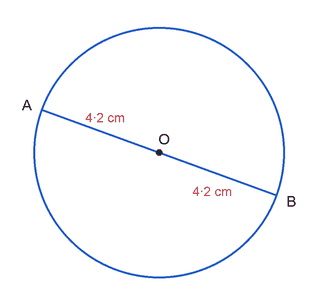
Draw a circle of radius 4·2 cm. Mark its centre as O. Take a point A on the circumference of the circle. Join AO and extend it till it meets point B on the circumference of the circle.
(i) Measure the length of AB. (ii) Assign a special name to AB.
Solve with AIWritten solution
Solution:
Concept: To draw a circle of a given radius, open the compasses to that radius on the ruler, place the steel point on the centre and turn the pencil once round. Every point of the circle is then at the same distance, the radius, from the centre. A chord through the centre is a diameter.
Given: Radius = 4·2 cm.
Step 1 — Draw the circle.
Open the compasses to 4·2 cm, put the steel point on a point O and draw the circle. Mark the centre O.
Step 2 — Draw AB.
Mark a point A on the circle. Draw a line from A through O and extend it until it meets the circle again at B.
Step 3 — Part (i): measure AB.
AB is made of the two radii AO and OB, each 4·2 cm, so on measuring AB is 8·4 cm (lengths in cm).
Step 4 — Part (ii): name AB.
AB is a chord that passes through the centre O, so it is a diameter of the circle.
Watch out: Extend AO beyond O to the far side of the circle; AO alone is only a radius.
Therefore, (i) AB = 8·4 cm; (ii) AB is a diameter of the circle.
- 33 marks
Question 3
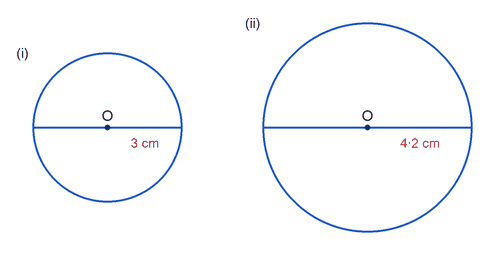
Draw circles with diameter : (i) 6 cm (ii) 8·4 cm
In each case, measure the length of the radius of the circle drawn.
Solve with AIWritten solution
Solution:
Concept: To draw a circle of a given radius, open the compasses to that radius on the ruler, place the steel point on the centre and turn the pencil once round. Every point of the circle is then at the same distance, the radius, from the centre. The radius is half of the diameter.
Given: Diameters 6 cm and 8·4 cm.
Step 1 — Find the radius for part (i).
A diameter is made of two radii, so the radius is half of the diameter (in cm).
Step 2 — Find the radius for part (ii).
In the same way, half of 8·4 cm is the radius (in cm).
Step 3 — Draw the circles.
Open the compasses to 3 cm and draw the first circle; then open them to 4·2 cm and draw the second. Draw a diameter in each and check it measures 6 cm and 8·4 cm.
Step 4 — Measure the radii.
Measuring from the centre to the circle gives 3 cm for circle (i) and 4·2 cm for circle (ii).
Watch out: Open the compasses to the RADIUS, not to the diameter, or the circle comes out twice as large.
Therefore, the radius is (i) 3 cm; (ii) 4·2 cm.
- 43 marks
Question 4
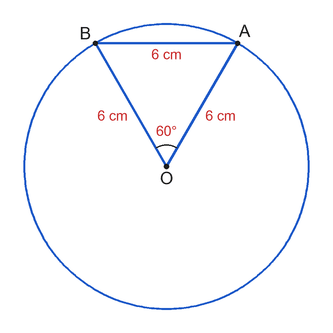
Draw a circle of radius 6 cm. In the circle, draw a chord AB = 6 cm.
(i) If O is the centre of the circle, join OA and OB.
(ii) Assign a special name to Δ AOB.
(iii) Write the measure of angle AOB.
Solve with AIWritten solution
Solution:
Concept: The centre is the fixed point inside a circle. A radius joins the centre to a point on the circle. A chord joins two points on the circle, and a chord through the centre is a diameter, so a diameter is made of two radii: diameter = 2 × radius. A triangle with all three sides equal is equilateral, and each of its angles is 60°.
Given: Radius = 6 cm and chord AB = 6 cm.
Step 1 — Draw the circle and the chord.
Draw a circle with centre O and radius 6 cm. Mark a point A on it. With A as centre and radius 6 cm, cut the circle at B, and join AB. Now the chord AB is 6 cm long.
Step 2 — Part (i): join OA and OB.
Join OA and OB. Both are radii, so OA = 6 cm and OB = 6 cm.
Step 3 — Part (ii): name the triangle.
In triangle AOB all three sides OA, OB and AB are 6 cm, so it is an equilateral triangle.
Step 4 — Part (iii): find ∠AOB.
Each angle of an equilateral triangle is 60°, and a protractor confirms ∠AOB = 60°.
Watch out: The sides OA and OB are radii, so they are 6 cm long without measuring; only AB has to be cut off.
Therefore, (ii) Δ AOB is an equilateral triangle; (iii) ∠AOB = 60°.
- 53 marks
Question 5
Draw a circle of radius 4·8 cm and mark its centre as P.
(i) Draw radii PA and PB such that ∠APB = 45°.
(ii) Shade the major sector of the circle.
Solve with AIWritten solution
Solution:
Concept: A sector is the part of a circle bounded by two radii and the arc between them. A segment is the part bounded by a chord and an arc. The smaller of the two parts is called minor and the larger major.
Given: Radius = 4·8 cm and ∠APB = 45°.
Step 1 — Draw the circle and PA.
Draw a circle with centre P and radius 4·8 cm. Draw a radius PA.
Step 2 — Part (i): draw PB.
Place the protractor's centre on P with its base along PA, mark 45°, and draw the radius PB through the mark. Now ∠APB = 45°.
Step 3 — Find the two sectors.
The radii PA and PB divide the circle into two sectors. The small one has the 45° angle; the large one has the rest of the 360° round P.
Step 4 — Part (ii): shade the major sector.
Shade the larger region bounded by PA, PB and the long arc AB. This is the major sector.

Watch out: The major sector is the LARGER one (315°); the 45° region between PA and PB is the minor sector.
Therefore, the shaded region, bounded by PA, PB and the major arc AB, is the major sector (angle 315°).
- 63 marks
Question 6
Draw a circle of radius 3·6 cm. In the circle, draw a chord AB = 5 cm. Now shade the minor segment of the circle.
Solve with AIWritten solution
Solution:
Concept: A sector is the part of a circle bounded by two radii and the arc between them. A segment is the part bounded by a chord and an arc. The smaller of the two parts is called minor and the larger major.
Given: Radius = 3·6 cm and chord AB = 5 cm.
Step 1 — Draw the circle.
Draw a circle with centre O and radius 3·6 cm. Its diameter is 7·2 cm, so a 5 cm chord fits.
Step 2 — Draw the chord AB.
Mark a point A on the circle. With A as centre and radius 5 cm, cut the circle at B, and join AB.
Step 3 — Shade the minor segment.
The chord AB divides the circle into two segments. The smaller one, between AB and the short arc AB, does not contain the centre O; shade it.
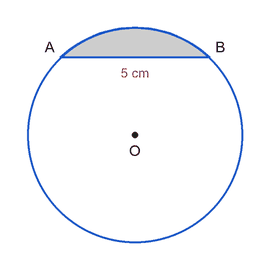
Watch out: The minor segment is on the side of AB away from the centre; the part containing O is the major segment.
Therefore, the shaded part between the chord AB and the minor arc AB is the minor segment.
- 73 marks
Question 7
Mark two points A and B, 4 cm apart.
Draw a circle passing through B and with A as centre.
Solve with AIWritten solution
Solution:
Concept: To draw a circle of a given radius, open the compasses to that radius on the ruler, place the steel point on the centre and turn the pencil once round. Every point of the circle is then at the same distance, the radius, from the centre.
Given: AB = 4 cm; centre A.
Step 1 — Mark A and B.
Draw a line segment AB, 4 cm long, and mark its ends A and B.
Step 2 — Draw the circle.
The circle has centre A and must pass through B, so its radius is AB = 4 cm. Put the steel point of the compasses on A, open them to B and draw the circle.
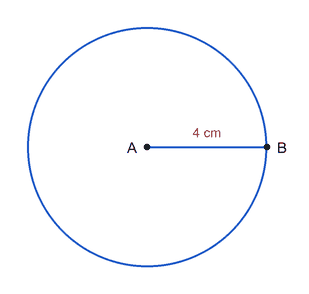
Watch out: The centre is A, not B; the circle passes THROUGH B.
Therefore, the circle has centre A and radius AB = 4 cm, and it passes through B.
- 83 marks
Question 8
Draw a line AB = 8·4 cm. Now draw a circle with AB as diameter.
Mark a point C on the circumference of the circle. Measure angle ACB.
Solve with AIWritten solution
Solution:
Concept: To draw a circle of a given radius, open the compasses to that radius on the ruler, place the steel point on the centre and turn the pencil once round. Every point of the circle is then at the same distance, the radius, from the centre. An angle drawn in a semicircle (at a point of the circle, with its arms through the ends of a diameter) is always a right angle.
Given: AB = 8·4 cm is a diameter.
Step 1 — Draw AB and find the centre.
Draw AB, 8·4 cm long. The centre of a circle with diameter AB is the mid-point O of AB, and the radius is half of AB (in cm).
Step 2 — Draw the circle.
With centre O and radius 4·2 cm, draw the circle. It passes through A and B.
Step 3 — Mark C and measure ∠ACB.
Mark any point C on the circle and join CA and CB. Measuring with a protractor gives ∠ACB = 90°.

Watch out: C must lie ON the circle; for a point inside or outside the circle the angle is not 90°.
Therefore, ∠ACB = 90°, wherever C is taken on the circle.
- 91 mark
Question 9
A part of the circle bounded by an arc and two radii is called a :
Solve with AIAnswer
(A) segment
- Correct
(B) sector
(C) semi-circle
(D) both (A) and (B)
Answer: (B) sector
Concept: A sector is the part of a circle bounded by two radii and the arc between them. A segment is the part bounded by a chord and an arc. The smaller of the two parts is called minor and the larger major.
Step 1 — Picture the region.
Two radii start together at the centre and end on the circle; the arc between their ends closes the region. A region bounded by two radii and an arc is a sector.
Watch out: A segment has a chord as its straight edge; a sector has two radii.
Why the other options are wrong:
- (A) segment: a segment is bounded by a chord and an arc, not by two radii.
- (C) semi-circle: a semi-circle is bounded by a diameter and half the circle.
- (D) both (A) and (B): both (A) and (B) cannot be right, because option (A), segment, is wrong.
Therefore, the part bounded by an arc and two radii is a sector, option (B).
- 101 mark
Question 10
A part of a circle enclosed by an arc and two mutually perpendicular radii is a :
Solve with AIAnswer
(A) semi-circle
(B) segment
- Correct
(C) quadrant
(D) none of these
Answer: (C) quadrant
Concept: A sector is the part of a circle bounded by two radii and the arc between them. A segment is the part bounded by a chord and an arc. The smaller of the two parts is called minor and the larger major. A sector with a right angle at the centre is a quadrant.
Step 1 — Find the angle of the sector.
The region is a sector whose two radii are perpendicular, so the angle between them is 90°. That is one quarter of the full turn of 360°.
Step 2 — Name it.
A sector that is a quarter of the circle is called a quadrant.
Why the other options are wrong:
- (A) semi-circle: a semi-circle is bounded by a diameter, which is two radii in one straight line (180°), not at 90°.
- (B) segment: a segment is bounded by a chord and an arc, not by two radii.
- (D) none of these: none of these is wrong, because (C) quadrant fits exactly.
Therefore, the region is a quadrant, option (C).
- 111 mark
Question 11
Chord of a circle divides the circle into two :
Solve with AIAnswer
(A) sectors
- Correct
(B) segments
(C) semi-circles
(D) equal parts
Answer: (B) segments
Concept: A sector is the part of a circle bounded by two radii and the arc between them. A segment is the part bounded by a chord and an arc. The smaller of the two parts is called minor and the larger major.
Step 1 — Look at the two parts.
A chord cuts the circle into two parts, each bounded by the chord and one of the two arcs. A part bounded by a chord and an arc is a segment.
Watch out: The two segments are equal only when the chord is a diameter.
Why the other options are wrong:
- (A) sectors: sectors are bounded by two radii, and a chord is not a radius.
- (C) semi-circles: only a diameter divides the circle into two semi-circles; most chords do not pass through the centre.
- (D) equal parts: the two parts are equal only for a diameter; for any other chord one part is larger.
Therefore, a chord divides the circle into two segments, option (B).
- 121 mark
Question 12
A straight line intersecting a circle at two points is a :
Solve with AIAnswer
- Correct
(A) secant
(B) chord
(C) tangent
(D) diameter
Answer: (A) secant
Concept: A line that cuts a circle at two points is a secant; a line that only touches a circle at one point is a tangent. A chord is the line segment joining the two points.
Step 1 — Match the description.
The object is a straight LINE (not a segment) that cuts the circle at two points. Such a line is called a secant.
Watch out: A chord stops at the circle; a secant is the whole line, which goes on beyond the circle.
Why the other options are wrong:
- (B) chord: a chord is a line segment that ends on the circle, not a whole line.
- (C) tangent: a tangent meets the circle at one point only, not two.
- (D) diameter: a diameter is a chord through the centre, a line segment, not a whole line.
Therefore, a straight line cutting a circle at two points is a secant, option (A).
- 131 mark
Question 13
A line touching a given circle is called :
Solve with AIAnswer
(A) radius
(B) diameter
(C) chord
- Correct
(D) tangent
Answer: (D) tangent
Concept: A line that cuts a circle at two points is a secant; a line that only touches a circle at one point is a tangent.
Step 1 — Match the description.
A line that touches the circle meets it at exactly one point without cutting into it. Such a line is a tangent.
Why the other options are wrong:
- (A) radius: a radius is a segment from the centre to the circle, not a line touching it.
- (B) diameter: a diameter passes through the centre and cuts the circle at two points.
- (C) chord: a chord joins two points of the circle, so it does not just touch it.
Therefore, a line touching a circle is a tangent, option (D).
- 141 mark
Question 14
In the given figure, O is centre of the circle and chord AB = radius of the circle, angle AOB is equal to :
 Solve with AI
Answer
(A) 30°
- Correct
(B) 60°
(C) 90°
(D) 120°
Answer: (B) 60°
Concept: The centre is the fixed point inside a circle. A radius joins the centre to a point on the circle. A chord joins two points on the circle, and a chord through the centre is a diameter, so a diameter is made of two radii: diameter = 2 × radius. A triangle with three equal sides is equilateral, and each of its angles is 60°.
Step 1 — Compare the three sides.
OA and OB are radii, and AB is given equal to the radius, so all three sides OA, OB and AB are equal. Triangle AOB is therefore equilateral.
Step 2 — Find ∠AOB.
Each angle of an equilateral triangle is the same, and the three add up to 180°.
Watch out: OA and OB are radii even though their lengths are not written; that is what makes the triangle equilateral.
Why the other options are wrong:
- (A) 30°: 30° would make the chord AB shorter than the radius.
- (C) 90°: 90° would make AB longer than the radius (a right-angled corner at O).
- (D) 120°: 120° would make AB much longer than the radius.
Therefore, ∠AOB = 60°, option (B).
- 151 mark
Question 15
A chord of a circle can be its :
Solve with AIAnswer
(A) radius
- Correct
(B) diameter
(C) tangent
(D) none of these
Answer: (B) diameter
Concept: The centre is the fixed point inside a circle. A radius joins the centre to a point on the circle. A chord joins two points on the circle, and a chord through the centre is a diameter, so a diameter is made of two radii: diameter = 2 × radius.
Step 1 — Picture a chord.
A chord joins two points on the circle. If the chord happens to pass through the centre, it is a diameter, so a chord can be a diameter.
Watch out: Every diameter is a chord, but not every chord is a diameter.
Why the other options are wrong:
- (A) radius: a radius has one end at the centre, which is not on the circle, so it is not a chord.
- (C) tangent: a tangent touches the circle at only one point, while a chord has two points on the circle.
- (D) none of these: none of these is wrong, because (B) diameter fits.
Therefore, a chord of a circle can be its diameter, option (B).
- 161 mark
Question 16
Choose your answer based on the codes given below :
(1) A is true, R is false. (2) A is false, R is true. (3) Both A and R are true. (4) Both A and R are false.
Assertion (A) : A line which meets a circle at a distance equal to radius of the circle.
Reason (R) : The line is tangent to the circle.
Solve with AIAnswer
(A) (1) A is true, R is false.
(B) (2) A is false, R is true.
- Correct
(C) (3) Both A and R are true.
(D) (4) Both A and R are false.
Answer: (C) (3) Both A and R are true.
Concept: In an Assertion–Reason item we judge the Assertion (A) and the Reason (R) separately, true or false, and choose the code that matches both verdicts. A line that cuts a circle at two points is a secant; a line that only touches a circle at one point is a tangent. A line whose distance from the centre equals the radius touches the circle at one point.
Step 1 — Read the Assertion.
The Assertion is printed as an incomplete sentence. Read with the Reason, it describes a line whose distance from the centre of the circle is equal to the radius.
Step 2 — Judge the Assertion.
Such a line reaches the circle at exactly one point, the foot of the perpendicular from the centre, and does not cut into it. So the line meets the circle at one point. The Assertion is true.
Step 3 — Judge the Reason.
A line meeting a circle at exactly one point is a tangent. The Reason is true.
Watch out: Measure the distance of a line from the CENTRE, along the perpendicular, not from any point of the circle.
Note: Because the Assertion is printed without a complete claim, we read it with its intended meaning, as above. Read that way, the key 'both true' holds.
Why the other options are wrong:
- (A): code (1) calls R false, but a line meeting the circle at one point is a tangent.
- (B): code (2) calls A false, but such a line does meet the circle, at one point.
- (D): code (4) calls both false, but both are true.
Therefore, both A and R are true, option (C).
- 171 mark
Question 17
Statement 1 : The longest chord of a circle is its diameter.
Statement 2 : Any chord of a circle that passes through its centre is its diameter.
Which of the following options is correct?
Solve with AIAnswer
- Correct
(A) Both the statements are true.
(B) Both the statements are false.
(C) Statement 1 is true, and statement 2 is false.
(D) Statement 1 is false, and statement 2 is true.
Answer: (A) Both the statements are true.
Concept: The centre is the fixed point inside a circle. A radius joins the centre to a point on the circle. A chord joins two points on the circle, and a chord through the centre is a diameter, so a diameter is made of two radii: diameter = 2 × radius. We judge each statement separately, true or false, and choose the option that matches both verdicts.
Step 1 — Judge Statement 1.
A chord through the centre is made of two radii, and every other chord is shorter than this. So the longest chord is the diameter. Statement 1 is true.
Step 2 — Judge Statement 2.
By definition, a chord that passes through the centre is a diameter. Statement 2 is true.
Why the other options are wrong:
- (B): this calls both statements false, but both are true.
- (C): this calls Statement 2 false, but a chord through the centre is a diameter by definition.
- (D): this calls Statement 1 false, but no chord is longer than the diameter.
Therefore, both the statements are true, option (A).
What Class 6 Maths Ch 17 covers
The sections of the chapter, in the order the book takes them. Every question above comes from one of these.
- 01Circle
- 02Radius
- 03Diameter
- 04Chord
- 05Secant and Tangent
- 06Arc
- 07Sector
More ways to study this chapter
The same chapter asked three other ways. Practise it, revise it, and see what the board has set on Ch 17 before.
Class 6 Maths Ch 17 questions students ask
How many questions are there in Class 6 Maths Ch 17?
17 questions. Every one is solved step by step on this page.
Are these Class 6 Maths solutions free?
Yes. Every question and its full working is free to read, with no account needed.
Can I download the Class 6 Maths Ch 17 solutions as a PDF?
There is no PDF to download. Every solution is on this page instead, which means it is searchable, always the current syllabus, and readable on a phone. Use your browser's print option if you want it on paper.