Solution:
Concept: The heart has four chambers: two upper auricles (atria) that receive blood and two lower ventricles that pump it out. The right side handles deoxygenated blood and the left side oxygenated blood.
Step 1 — Label the parts.
Read each part from its position: 1 – pulmonary artery (leaves the right ventricle for the lungs), 2 – superior vena cava (enters the right auricle from above), 3 – pulmonary vein (enters the left auricle from the lungs), 4 – right auricle (atrium), 5 – left ventricle. The labelled figure is shown below.
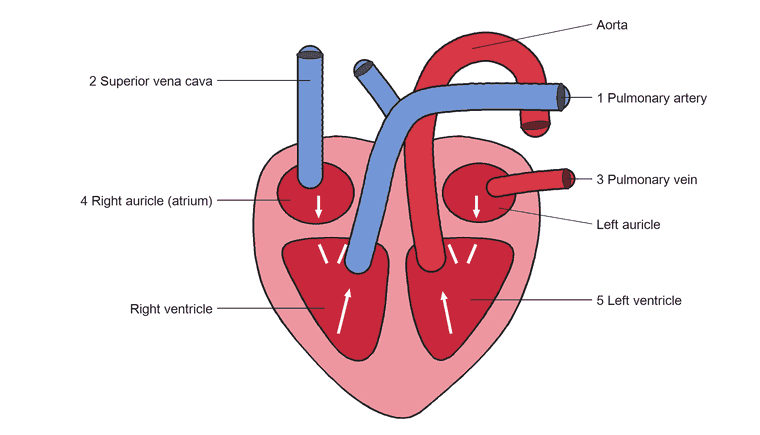
Step 2 — (a) Vessel 2.
Vessel 2, the superior vena cava, brings blood back from the head, neck and arms, so it carries deoxygenated blood.
Step 3 — (b) The main artery.
The main artery that takes blood from the heart to the body is the aorta, which leaves the left ventricle.
Step 4 — (c) Blood from the lungs.
Oxygenated blood from the lungs enters the left auricle (left atrium).
Watch out: In a front view the heart's right side is on the viewer's left.
Therefore, 1 pulmonary artery, 2 superior vena cava, 3 pulmonary vein, 4 right auricle, 5 left ventricle; (a) deoxygenated blood, (b) aorta, (c) left auricle.

