
Opening your dashboard
Class 5 Maths Chapter 18: Volume Solutions
12 textbook questions with step-by-step answers, free to read, for ICSE 2026-27.
Get talked through Ch 18, not just shown the answer
Reading a finished solution is not the same as being able to do it. The AI tutor takes one question at a time and works it with you, in your own words, until you can.
- Ask it out loud, in your own words
- It gives you the next step, not the answer
- Stuck on part (ii)? Start there
12 questions with solutions
3 marks · Mixed difficulty
- 13 marks
Question 1
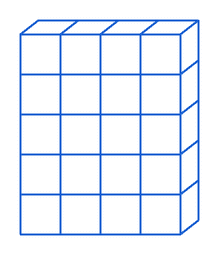
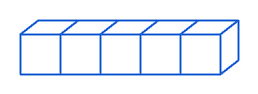
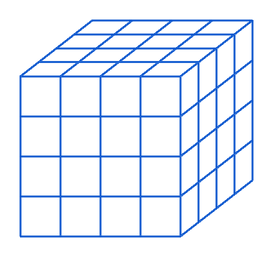
Find the volumes of the following cuboids and cubes by counting the unit cubes of volume 1 cu cm.
(a)
(b)
(c)
(d)
 Solve with AI
Written solution
Solution:
Concept: The volume of a solid is the amount of space it takes up. A unit cube has edges of 1 cm, and its volume is 1 cubic centimetre (1 cu cm, or 1 cm³).
Step 1 — Part (a).
The front face has 4 cubes in each row and 5 rows. The solid is only 1 cube deep. So there are 4 × 5 cubes in one layer, and there is 1 layer.
Step 2 — Part (b).
There is just one row of 5 cubes. It is 1 cube high and 1 cube deep.
Step 3 — Part (c).
The cube is 4 cubes long, 4 cubes wide and 4 cubes high. Each layer has 4 × 4 = 16 cubes, and there are 4 layers.
Step 4 — Part (d).
The cube is 2 cubes long, 2 cubes wide and 2 cubes high.
Step 5 — Write the volumes.
Each unit cube has a volume of 1 cu cm. So the number of cubes is the volume in cu cm.
Watch out: Count the hidden cubes too. In part (c) we see only 3 faces, but the cube is full of cubes inside.
Therefore, (a) 20 cu cm; (b) 5 cu cm; (c) 64 cu cm; (d) 8 cu cm.
- 23 marks
Question 2
Find the volume of the cuboid whose dimensions are:
(a) length = 8m, breadth = 5m, height = 4m
(b) length = 15m, breadth = 12m, height = 5m
(c) length = 75cm, breadth = 50cm, height = 30cm
Solve with AIWritten solution
Solution:
Concept: A cuboid is made of layers of unit cubes. So the volume of a cuboid is length × breadth × height. All three lengths must be in the same unit. If they are in metres, the volume is in cubic metres (cu m).
Step 1 — Part (a).
We multiply the length, the breadth and the height. All are in metres, so the volume is in cu m.
Step 2 — Part (b).
All three lengths are in metres.
Step 3 — Part (c).
All three lengths are in centimetres, so the volume is in cu cm.
Watch out: The unit of volume is cubic: cu m or cu cm, not m or cm.
Therefore, (a) 160 cu m; (b) 900 cu m; (c) 1,12,500 cu cm.
- 33 marks
Question 3
Find the volume of a cube whose volume is three times the volume of a cuboid of dimensions 20cm × 15cm × 10cm.
Solve with AIWritten solution
Solution:
Concept: A cuboid is made of layers of unit cubes. So the volume of a cuboid is length × breadth × height. All three lengths must be in the same unit. If they are in metres, the volume is in cubic metres (cu m).
Given: The cube's volume is 3 times the volume of a cuboid 20 cm × 15 cm × 10 cm.
Step 1 — Find the volume of the cuboid.
The cuboid measures 20 cm by 15 cm by 10 cm. We multiply the three lengths.
Step 2 — Find the volume of the cube.
The cube has three times the volume of the cuboid. So we multiply by 3.
Watch out: Multiply the volume of the cuboid by 3. Do not multiply each length by 3; that would make the volume 27 times bigger.
Therefore, the volume of the cube is 9,000 cu cm.
- 43 marks
Question 4
Find the volume of air in a room 10m long, 8m wide and 6m high.
Solve with AIWritten solution
Solution:
Concept: A cuboid is made of layers of unit cubes. So the volume of a cuboid is length × breadth × height. All three lengths must be in the same unit. If they are in metres, the volume is in cubic metres (cu m).
Given: A room 10 m long, 8 m wide and 6 m high.
Step 1 — Find the volume of the room.
The air fills the whole room. So the volume of air is the volume of the room.
Watch out: Write the answer in cu m, because the lengths are in metres.
Therefore, the room has 480 cu m of air.
- 53 marks
Question 5
The dimensions of a tank are 12.4m, 7.9m and 5m. How much water can be filled in it?
Solve with AIWritten solution
Solution:
Concept: A cuboid is made of layers of unit cubes. So the volume of a cuboid is length × breadth × height. All three lengths must be in the same unit. If they are in metres, the volume is in cubic metres (cu m).
Given: A tank 12.4 m by 7.9 m by 5 m.
Step 1 — Multiply the length and the breadth.
The water the tank can hold is the volume of the tank. We first multiply 12.4 by 7.9.
Step 2 — Multiply by the height.
Now we multiply by the third length, 5 m.
Watch out: 12.4 × 7.9 has two decimal places in all (one from each number), so the product is 97.96.
Therefore, the tank can hold 489.8 cu m of water.
- 63 marks
Question 6
A room is 4.5m long, 4m broad and 3.5m high. How much air does it contain? How many boys can sit in it if each boy occupies 2.5 m³ of air space?
Solve with AIWritten solution
Solution:
Concept: A cuboid is made of layers of unit cubes. So the volume of a cuboid is length × breadth × height. All three lengths must be in the same unit. If they are in metres, the volume is in cubic metres (cu m).
Given: A room 4.5 m by 4 m by 3.5 m; each boy needs 2.5 m³ of air.
Step 1 — Find the volume of air.
The air fills the room, so we find the volume of the room.
Step 2 — Divide by the space for one boy.
Each boy needs 2.5 cu m of air. So we divide 63 by 2.5.
Step 3 — Keep only whole boys.
We cannot have 0.2 of a boy. So we take the whole number part: 25 boys. The air left over is not enough for one more boy.
Watch out: Do not round 25.2 up. A 26th boy would not have his full 2.5 cu m of air.
Therefore, the room has 63 cu m of air, and 25 boys can sit in it.
- 73 marks
Question 7
How many bricks each 25cm long, 10cm wide and 7.5cm thick, will be required for a wall 15m long, 2.5m high and 1.25m thick?
Solve with AIWritten solution
Solution:
Concept: To find how many small pieces can be made from a big solid, we divide the volume of the big solid by the volume of one piece. Both volumes must be in the same unit, so we change metres into centimetres first (1 m = 100 cm).
Given: Bricks 25 cm × 10 cm × 7.5 cm; a wall 15 m long, 2.5 m high and 1.25 m thick.
Step 1 — Change the wall's lengths into centimetres.
The bricks are measured in centimetres, so we change the wall's lengths into centimetres too. Each metre is 100 cm.
Step 2 — Find the volume of the wall.
We multiply the three lengths of the wall.
Step 3 — Find the volume of one brick.
We multiply the three lengths of one brick.
Step 4 — Find the number of bricks.
We divide the volume of the wall by the volume of one brick.
Watch out: Change the wall's lengths into cm before you multiply. Mixing metres and centimetres gives a wrong count.
Therefore, 25,000 bricks are needed.
- 83 marks
Question 8
A cuboidal tank is 30cm long, 30cm wide and 1m 60cm high. It has water up to a height of 40cm.

How much more cu cm of water can the tank contain?
Solve with AIWritten solution
Solution:
Concept: A cuboid is made of layers of unit cubes. So the volume of a cuboid is length × breadth × height. All three lengths must be in the same unit. If they are in metres, the volume is in cubic metres (cu m).
Given: A tank 30 cm long, 30 cm wide and 1 m 60 cm high, with water 40 cm deep.
Step 1 — Write the height in centimetres.
The other lengths are in cm. So we write 1 m 60 cm in cm.
Step 2 — Find the height of the empty part.
Water fills the tank up to 40 cm. The empty part above it has the same base and a height of 160 cm minus 40 cm.
Step 3 — Find the volume of the empty part.
The empty part is a cuboid 30 cm by 30 cm by 120 cm.
Watch out: The question asks how much MORE water fits. Use the empty height (120 cm), not the full height.
Therefore, the tank can hold 1,08,000 cu cm more water.
- 93 marks
Question 9
A cubical block of gold was melted and cast into 10 smaller cubes of edge 1.5cm. What was the volume of the cubical block of gold?
Solve with AIWritten solution
Solution:
Concept: The volume of a cube is edge × edge × edge. When a solid is melted and made into new shapes, its volume stays the same.
Given: 10 small cubes of edge 1.5 cm.
Step 1 — Find the volume of one small cube.
Each small cube has an edge of 1.5 cm. The volume of a cube is edge × edge × edge.
Step 2 — Find the volume of the block.
Melting does not change the amount of gold. So the big block had the same volume as the 10 small cubes together.
Watch out: 1.5 × 1.5 is 2.25, not 2.5. Multiply carefully with decimals.
Therefore, the block of gold had a volume of 33.75 cu cm.
- 103 marks
Question 10
A block of wood is in the form of a cube and its edge is 4m. How many cuboidal pieces of size 20cm × 10cm × 5cm can be cut from the block if there is no wastage of wood?
Solve with AIWritten solution
Solution:
Concept: To find how many small pieces can be made from a big solid, we divide the volume of the big solid by the volume of one piece. Both volumes must be in the same unit, so we change metres into centimetres first (1 m = 100 cm).
Given: A cube of edge 4 m; pieces 20 cm × 10 cm × 5 cm.
Step 1 — Change the edge into centimetres.
The pieces are measured in cm, so we write 4 m in cm.
Step 2 — Find the volume of the block.
The block is a cube, so we multiply the edge three times.
Step 3 — Find the volume of one piece.
We multiply the three lengths of one piece.
Step 4 — Find the number of pieces.
There is no wastage, so we divide the volume of the block by the volume of one piece.
Watch out: 4 m is 400 cm, not 40 cm.
Therefore, 64,000 pieces can be cut from the block.
- 113 marks
Question 11
The dimensions of a rectangular log of wood are 8m, 1.5m and 100cm. Find the number of cubical blocks which can be cut from it if the edge of a block is 50cm.
Solve with AIWritten solution
Solution:
Concept: To find how many small pieces can be made from a big solid, we divide the volume of the big solid by the volume of one piece. Both volumes must be in the same unit, so we change metres into centimetres first (1 m = 100 cm).
Given: A log 8 m by 1.5 m by 100 cm; cubes of edge 50 cm.
Step 1 — Write all lengths in centimetres.
The block's edge is in cm, so we change the log's lengths into cm.
Step 2 — Find the volume of the log.
The third length is already 100 cm. We multiply the three lengths.
Step 3 — Find the volume of one block.
Each block is a cube of edge 50 cm.
Step 4 — Find the number of blocks.
We divide the volume of the log by the volume of one block.
Watch out: The three lengths of the log are in different units. Change them all to cm first.
Note: The blocks fit exactly: 16 along 800 cm, 3 along 150 cm and 2 along 100 cm, and 16 × 3 × 2 is 96.
Therefore, 96 blocks can be cut from the log.
- 123 marks
Question 12
A swimming pool is 30m long and 15m wide. How many kilolitres of water must be pumped into it so as to raise the level of water by 4m? (1000cm³ = 1 litre)
Solve with AIWritten solution
Solution:
Concept: A cuboid is made of layers of unit cubes. So the volume of a cuboid is length × breadth × height. All three lengths must be in the same unit. If they are in metres, the volume is in cubic metres (cu m).
Given: A pool 30 m long and 15 m wide; the water level rises by 4 m; 1000 cm³ = 1 litre.
Step 1 — Find the volume of the water.
The extra water forms a cuboid 30 m long, 15 m wide and 4 m deep.
Step 2 — Find how many litres are in 1 cu m.
A cube of edge 1 m is 100 cm on each edge. So we find its volume in cu cm.
Each 1000 cu cm make 1 litre, so we divide by 1000.
1000 litres make 1 kilolitre. So 1 cu m of water is 1 kilolitre.
Step 3 — Write the water in kilolitres.
Each cu m is 1 kilolitre, so 1800 cu m is 1800 kilolitres.
Watch out: 1 cu m is 1000 litres, not 100 litres, because 1 m³ is 100 × 100 × 100 cu cm.
Therefore, 1,800 kilolitres of water must be pumped in.
What Class 5 Maths Ch 18 covers
The sections of the chapter, in the order the book takes them. Every question above comes from one of these.
- 01Concept of Volume
- 02Unit of Volume
More ways to study this chapter
The same chapter asked three other ways. Practise it, revise it, and see what the board has set on Ch 18 before.
Class 5 Maths Ch 18 questions students ask
How many questions are there in Class 5 Maths Ch 18?
12 questions. Every one is solved step by step on this page.
Are these Class 5 Maths solutions free?
Yes. Every question and its full working is free to read, with no account needed.
Can I download the Class 5 Maths Ch 18 solutions as a PDF?
There is no PDF to download. Every solution is on this page instead, which means it is searchable, always the current syllabus, and readable on a phone. Use your browser's print option if you want it on paper.