
Opening your dashboard
Class 5 Maths Chapter 15: Geometry Solutions
17 textbook questions with step-by-step answers, free to read, for ICSE 2026-27.
Get talked through Ch 15, not just shown the answer
Reading a finished solution is not the same as being able to do it. The AI tutor takes one question at a time and works it with you, in your own words, until you can.
- Ask it out loud, in your own words
- It gives you the next step, not the answer
- Stuck on part (ii)? Start there
17 questions with solutions
3 marks · Easy difficulty
- 13 marks
Question 1
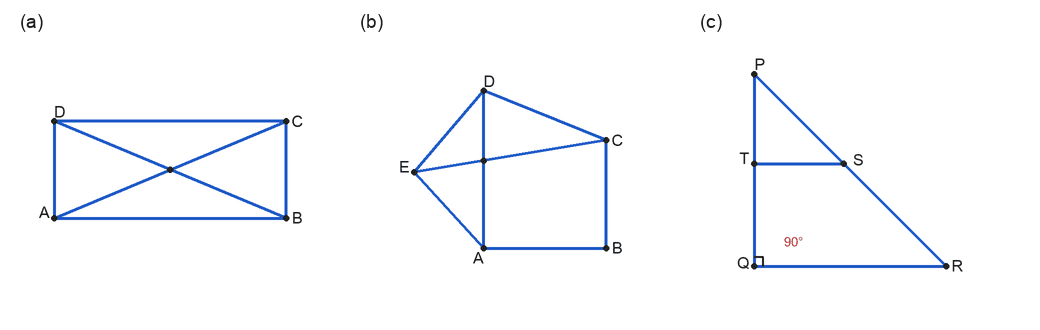
Name the line segments in the following figures.
 Solve with AI
Written solution
Solution:
Concept: A line segment is the straight path between two named points. We name it by its two end points, in either order: AB and BA are the same segment.
Step 1 — Figure (a).
We go round the rectangle ABCD and name its four sides. Then we name the two lines drawn inside it, which join opposite corners.
Sides: AB, BC, CD and DA.
Lines inside: AC and BD.
Step 2 — Figure (b).
We go round the five-sided figure ABCDE and name its five sides. Then we name the two lines drawn inside it.
Sides: AB, BC, CD, DE and EA.
Lines inside: AD and CE.
Step 3 — Figure (c).
T lies on PQ, and S lies on PR. So PQ is made of two parts, PT and TQ, and PR is made of two parts, PS and SR. We name the whole lines, their parts, the side QR and the line TS.
On PQ: PQ, PT and TQ.
On PR: PR, PS and SR.
The others: QR and TS.
Watch out: In (c), do not forget the parts of a side. Since T is on PQ, PT and TQ are segments too.
Note: In (a) and (b) the two inside lines cross at a point that has no letter (shown by a dot). We name only segments between lettered points, so we do not count the parts at that point.
Therefore, (a) AB, BC, CD, DA, AC, BD; (b) AB, BC, CD, DE, EA, AD, CE; (c) PQ, PT, TQ, PR, PS, SR, QR, TS.
- 23 marks
Question 2
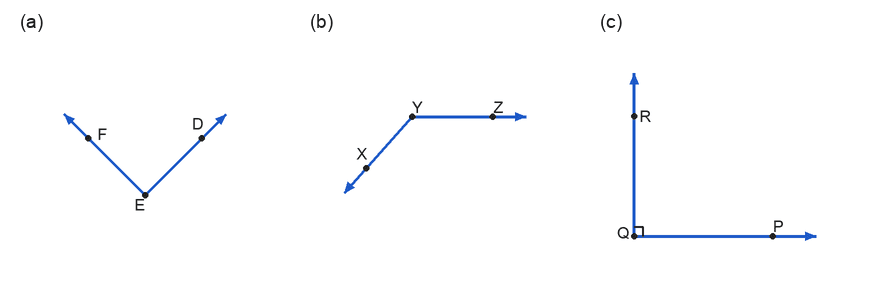
For each of the following angles name the vertex and the arms.
 Solve with AI
Written solution
Solution:
Concept: An angle is made by two arms (rays) that start from the same point. That common starting point is the vertex. We name an arm by the vertex first and then a point on the arm.
Step 1 — Figure (a).
The two arms start from E, so E is the vertex. The arms go out through F and through D.
Vertex: E. Arms: EF and ED.
Step 2 — Figure (b).
The two arms start from Y. They go out through X and through Z.
Vertex: Y. Arms: YX and YZ.
Step 3 — Figure (c).
The two arms start from Q. They go out through R and through P.
Vertex: Q. Arms: QR and QP.
Watch out: An arm is named from the vertex, so write EF, not FE.
Therefore, (a) vertex E, arms EF and ED; (b) vertex Y, arms YX and YZ; (c) vertex Q, arms QR and QP.
- 33 marks
Question 3
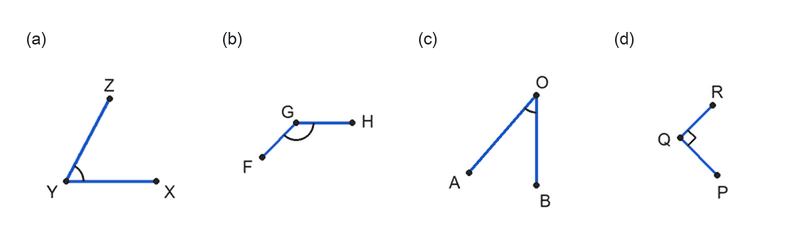
Write the names of the angles (acute, right, or obtuse).
 Solve with AI
Written solution
Solution:
Concept: An acute angle is less than 90°. A right angle is exactly 90° and is shown by a small square. An obtuse angle is more than 90° but less than 180°.
Step 1 — Compare each angle with a right angle.
A right angle looks like the corner of a page. We put a page corner on each angle and see if the angle is smaller, bigger or the same.
Step 2 — Name each angle.
We use what we see.
Part Angle Compared with a right angle Type (a) ∠XYZ smaller acute (b) ∠FGH bigger obtuse (c) ∠AOB smaller (narrow) acute (d) ∠PQR same (square mark) right Watch out: The size of an angle does not depend on how long its arms are drawn. Look only at how wide it opens.
Therefore, (a) acute; (b) obtuse; (c) acute; (d) right angle.
- 43 marks
Question 4
Find the lengths of the following line segments using a ruler.
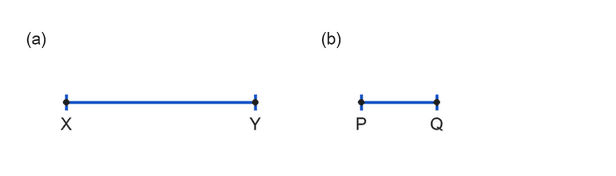
(a) XY = ____ cm (b) PQ = ____ cm
Solve with AIWritten solution
Solution:
Concept: To measure a line segment, we start the ruler's 0 at one end point and read the mark at the other end point. Each centimetre has 10 small parts, and each small part is 0.1 cm (1 mm).
Step 1 — Place the ruler.
We put the 0 mark of the ruler exactly on X. The edge of the ruler lies along XY.
Step 2 — Read the other end.
We read the mark under Y. It is 4 cm and 5 small parts, so XY is 4.5 cm. In the same way, PQ reads 1 cm and 8 small parts, so PQ is 1.8 cm.
So XY is two and a half times as long as PQ, as the figure shows.
Watch out: Start from 0, not from the end of the ruler. Many rulers have a little gap before 0.
Note: A screen may show the picture bigger or smaller than its real size. These lengths are for the figure at its real size.
Therefore, (a) XY = 4.5 cm; (b) PQ = 1.8 cm.
- 53 marks
Question 5
Draw line segments of the following lengths:
(a) 8 cm (b) 2.8 cm (c) 4.5 cm
Solve with AIWritten solution
Solution:
Concept: To draw a line segment of a given length, we mark a point, put the ruler's 0 on it, mark the second point at the given length and join the two points.
Step 1 — Draw AB = 8 cm.
We mark a point A. We put the ruler's 0 on A and mark a point B at 8 cm. Then we join A and B.
Step 2 — Draw CD = 2.8 cm.
We mark C and put the 0 on it. We count 2 cm and then 8 small parts, mark D there and join C and D.
Step 3 — Draw EF = 4.5 cm.
We mark E and put the 0 on it. We count 4 cm and then 5 small parts, mark F there and join E and F.

Watch out: Hold the ruler firmly so it does not slip while you draw.
Therefore, (a) AB = 8 cm; (b) CD = 2.8 cm; (c) EF = 4.5 cm.
- 63 marks
Question 6
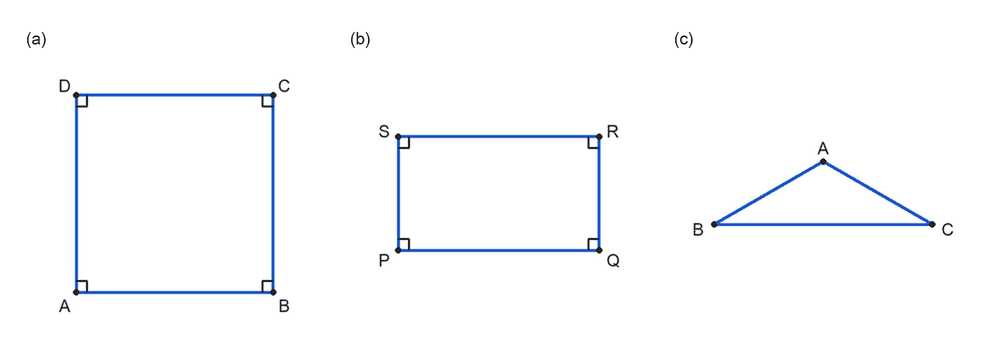
Measure the lengths of the sides of (a) square (b) rectangle (c) triangle.
 Solve with AI
Written solution
Solution:
Concept: We measure each side with a ruler, starting from 0. All four sides of a square are equal, and the opposite sides of a rectangle are equal. These facts help us check our readings.
Step 1 — The square.
We measure each side of ABCD with a ruler. All four sides read the same.
Each of AB, BC, CD and DA is 4.7 cm.
Step 2 — The rectangle.
We measure the sides of PQRS. The opposite sides are equal.
PQ and RS are each 4.8 cm. PS and QR are each 2.7 cm.
Step 3 — The triangle.
We measure the three sides of ABC. Two of them are equal.
AB and AC are each 3 cm. BC is 5.2 cm.
Watch out: If two sides of the square read differently, measure again; a square's sides are all equal.
Note: A screen may show the picture bigger or smaller than its real size. These lengths are for the figure at its real size.
Therefore, (a) each side of the square is 4.7 cm; (b) PQ and RS are 4.8 cm, PS and QR are 2.7 cm; (c) AB and AC are 3 cm, BC is 5.2 cm.
- 73 marks
Question 7
Measure each of the following angles:
 Solve with AI
Written solution
Solution:
Concept: A protractor measures angles in degrees (°). It has two scales, one starting from 0 on the right and one starting from 0 on the left.
Step 1 — Place the protractor.
We put the centre of the protractor on the vertex. Its base line lies along one arm.
Step 2 — Read the scale.
We start from the 0 that lies on that arm and read where the other arm crosses the scale.
Part Angle Reading (a) ∠ABC 68° (b) ∠PQR 49° (c) ∠DEF 132° Step 3 — Check the readings.
Angles (a) and (b) are smaller than a right angle, so their readings must be less than 90°. Angle (c) is wider than a right angle, so its reading must be more than 90°. All three readings fit.
Watch out: Use the scale that starts at 0 on your arm. Using the other scale gives 180° minus the angle, like 112° for 68°.
Therefore, (a) ∠ABC = 68°; (b) ∠PQR = 49°; (c) ∠DEF = 132°.
- 83 marks
Question 8
Construct angles of the following measures using a protractor:
(a) 45° (b) 75° (c) 90°
(d) 135° (e) 150° (f) 170°
Solve with AIWritten solution
Solution:
Concept: To draw an angle with a protractor, we draw one arm, put the protractor's centre on its end point, mark the required number of degrees and join that mark to the vertex.
Step 1 — Draw the first arm.
We draw a ray BA with a ruler.
Step 2 — Place the protractor.
We put the centre of the protractor on B, with its base line along BA.
Step 3 — Mark the angle.
We start at the 0 that lies on BA. We move along that scale to 45 and mark a point C.
Step 4 — Draw the second arm.
We take away the protractor and join B to C, running the line past C. Then ∠ABC = 45°.
Step 5 — Draw the other angles.
We do the same for 75°, 90°, 135°, 150° and 170°, marking C at that number each time.
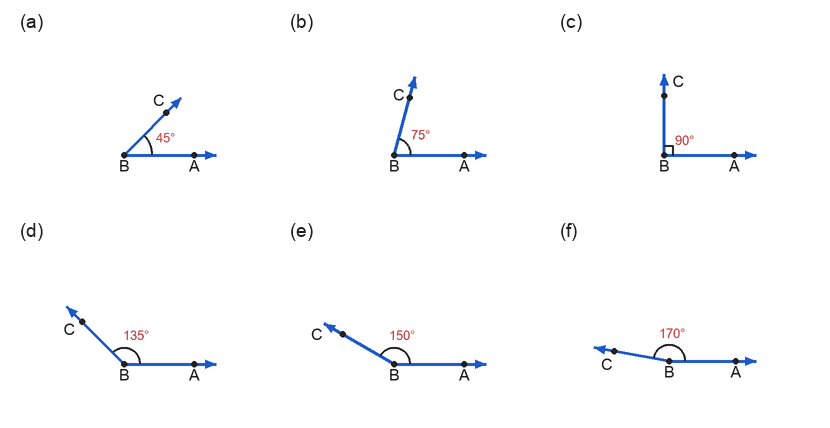
Watch out: Angles of 135°, 150° and 170° are obtuse, so they open wide. If your 150° angle looks narrow, you read the wrong scale.
Therefore, the angles 45°, 75°, 90°, 135°, 150° and 170° are drawn as ∠ABC in the figure.
- 93 marks
Question 9
Classify the following triangles :
 Solve with AI
Written solution
Solution:
Concept: By sides: equilateral (all three sides equal), isosceles (two sides equal), scalene (all sides different). By angles: acute (all angles less than 90°), right (one angle of 90°), obtuse (one angle more than 90°).
Step 1 — Triangles named by their sides.
In (a) all three sides are 6 cm, so the triangle is equilateral. In (e) the sides are 3 cm, 6 cm and 8 cm, all different, so the triangle is scalene.
Step 2 — Triangles named by their angles.
In (b) the angles are 35°, 65° and 80°, all less than 90°, so the triangle is acute. In (c) ∠Y = 100° and in (f) ∠S = 130°; each is more than 90°, so these triangles are obtuse. In (d) ∠N has the square mark, so the triangle is a right triangle.
Watch out: One angle of more than 90° is enough to make a triangle obtuse; the other two angles are then acute.
Note: We use the facts marked on each figure. A triangle also has a name of the other kind; for example, the triangle in (a) has three angles of 60°, so it is also acute.
Therefore, (a) equilateral; (b) acute; (c) obtuse; (d) right; (e) scalene; (f) obtuse.
- 103 marks
Question 10
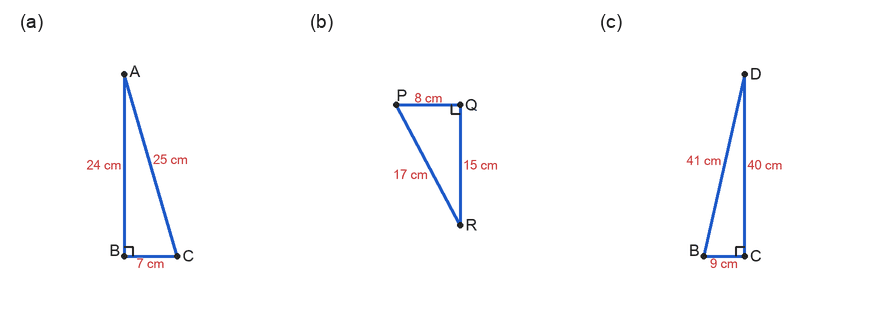
Find the area of the following right triangles.
 Solve with AI
Written solution
Solution:
Concept: The area of a right triangle is half the area of a rectangle with the same two short sides: Area . The base and the height are the two sides that make the right angle.
Step 1 — Triangle (a).
The right angle is at B, so the sides AB = 24 cm and BC = 7 cm make the right angle. We use them as the height and the base.
Step 2 — Triangle (b).
The right angle is at Q, so PQ = 8 cm and QR = 15 cm make the right angle.
Step 3 — Triangle (c).
The right angle is at C, so BC = 9 cm and CD = 40 cm make the right angle.
Watch out: Do not use the longest side (25 cm, 17 cm or 41 cm). It is opposite the right angle and is not a height.
Therefore, (a) 84 cm²; (b) 60 cm²; (c) 180 cm².
- 113 marks
Question 11
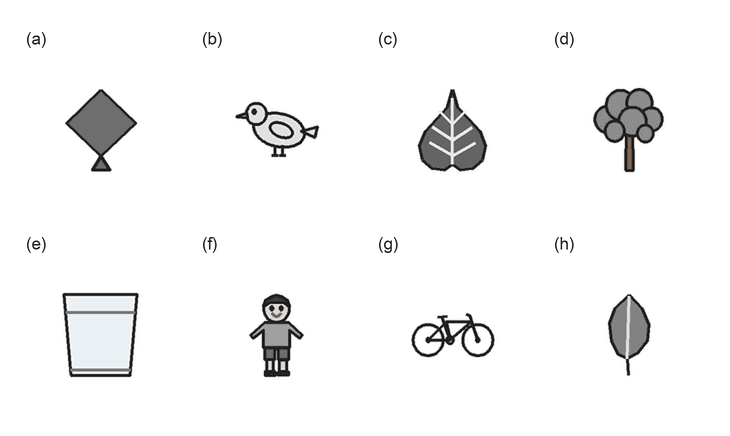
Identify and tell which of the following are symmetrical.
 Solve with AI
Written solution
Solution:
Concept: A picture is symmetrical when a line can divide it into two halves that are mirror images. If we fold it along that line, one half covers the other exactly.
Step 1 — Fold each picture in your mind.
We imagine a fold down the middle of each picture and ask: do the two halves match exactly?
Step 2 — The pictures that match.
The kite, the peepal leaf, the glass and the boy each have a vertical line down the middle, and the two halves match.
Step 3 — The pictures that do not match.
The bird faces one way. The tree's round clumps are uneven. The bicycle's seat and handle are different. The leaf in (h) has uneven sides and a stalk bent to one side.
Watch out: Both halves must match exactly, not just look alike in size.
Therefore, (a) the kite, (c) the peepal leaf, (e) the glass and (f) the boy are symmetrical; (b), (d), (g) and (h) are not.
- 123 marks
Question 12
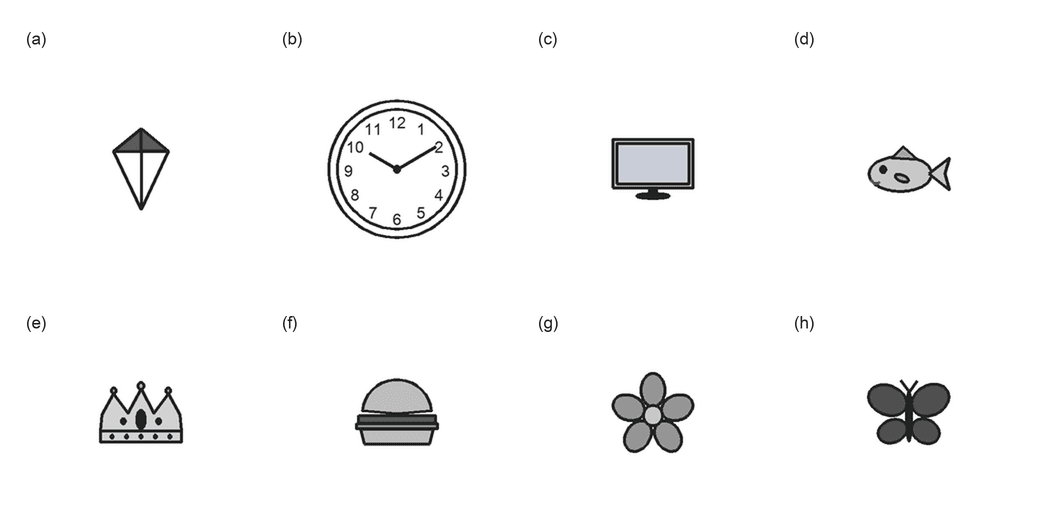
Draw a line of symmetry in the following, wherever possible.
 Solve with AI
Written solution
Solution:
Concept: A line of symmetry divides a figure into two halves that are mirror images of each other.
Step 1 — Look for a fold in each picture.
We look for a line that splits the picture into two matching halves.
Step 2 — Draw the lines.
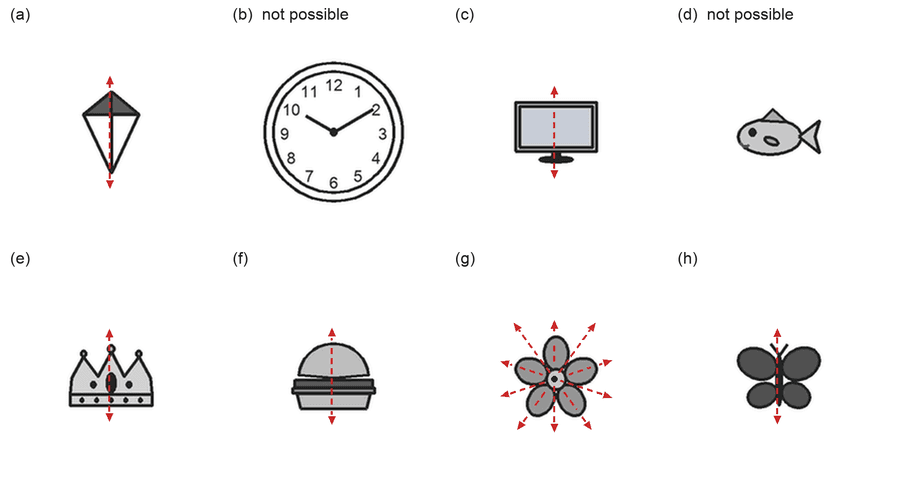
The kite, the TV, the crown, the burger and the butterfly each have one vertical line down the middle. The flower has five equal petals, so it has five lines, one through each petal and the centre.
Step 3 — Pictures with no line.
The clock has hands of different lengths, and its numbers on the two sides (like 2 and 10) are not mirror images. The fish has its head on one side and its tail on the other. So no line is possible.
Watch out: A picture can have more than one line. The flower has five.
Therefore, (a) kite, (c) TV, (e) crown, (f) burger and (h) butterfly have one line each; (g) the flower has five lines; for (b) the clock and (d) the fish a line is not possible.
- 133 marks
Question 13
Draw a line of symmetry in letters between A to Z, wherever possible.
Solve with AIWritten solution
Solution:
Concept: A letter has a line of symmetry if folding it along that line makes the two halves match exactly. We try a vertical fold and a horizontal fold.
Step 1 — Try a vertical fold.
We fold each capital letter down the middle, from top to bottom.
Vertical line: A, H, I, M, O, T, U, V, W, X, Y.
Step 2 — Try a horizontal fold.
We fold each letter across the middle, from left to right.
Horizontal line: B, C, D, E, H, I, K, O, X.
Step 3 — Letters with no line.
The other letters match neither way.
No line: F, G, J, L, N, P, Q, R, S, Z.

Watch out: N, S and Z look balanced, but no fold makes their halves match. They have no line of symmetry.
Note: K has a horizontal line when its two arms meet the upright exactly at the middle, as in the figure. In some printed styles the arms meet a little above the middle, and then K has no line.
Therefore, vertical lines: A, H, I, M, O, T, U, V, W, X, Y; horizontal lines: B, C, D, E, H, I, K, O, X (H, I, O and X have both); no line: F, G, J, L, N, P, Q, R, S, Z.
- 143 marks
Question 14
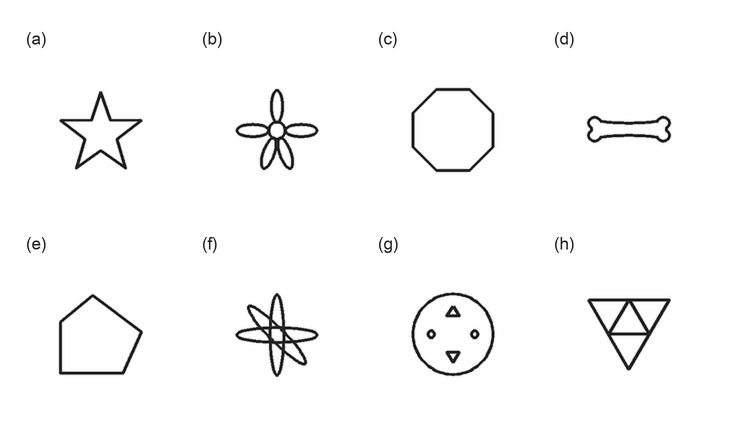
Draw all possible lines of symmetry in each of the following.
 Solve with AI
Written solution
Solution:
Concept: To find all the lines of symmetry, we try every fold: through the corners, through the middles of the sides and through the centre. Lines of symmetry of one figure all pass through its centre.
Step 1 — Shapes with one or two lines.
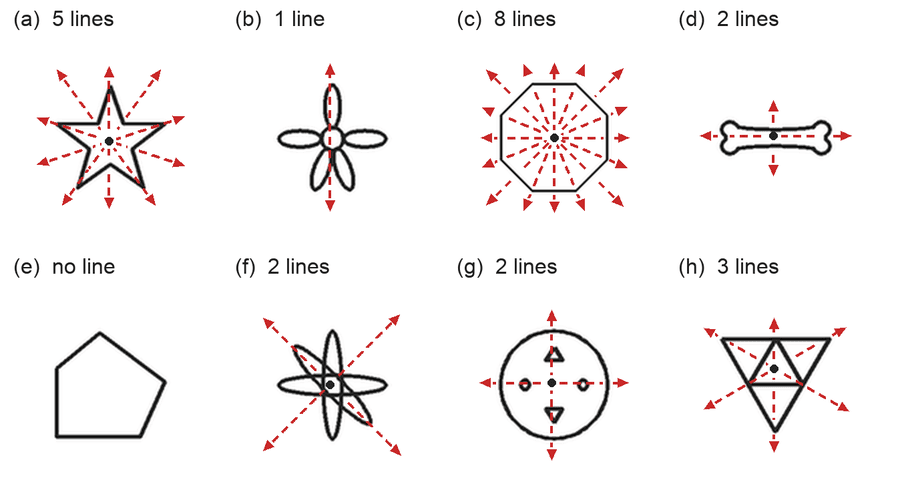
The flower has only one line, the vertical one, because its lower petals are not like its top petal. The bone has two lines: one along its length and one across its middle. The circle design has two: one vertical and one horizontal.
Step 2 — Shapes with many lines.
The star has 5 lines, one from each point through the centre. The octagon with equal sides has 8 lines: 4 join opposite corners and 4 join the middles of opposite sides. The divided triangle has 3 lines, one from each corner to the middle of the opposite side.
Step 3 — The three ovals and the pentagon.
For the three ovals, the slanting oval's long line and the line across it at right angles each swap the upright oval and the flat oval, so there are 2 lines. The pentagon as drawn has sides of different lengths, so no fold makes it match.
Watch out: Count every line. A regular octagon has 8, not 4.
Therefore, (a) 5 lines; (b) 1 line; (c) 8 lines; (d) 2 lines; (e) no line; (f) 2 lines; (g) 2 lines; (h) 3 lines.
- 153 marks
Question 15
Draw the geometrical figure mentioned below and write the number of lines of symmetry possible for each.
(a) Rectangle ____ (b) Equilateral triangle ____
(c) Scalene triangle ____ (d) Isosceles triangle ____
(e) Trapezium ____ (f) Square ____
(g) Parallelogram ____ (h) Semicircle ____
Solve with AIWritten solution
Solution:
Concept: A line of symmetry folds a shape so that the two halves cover each other exactly. The more equal sides and angles a shape has, the more lines it can have.
Step 1 — Draw the shapes.
We draw each shape and try every fold.

Step 2 — Count the lines.
We write the number of folds that make the two halves match.
Shape Lines of symmetry Where (a) Rectangle 2 through the middles of opposite sides (b) Equilateral triangle 3 from each corner to the middle of the opposite side (c) Scalene triangle 0 — (d) Isosceles triangle 1 from the corner between the equal sides to the middle of the base (e) Trapezium 0 — (f) Square 4 2 through the middles of opposite sides, 2 along the diagonals (g) Parallelogram 0 — (h) Semicircle 1 through the centre, at right angles to the straight edge Watch out: A rectangle's diagonals are NOT lines of symmetry; folding along a diagonal does not make the halves match.
Note: A trapezium whose two slanting sides are not equal has no line of symmetry, as drawn here. A trapezium with equal slanting sides (an isosceles trapezium) has 1 line, through the middles of its parallel sides.
Therefore, (a) 2; (b) 3; (c) none; (d) 1; (e) none; (f) 4; (g) none; (h) 1.
- 163 marks
Question 16
Complete the following figures using graph paper.
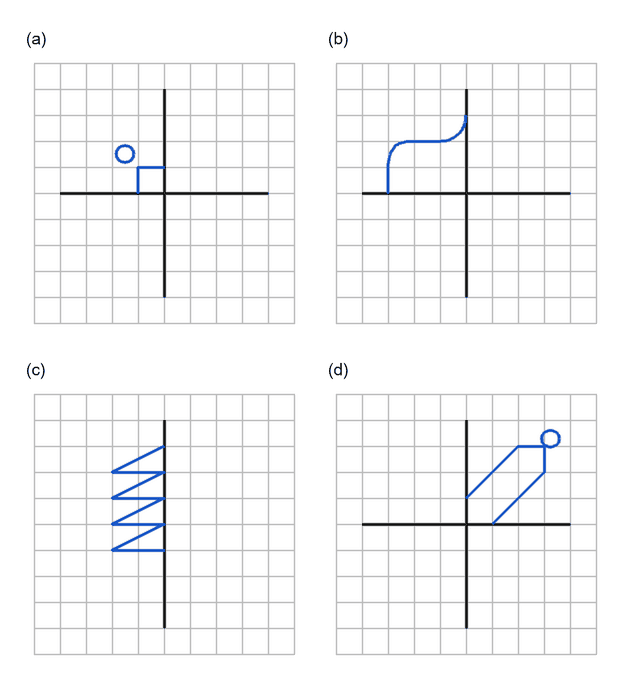 Solve with AI
Written solution
Solution:
Concept: A mirror line works like a mirror. Each point of the figure has an image on the other side, the same distance from the line, straight across it.
Step 1 — Count squares to the mirror.
For every corner of the figure, we count the squares from it to the mirror line. We mark its image the same number of squares on the other side.
Step 2 — Reflect in both lines.
Where there are two mirror lines, we first reflect in one line. Then we reflect everything we now have in the other line.
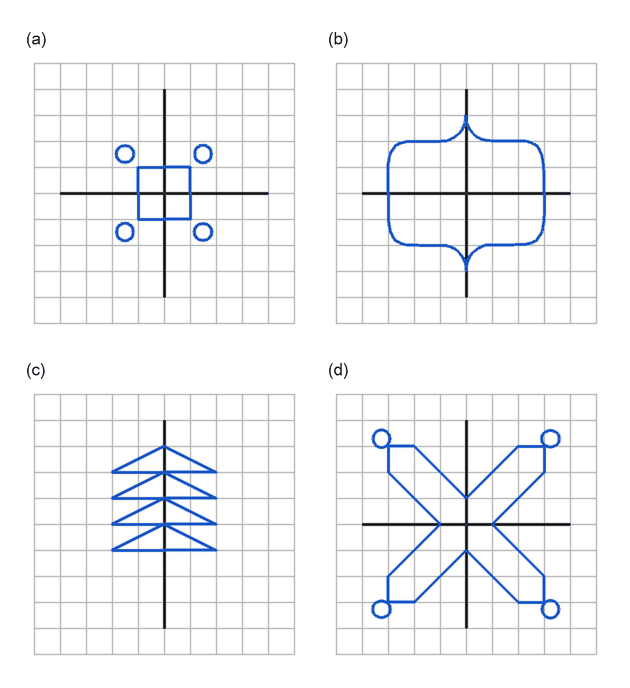
Step 3 — Describe the results.
Here is what we get. (a) The four reflections make a square in the middle with a small circle near each corner. (b) They make a closed curve shaped like a pair of brackets. (c) The zigzag and its image in the vertical line make a fir-tree of four arrow-heads. (d) The four reflections make an X shape with a small circle at each end.
Watch out: Count the squares from the mirror line, not from the edge of the graph paper.
Therefore, (a) a square with a small circle near each corner; (b) a closed bracket-shaped curve; (c) a fir-tree of four arrow-heads; (d) an X shape with a small circle at each end, as in the figure.
- 173 marks
Question 17
Complete the following figures using a graph paper.
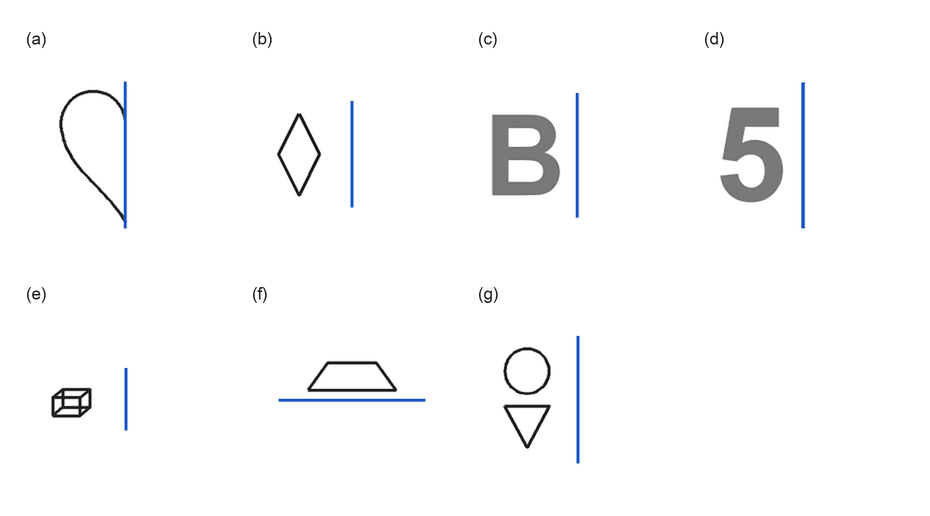 Solve with AI
Written solution
Solution:
Concept: A mirror image is the same size and shape as the figure, but turned the other way, like your reflection in a mirror.
Step 1 — Reflect each figure.
Every point goes straight across the blue line to the same distance on the other side. So left and right are swapped (or top and bottom, when the line is flat).

Step 2 — Describe the results.
Here is what we get. (a) The half heart becomes a whole heart. (b) A second rhombus appears on the right, as far from the line as the first. (c) The mirror image of B, facing the other way, appears on the right. (d) The mirror image of 5 appears on the right. (e) A second box appears, its slanting edges going the other way. (f) An upside-down trapezium appears below the line. (g) Another circle with a triangle below it appears on the right.
Watch out: A mirror image of a letter or digit faces the other way. B does not stay B; its bowls face left.
Therefore, each figure is completed by its mirror image in the blue line, as shown in the answer figure.
What Class 5 Maths Ch 15 covers
The sections of the chapter, in the order the book takes them. Every question above comes from one of these.
- 01Triangles
- 02Symmetry
- 03More Than One Line of Symmetry
- 04Reflection
- 05Nets of 3D Figures
More ways to study this chapter
The same chapter asked three other ways. Practise it, revise it, and see what the board has set on Ch 15 before.
Class 5 Maths Ch 15 questions students ask
How many questions are there in Class 5 Maths Ch 15?
17 questions. Every one is solved step by step on this page.
Are these Class 5 Maths solutions free?
Yes. Every question and its full working is free to read, with no account needed.
Can I download the Class 5 Maths Ch 15 solutions as a PDF?
There is no PDF to download. Every solution is on this page instead, which means it is searchable, always the current syllabus, and readable on a phone. Use your browser's print option if you want it on paper.