
Opening your dashboard
Class 5 Maths Chapter 14: Introduction to Negative Numbers Solutions
18 textbook questions with step-by-step answers, free to read, for ICSE 2026-27.
Get talked through Ch 14, not just shown the answer
Reading a finished solution is not the same as being able to do it. The AI tutor takes one question at a time and works it with you, in your own words, until you can.
- Ask it out loud, in your own words
- It gives you the next step, not the answer
- Stuck on part (ii)? Start there
18 questions with solutions
3 marks · Mixed difficulty
- 13 marks
Question 1
Which number in each of the following pairs is bigger ?
(a) (b) (c) (d)
(e) (f) (g) (h)
Solve with AIWritten solution
Solution:
Concept: On a number line, numbers get bigger as we go to the right. So the number on the right is the bigger one, and the number on the left is the smaller one. Every positive number is bigger than 0, and 0 is bigger than every negative number.
Step 1 — A positive and a negative number.
In parts (a), (b) and (h), one number is positive and the other is negative. A positive number is always on the right of a negative number, so the positive number is bigger.
Step 2 — Zero and a positive number.
In part (g), 7 is on the right of 0. So 7 is bigger.
Step 3 — Two negative numbers.
In parts (c), (d), (e) and (f), both numbers are negative. The one nearer to 0 is on the right, so it is the bigger one.
Watch out: For negative numbers, the one that looks bigger is the smaller one. For example, −6 is smaller than −5.
Therefore, the bigger numbers are (a) 2; (b) 3; (c) −5; (d) −1; (e) −4; (f) −15; (g) 7; (h) 3.
- 23 marks
Question 2
Which number in each of the folloiwng pairs is smaller ?
(a) (b) (c) (d)
(e) (f) (g) (h)
Solve with AIWritten solution
Solution:
Concept: On a number line, numbers get bigger as we go to the right. So the number on the right is the bigger one, and the number on the left is the smaller one. Every positive number is bigger than 0, and 0 is bigger than every negative number.
Step 1 — Pairs with zero.
In part (a), is on the left of 0. In part (d), 0 is on the left of 5. The number on the left is smaller.
Step 2 — A positive and a negative number.
In parts (b), (c), (e) and (g), the negative number is on the left of the positive number. So the negative number is smaller.
Step 3 — Two negative numbers.
In parts (f) and (h), both numbers are negative. The one farther from 0 is on the left, so it is smaller.
Watch out: −20 is smaller than −14, even though 20 is bigger than 14.
Therefore, the smaller numbers are (a) −3; (b) −2; (c) −7; (d) 0; (e) −15; (f) −10; (g) −13; (h) −20.
- 33 marks
Question 3
Use a number line to write the following integers in ascending order.
(a) and
(b) and
(c) and
Solve with AIWritten solution
Solution:
Concept: On a number line, numbers get bigger as we go to the right. So the number on the right is the bigger one, and the number on the left is the smaller one. Every positive number is bigger than 0, and 0 is bigger than every negative number. Ascending order means from the smallest to the biggest.
Step 1 — Part (a).
We mark the integers on a number line. Then we read them from left to right, which is from the smallest to the biggest.

Step 2 — Part (b).
We mark the integers on a number line. Then we read them from left to right, which is from the smallest to the biggest.

Step 3 — Part (c).
We mark the integers on a number line. Then we read them from left to right, which is from the smallest to the biggest.

Watch out: Start with the number farthest to the left. That is the negative number with the biggest size, like −7.
Therefore, (a) −7 < −6 < −5 < −1 < 0 < 2 < 4 < 5; (b) −9 < −6 < −5 < −4 < 0 < 3 < 4 < 7; (c) −10 < −2 < 0 < 3 < 4 < 7 < 9 < 12.
- 43 marks
Question 4
Use a number line to write the following integers in descending order.
(a) and
(b) and
(c) and
Solve with AIWritten solution
Solution:
Concept: On a number line, numbers get bigger as we go to the right. So the number on the right is the bigger one, and the number on the left is the smaller one. Every positive number is bigger than 0, and 0 is bigger than every negative number. Descending order means from the biggest to the smallest.
Step 1 — Part (a).
We mark the integers on a number line. Then we read them from right to left, which is from the biggest to the smallest.

Step 2 — Part (b).
We mark the integers on a number line. Then we read them from right to left, which is from the biggest to the smallest.

Step 3 — Part (c).
We mark the integers on a number line. Then we read them from right to left, which is from the biggest to the smallest.

Watch out: In descending order, −1 comes before −2, because −1 is on the right of −2.
Therefore, (a) 22 > 16 > 5 > 2 > 0 > −7 > −12; (b) 16 > 8 > 3 > 0 > −1 > −2 > −4 > −5; (c) 12 > 10 > 5 > 2 > 0 > −6 > −7 > −8.
- 53 marks
Question 5
Write the negatives of the following numbers.
(a) (b) (c) (d)
(e) (f) (g) (h)
Solve with AIWritten solution
Solution:
Concept: The negative (or opposite) of a number has the same size but the other sign. The negative of 6 is , and the negative of is 6. Zero has no sign, so the negative of 0 is 0.
Step 1 — Negative numbers.
The negative of a negative number is a positive number. We just drop the minus sign.
Step 2 — Positive numbers.
The negative of a positive number is a negative number. We put a minus sign in front.
Step 3 — Zero.
Zero is neither positive nor negative. So the negative of 0 is 0.
Watch out: The negative of a number is not always a negative number. The negative of −12 is +12.
Therefore, the negatives are (a) 12; (b) −6; (c) 0; (d) 7; (e) 4; (f) 10; (g) −8; (h) −4.
- 63 marks
Question 6
Mark the following integers on a number line.
(a) (b) (c) (d)
(e) (f) (g) (h)
Solve with AIWritten solution
Solution:
Concept: A number line has 0 in the middle and equal steps on both sides. Positive integers are on the right of 0 and negative integers are on the left of 0.
Step 1 — Choose how long the line must be.
The smallest number is and the biggest is 12. So the line must go at least from on the left to 12 on the right. We draw it a little longer, from to 13.
Step 2 — Mark equal steps.
We mark 0. Then we mark equal steps on both sides of 0. The positive numbers 1, 2, 3, … go to the right, and the negative numbers , , , … go to the left.
Step 3 — Put a dot on each integer.
We put a dot on each given integer and write its part letter above it.

Watch out: Count the steps from 0 carefully. The integer −9 is 9 steps to the left of 0, not 9 steps from −1.
Therefore, the dots are at (f) −15, (c) −9, (a) −6, (h) −4, (d) −2, (b) 0, (g) 6 and (e) 12, from left to right.
- 73 marks
Question 7
How many integers are there between the following integers ?
(a) and (b) and (c) and
(d) and (e) and (f) and
Solve with AIWritten solution
Solution:
Concept: The integers "between" two integers are the ones that lie strictly between them. The two given integers are not counted. So the number of integers between them is (bigger − smaller) − 1.
Step 1 — Part (a).
The integers between and are , , , , and . We count them: there are 6. We can check this with the rule: bigger − smaller − 1.
Step 2 — Part (b).
The integers between and are , , , , and . We count them: there are 6. We can check this with the rule: bigger − smaller − 1.
Step 3 — Part (c).
The integers between and are , , , , and . We count them: there are 6. We can check this with the rule: bigger − smaller − 1.
Step 4 — Part (d).
The integers between and are , , , , , , , and . We count them: there are 9. We can check this with the rule: bigger − smaller − 1.
Step 5 — Part (e).
The integers between and are , , , and . We count them: there are 5. We can check this with the rule: bigger − smaller − 1.
Step 6 — Part (f).
The integers between and are , , , , , and . We count them: there are 7. We can check this with the rule: bigger − smaller − 1.
Watch out: Do not count the two given integers. Between −5 and 2 there are 6 integers, not 8.
Therefore, the numbers of integers between them are (a) 6; (b) 6; (c) 6; (d) 9; (e) 5; (f) 7.
- 83 marks
Question 8
Write all integers between the following integers.
(a) and (b) and (c) and
(d) and (e) and (f) and
Solve with AIWritten solution
Solution:
Concept: The integers "between" two integers are the ones that lie strictly between them. We do not write the two given integers.
Step 1 — Part (a).
We start just after and stop just before . So we write the 8 integers from to .
Step 2 — Part (b).
We start just after and stop just before . So we write the 7 integers from to .
Step 3 — Part (c).
We start just after and stop just before . So we write the 4 integers from to .
Step 4 — Part (d).
We start just after and stop just before . So we write the 6 integers from to .
Step 5 — Part (e).
We start just after and stop just before . So we write the 5 integers from to .
Step 6 — Part (f).
We start just after and stop just before . So we write the 9 integers from to .
Watch out: For part (c), the integers between 0 and −5 are −4, −3, −2 and −1; 0 and −5 themselves are left out.
Therefore, (a) −1, 0, 1, 2, 3, 4, 5, 6; (b) −3, −2, −1, 0, 1, 2, 3; (c) −4, −3, −2, −1; (d) 3, 4, 5, 6, 7, 8; (e) 0, 1, 2, 3, 4; (f) 1, 2, 3, 4, 5, 6, 7, 8, 9.
- 93 marks
Question 9
Indicate the following situations by using integers.
(a) A loss of ₹ 90 (b) A profit of ₹ 48
(c) 5 km above ground level (d) 2 km below water level
(e) 22°C above zero (f) 3°C below zero
Solve with AIWritten solution
Solution:
Concept: Integers can show two opposite ideas. We use positive integers for profit, gain, above, up and going forward. We use negative integers for loss, below, down and going back.
Step 1 — Decide the sign.
We look for the key word in each situation. Profit and above are positive. Loss and below are negative.
Step 2 — Write the integers.
We write the number with its sign.
Part Situation Key word Integer (a) A loss of ₹ 90 loss −90 (b) A profit of ₹ 48 profit +48 (c) 5 km above ground level above +5 (d) 2 km below water level below −2 (e) 22°C above zero above +22 (f) 3°C below zero below −3 Watch out: A loss of ₹ 90 is −90, not 90. The sign shows the kind of change.
Therefore, (a) −90; (b) +48; (c) +5; (d) −2; (e) +22; (f) −3.
- 103 marks
Question 10
Find the opposite of each of the following.
(a) A profit of ₹ 700 (b)
(c) (d) Going south
(e) A loss of ₹ 500 (f) Decrease in population
(g) Crediting money in bank.
Solve with AIWritten solution
Solution:
Concept: Integers can show two opposite ideas. We use positive integers for profit, gain, above, up and going forward. We use negative integers for loss, below, down and going back. The negative (or opposite) of a number has the same size but the other sign. The negative of 6 is , and the negative of is 6. Zero has no sign, so the negative of 0 is 0.
Step 1 — Opposites of situations.
The opposite of a situation goes the other way. A profit becomes a loss, south becomes north, a decrease becomes an increase, and putting money in becomes taking money out.
Part Given Opposite (a) A profit of ₹ 700 A loss of ₹ 700 (d) Going south Going north (e) A loss of ₹ 500 A profit of ₹ 500 (f) Decrease in population Increase in population (g) Crediting money in bank Withdrawing (debiting) money from bank Step 2 — Opposites of numbers.
The opposite of a number has the same size and the other sign.
Watch out: The opposite keeps the same amount. The opposite of a profit of ₹ 700 is a loss of ₹ 700, not of some other amount.
Therefore, (a) a loss of ₹ 700; (b) +13; (c) −27; (d) going north; (e) a profit of ₹ 500; (f) increase in population; (g) withdrawing money from the bank.
- 113 marks
Question 11
Find the sum of the following :
(a) and (b) and (c) and
(d) and (e) and (f) and
Solve with AIWritten solution
Solution:
Concept: To add two integers with the same sign, we add their sizes and keep that sign. To add two integers with different signs, we take the smaller size from the bigger size and keep the sign of the bigger one.
Step 1 — Parts (a), (b), (d) and (f): same signs.
When the signs are the same, we add the sizes and keep the sign.
Step 2 — Part (c): different signs.
The signs are different. We take 5 from 6 and keep the sign of 6, which is plus.
Step 3 — Part (e): three numbers.
We add the first two numbers, and then add the third number to the result.
Watch out: Two negative numbers never give a positive sum. (−3) + (−2) is −5, not +5.
Therefore, (a) +7; (b) −5; (c) +1; (d) −9; (e) −3; (f) −9.
- 123 marks
Question 12
Add the following :
(a)
(b)
(c)
(d)
(e)
(f)
(g)
(h)
(i)
(j)
Solve with AIWritten solution
Solution:
Concept: To add two integers with the same sign, we add their sizes and keep that sign. To add two integers with different signs, we take the smaller size from the bigger size and keep the sign of the bigger one.
Step 1 — Parts (a) to (f): two numbers.
For two numbers with different signs, we subtract the smaller size from the bigger size and keep the sign of the bigger one. For two negative numbers, we add the sizes and keep the minus sign.
Step 2 — Parts (g) to (j): more than two numbers.
We put all the positive numbers together and all the negative numbers together. Then we combine the two totals.
Watch out: In part (a) the bigger size is 230, and 230 has a minus sign, so the answer is −105, not +105.
Therefore, (a) −105; (b) +890; (c) −631; (d) −604; (e) −1531; (f) −395; (g) −145; (h) −25; (i) −80; (j) −370.
- 133 marks
Question 13
Find the successor and predecessor of the following :
(a) (b) (c) (d)
(e) (f) (g) (h)
Solve with AIWritten solution
Solution:
Concept: The successor of an integer is the integer just after it: one step to the right, so we add 1. The predecessor is the integer just before it: one step to the left, so we take away 1.
Step 1 — Work out part (a).
We use part (a), , to show the method. We add 1 to get the successor and take away 1 to get the predecessor.
Step 2 — Do every part in the same way.
We add 1 for the successor and take away 1 for the predecessor.
Part Number Successor (number + 1) Predecessor (number − 1) (a) −14 −13 −15 (b) 36 37 35 (c) −97 −96 −98 (d) −174 −173 −175 (e) −845 −844 −846 (f) −1094 −1093 −1095 (g) −999 −998 −1000 (h) −1000 −999 −1001 Watch out: For a negative number, the successor is nearer to 0. The successor of −14 is −13, not −15.
Therefore, (a) successor −13, predecessor −15; (b) successor 37, predecessor 35; (c) successor −96, predecessor −98; (d) successor −173, predecessor −175; (e) successor −844, predecessor −846; (f) successor −1093, predecessor −1095; (g) successor −998, predecessor −1000; (h) successor −999, predecessor −1001.
- 143 marks
Question 14
Using the number line find the integer which is :
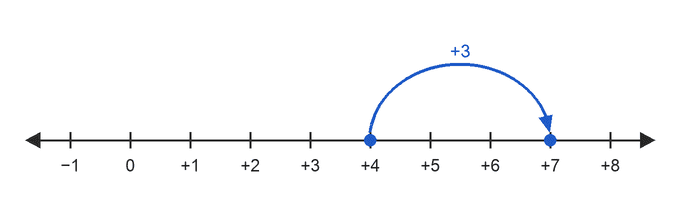
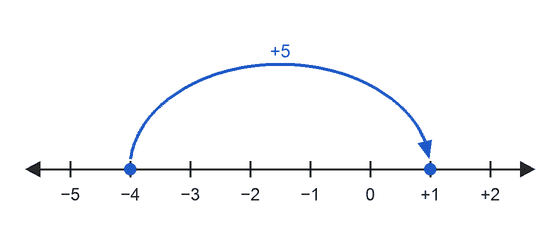
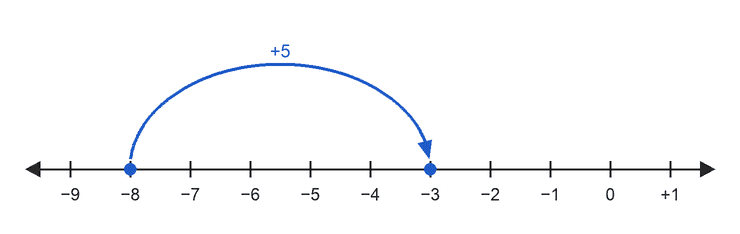
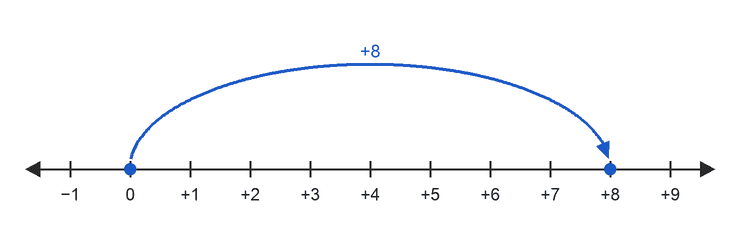
(a) 3 more than 4 (b) 5 more than (c) 5 more than
(d) 8 more than 0 (e) 4 less than (f) 5 less than
Solve with AIWritten solution
Solution:
Concept: On a number line, moving to the right adds and moving to the left takes away. So "3 more than 4" is , and "4 less than " is .
Step 1 — Parts (a) to (d): more than.
The words "more than" mean we start at the number and move to the right. Moving right means adding.
Step 2 — Parts (e) and (f): less than.
The words "less than" mean we start at the number and move to the left. Moving left means taking away.
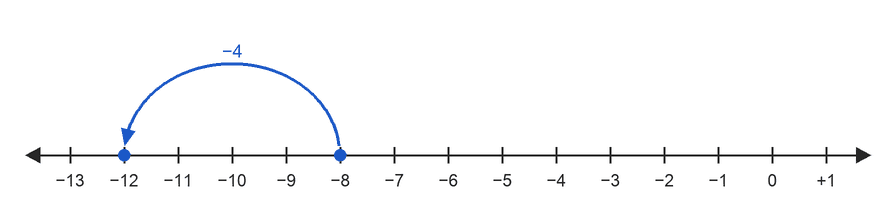
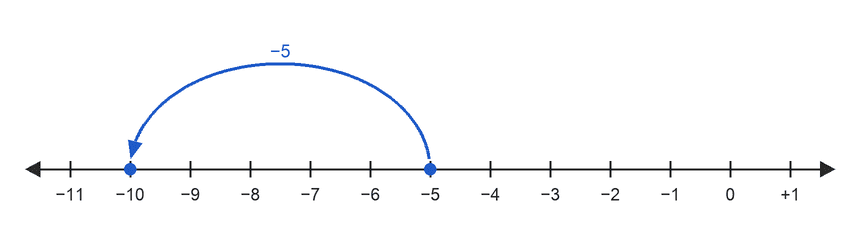
Watch out: The words "4 less than −8" mean start at −8 and move 4 steps left. It is −8 − 4, not 4 − (−8).
Therefore, (a) 7; (b) 1; (c) −3; (d) 8; (e) −12; (f) −10.
- 153 marks
Question 15
Write the additive inverse of following :
(a) (b) (c) (d)
(e) (f) (g) (h)
Solve with AIWritten solution
Solution:
Concept: The additive inverse of a number is the number we add to it to get 0. It is the same number with the other sign. For example, , so the additive inverse of 7 is .
Step 1 — Write the inverses.
We change the sign of each number.
Part Number Additive inverse (a) −5 +5 (b) 3 −3 (c) −12 +12 (d) 16 −16 (e) 25 −25 (f) −54 +54 (g) 8 −8 (h) 4 −4 Step 2 — Check two of them.
A number and its additive inverse must add up to 0.
Watch out: The additive inverse of a negative number is positive. The inverse of −5 is +5.
Therefore, (a) +5; (b) −3; (c) +12; (d) −16; (e) −25; (f) +54; (g) −8; (h) −4.
- 163 marks
Question 16
Subtract the following.
(a) (b) (c) (d)
(e) (f) (g) (h)
(i) (j) (k) (l)
Solve with AIWritten solution
Solution:
Concept: To subtract an integer, we add its opposite: . So subtracting is the same as adding 2, and subtracting 4 is the same as adding .
Step 1 — Subtracting a negative number.
Subtracting a negative number is the same as adding a positive number.
Step 2 — Subtracting a positive number.
Subtracting a positive number is the same as adding a negative number.
Watch out: Change the sign of the number being subtracted only. In (a), (−5) − (−2) becomes (−5) + (+2); the −5 stays as it is.
Therefore, (a) −3; (b) 11; (c) −7; (d) 4; (e) −5; (f) 7; (g) 4; (h) −11; (i) 5; (j) −24; (k) 17; (l) −10.
- 173 marks
Question 17
Simplify.
(a)
(b)
(c)
(d)
(e)
(f)
(g)
(h)
(i)
(j)
(k)
Solve with AIWritten solution
Solution:
Concept: To subtract an integer, we add its opposite: . So subtracting is the same as adding 2, and subtracting 4 is the same as adding . When there are many numbers, we add the positive ones together and the negative ones together, and then combine the two totals.
Step 1 — Parts (a) to (e).
First we change every subtraction of a bracket into adding its opposite. Then we add all the positive numbers, add all the sizes of the negative numbers, and take one total from the other.
Step 2 — Parts (f) to (i).
We do these in the same way.
Step 3 — Part (j): make pairs.
We group the terms in pairs. Each pair, like , makes , and there are 5 pairs.
Step 4 — Part (k): pairs that make zero.
There are 20 terms. They make 10 pairs of , and each pair is 0.
Watch out: In (d), −(−9) becomes +9. Forgetting to change this sign is the most common mistake.
Therefore, (a) −3; (b) −8; (c) −8; (d) −3; (e) 3; (f) 4; (g) 5; (h) 1; (i) 2; (j) −5; (k) 0.
- 183 marks
Question 18
Fill the blanks by (, , ).
(a) ____
(b) ____
(c) ____
(d) ____
(e) ____
Solve with AIWritten solution
Solution:
Concept: To compare two expressions, we first work out each side to get one integer. Then we compare the two integers on the number line: the one on the right is bigger.
Step 1 — Part (a).
The left side is already one integer, so we work out the right side.
Now we compare with . Since is smaller than , the sign is .
Step 2 — Part (b).
The right side is already one integer, so we work out the left side.
Now we compare with . Since is smaller than , the sign is .
Step 3 — Part (c).
We work out both sides, one at a time.
Now we compare with . Since is equal to , the sign is .
Step 4 — Part (d).
We work out both sides, one at a time.
Now we compare with . Since is bigger than , the sign is .
Step 5 — Part (e).
The left side is already one integer, so we work out the right side.
Now we compare with . Since is bigger than , the sign is .
Watch out: In (a), −15 is smaller than −11, because −15 is farther to the left.
Therefore, (a) −15 < −8 − (3); (b) −3 + (−4) < 5; (c) (−5) + (5) = −2 − (−2); (d) 9 − (−2) > −7 + (−6); (e) 10 > −10 + (−4).
What Class 5 Maths Ch 14 covers
The sections of the chapter, in the order the book takes them. Every question above comes from one of these.
- 01Representation of Integers on Number Line
- 02Addition of Integers
- 03Subtraction of Integers
More ways to study this chapter
The same chapter asked three other ways. Practise it, revise it, and see what the board has set on Ch 14 before.
Class 5 Maths Ch 14 questions students ask
How many questions are there in Class 5 Maths Ch 14?
18 questions. Every one is solved step by step on this page.
Are these Class 5 Maths solutions free?
Yes. Every question and its full working is free to read, with no account needed.
Can I download the Class 5 Maths Ch 14 solutions as a PDF?
There is no PDF to download. Every solution is on this page instead, which means it is searchable, always the current syllabus, and readable on a phone. Use your browser's print option if you want it on paper.