
Opening your dashboard
Class 5 Maths Chapter 1: Revision Solutions
11 textbook questions with step-by-step answers, free to read, for ICSE 2026-27.
Get talked through Ch 1, not just shown the answer
Reading a finished solution is not the same as being able to do it. The AI tutor takes one question at a time and works it with you, in your own words, until you can.
- Ask it out loud, in your own words
- It gives you the next step, not the answer
- Stuck on part (ii)? Start there
11 questions with solutions
3 marks · Easy difficulty
- 13 marks
Question 1
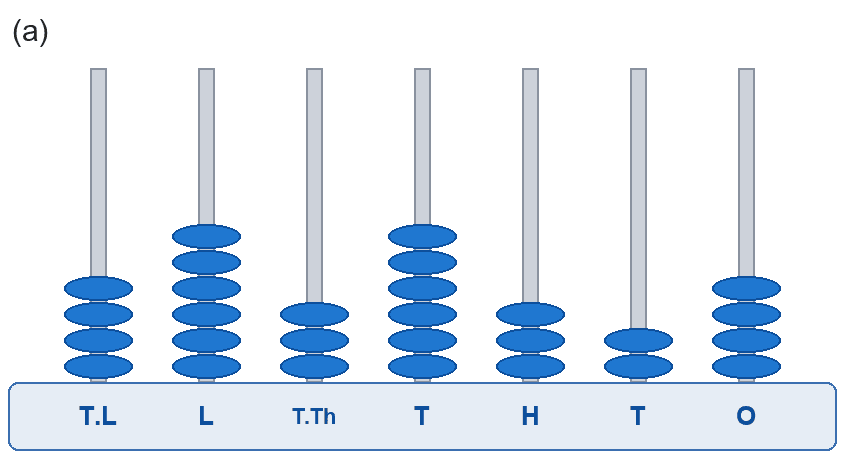
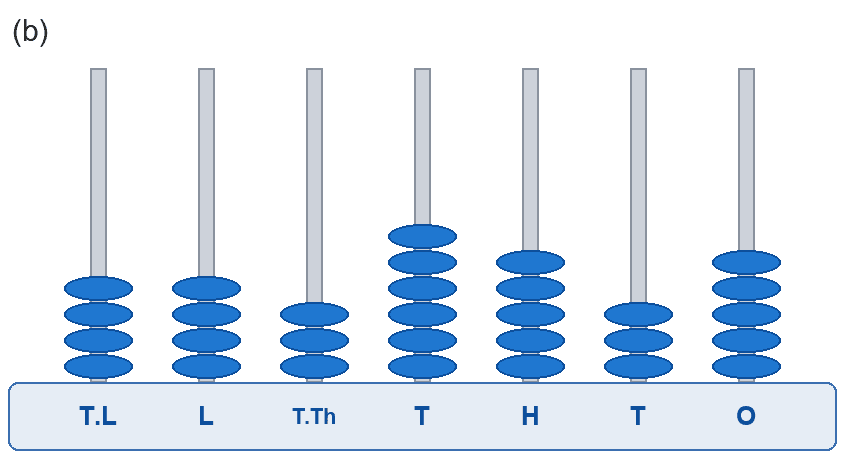
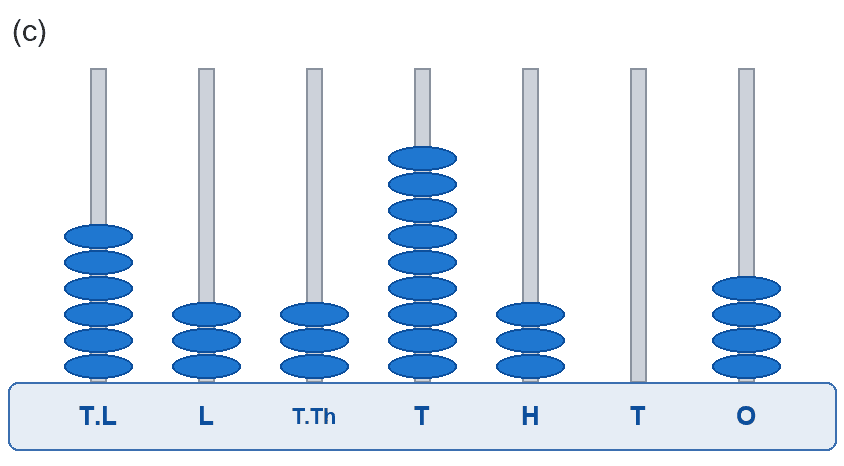
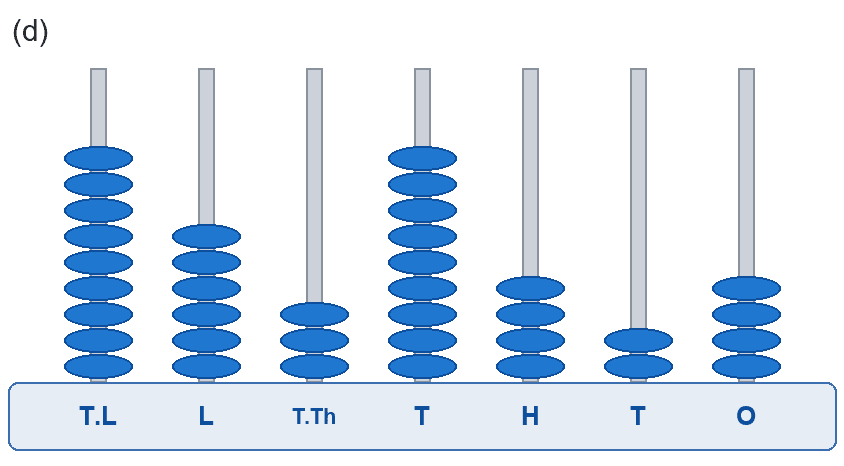
Write the numeral and number name that each abacus represents:
(a)
(b)
(c)
(d)
 Solve with AI
Written solution
Solution:
Concept: In the Indian system the places, from the right, are ones, tens, hundreds, thousands, ten thousands, lakhs and ten lakhs. We put the first comma after 3 digits from the right, and then a comma after every 2 digits. The commas split the number into periods: ones, thousands and lakhs.
Step 1 — Read the beads on each rod.
We count the beads on every rod, from left to right. The number of beads is the digit for that place. In the pictures the fourth rod is marked T for thousands, and the sixth rod is also marked T, but for tens. So we write Th for thousands in our chart.
Abacus T.L L T.Th Th H T O (a) 4 6 3 6 3 2 4 (b) 4 4 3 6 5 3 5 (c) 6 3 3 9 3 0 4 (d) 9 6 3 9 4 2 4 Step 2 — Write the numerals.
We write the digits side by side. Then we put the first comma after 3 digits from the right and the next comma after 2 more digits.
(a) 46,36,324
(b) 44,36,535
(c) 63,39,304
(d) 96,39,424
Step 3 — Write the number names.
We read the lakhs period first, then the thousands period, and then the last three digits with their place names.
(a) Forty six lakh thirty six thousand three hundred twenty four.
(b) Forty four lakh thirty six thousand five hundred thirty five.
(c) Sixty three lakh thirty nine thousand three hundred four.
(d) Ninety six lakh thirty nine thousand four hundred twenty four.
Watch out: In (c) the tens rod has no beads, so the tens digit is 0. Do not leave that place out: 63,39,304, not 6,33,934.
Therefore, (a) 46,36,324 (forty six lakh thirty six thousand three hundred twenty four); (b) 44,36,535 (forty four lakh thirty six thousand five hundred thirty five); (c) 63,39,304 (sixty three lakh thirty nine thousand three hundred four); (d) 96,39,424 (ninety six lakh thirty nine thousand four hundred twenty four).
- 23 marks
Question 2
Write the number name for each of the following numerals:
(a) 76,45,321
(b) 70,25,384
(c) 81,52,025
(d) 38,41,921
(e) 27,00,947
(f) 10,35,455
Solve with AIWritten solution
Solution:
Concept: In the Indian system the places, from the right, are ones, tens, hundreds, thousands, ten thousands, lakhs and ten lakhs. We put the first comma after 3 digits from the right, and then a comma after every 2 digits. The commas split the number into periods: ones, thousands and lakhs.
Step 1 — Split each numeral into periods.
The commas split each numeral into three periods: lakhs, thousands and ones.
Numeral Lakhs Thousands Ones (a) 76,45,321 76 45 321 (b) 70,25,384 70 25 384 (c) 81,52,025 81 52 025 (d) 38,41,921 38 41 921 (e) 27,00,947 27 00 947 (f) 10,35,455 10 35 455 Step 2 — Read each period with its name.
We read the lakhs number and say 'lakh', then the thousands number and say 'thousand', then the last three digits. A period that is all zeros is not read.
(a) Seventy six lakh forty five thousand three hundred twenty one.
(b) Seventy lakh twenty five thousand three hundred eighty four.
(c) Eighty one lakh fifty two thousand twenty five.
(d) Thirty eight lakh forty one thousand nine hundred twenty one.
(e) Twenty seven lakh nine hundred forty seven.
(f) Ten lakh thirty five thousand four hundred fifty five.
Watch out: In (e) the thousands period is 00, so we do not say 'thousand' at all: twenty seven lakh nine hundred forty seven.
Therefore, (a) seventy six lakh forty five thousand three hundred twenty one; (b) seventy lakh twenty five thousand three hundred eighty four; (c) eighty one lakh fifty two thousand twenty five; (d) thirty eight lakh forty one thousand nine hundred twenty one; (e) twenty seven lakh nine hundred forty seven; (f) ten lakh thirty five thousand four hundred fifty five.
- 33 marks
Question 3
Write the numeral for each of the following number names:
(a) Thirteen lakh twenty three thousand five hundred twenty eight.
(b) Sixty five lakh four thousand one hundred fifty two.
(c) Ninety five lakh sixty thousand five hundred.
(d) Seventeen lakh thirty thousand five.
(e) Thirty three lakh twenty four thousand eight hundred ninety six.
(f) Ninety five lakh seventy five thousand five hundred fifty five.
Solve with AIWritten solution
Solution:
Concept: In the Indian system the places, from the right, are ones, tens, hundreds, thousands, ten thousands, lakhs and ten lakhs. We put the first comma after 3 digits from the right, and then a comma after every 2 digits. The commas split the number into periods: ones, thousands and lakhs.
Step 1 — Put each period in a chart.
We write the lakhs number, then the thousands number as 2 digits, then the ones period as 3 digits. An empty place gets a 0.
Part Lakhs Thousands Ones (a) 13 23 528 (b) 65 04 152 (c) 95 60 500 (d) 17 30 005 (e) 33 24 896 (f) 95 75 555 Step 2 — Join the periods with commas.
We write the three periods side by side, with a comma between them.
(a) 13,23,528
(b) 65,04,152
(c) 95,60,500
(d) 17,30,005
(e) 33,24,896
(f) 95,75,555
Watch out: In (b) 'four thousand' fills the thousands period as 04, and in (d) 'five' fills the ones period as 005. Without these zeros the numeral is wrong.
Therefore, (a) 13,23,528; (b) 65,04,152; (c) 95,60,500; (d) 17,30,005; (e) 33,24,896; (f) 95,75,555.
- 43 marks
Question 4
Give the expanded form :
(a) 17,96,543
(b) 66,75,250
(c) 50,00,000
(d) 24,65,700
(e) 38,06,243
Solve with AIWritten solution
Solution:
Concept: The place value of a digit is the digit multiplied by the value of its place. The places, from the right, are ones (1), tens (10), hundreds (100), thousands (1,000), ten thousands (10,000), lakhs (1,00,000) and ten lakhs (10,00,000).
Step 1 — Find the value of each digit.
We write each digit times the value of its place, and join the parts with + signs. A digit 0 gives 0, and we still write that 0 so that every place is shown.
Step 2 — Part (a).
The digits of 17,96,543 are 1, 7, 9, 6, 5, 4, 3, from ten lakhs down to ones.
Step 3 — Part (b).
The digits of 66,75,250 are 6, 6, 7, 5, 2, 5, 0, from ten lakhs down to ones.
Step 4 — Part (c).
The digits of 50,00,000 are 5, 0, 0, 0, 0, 0, 0, from ten lakhs down to ones.
Step 5 — Part (d).
The digits of 24,65,700 are 2, 4, 6, 5, 7, 0, 0, from ten lakhs down to ones.
Step 6 — Part (e).
The digits of 38,06,243 are 3, 8, 0, 6, 2, 4, 3, from ten lakhs down to ones.
Watch out: The 7 in 17,96,543 is in the lakhs place, so it is worth 7,00,000, not 7,000.
Therefore, (a) 10,00,000 + 7,00,000 + 90,000 + 6,000 + 500 + 40 + 3; (b) 60,00,000 + 6,00,000 + 70,000 + 5,000 + 200 + 50 + 0; (c) 50,00,000 + 0 + 0 + 0 + 0 + 0 + 0; (d) 20,00,000 + 4,00,000 + 60,000 + 5,000 + 700 + 0 + 0; (e) 30,00,000 + 8,00,000 + 0 + 6,000 + 200 + 40 + 3.
- 53 marks
Question 5
Give the compact form :
(a) 10,00,000 + 2,00,000 + 30,000 + 6,000 + 800 + 70 + 0
(b) 40,00,000 + 5,00,000 + 20,000 + 1,000 + 800 + 90 + 0
(c) 10,00,000 + 2,00,000 + 60,000 + 0 + 700 + 40 + 0
(d) 30,00,000 + 1,00,000 + 20,000 + 6,000 + 100 + 10 + 8
(e) 60,00,000 + 4,00,000 + 30,000 + 2,000 + 300 + 50 + 7
Solve with AIWritten solution
Solution:
Concept: The place value of a digit is the digit multiplied by the value of its place. The places, from the right, are ones (1), tens (10), hundreds (100), thousands (1,000), ten thousands (10,000), lakhs (1,00,000) and ten lakhs (10,00,000).
Step 1 — Read the digit for each place.
Each term gives one digit. For example, 2,00,000 means 2 in the lakhs place, and a term 0 means the digit 0 in that place. So we write the first digit of each term in order.
Step 2 — Part (a).
We add the terms by writing their digits place by place.
Step 3 — Part (b).
We add the terms by writing their digits place by place.
Step 4 — Part (c).
We add the terms by writing their digits place by place.
Step 5 — Part (d).
We add the terms by writing their digits place by place.
Step 6 — Part (e).
We add the terms by writing their digits place by place.
Watch out: In (c) the thousands term is 0, so the thousands digit is 0: 12,60,740, not 1,26,740.
Therefore, (a) 12,36,870; (b) 45,21,890; (c) 12,60,740; (d) 31,26,118; (e) 64,32,357.
- 63 marks
Question 6
Give the place value of 7 in :
(a) 27,35,942
(b) 75,14,503
(c) 50,07,065
(d) 16,70,812
Solve with AIWritten solution
Solution:
Concept: The place value of a digit is the digit multiplied by the value of its place. The places, from the right, are ones (1), tens (10), hundreds (100), thousands (1,000), ten thousands (10,000), lakhs (1,00,000) and ten lakhs (10,00,000).
Step 1 — Part (a).
In 27,35,942 the digit 7 is in the lakhs place. So its place value is 7 times 1,00,000.
Step 2 — Part (b).
In 75,14,503 the digit 7 is in the ten lakhs place. So its place value is 7 times 10,00,000.
Step 3 — Part (c).
In 50,07,065 the digit 7 is in the thousands place. So its place value is 7 times 1,000.
Step 4 — Part (d).
In 16,70,812 the digit 7 is in the ten thousands place. So its place value is 7 times 10,000.
Watch out: The place value of 7 is not just 7. In (a) its place value is 7,00,000 (7 lakh).
Therefore, (a) 7,00,000; (b) 70,00,000; (c) 7,000; (d) 70,000.
- 73 marks
Question 7
Write the place value of the underlined digits in the following numbers :
(a)
(b)
(c)
(d)
(e)
(f)
(g)
(h)
Solve with AIWritten solution
Solution:
Concept: The place value of a digit is the digit multiplied by the value of its place. The places, from the right, are ones (1), tens (10), hundreds (100), thousands (1,000), ten thousands (10,000), lakhs (1,00,000) and ten lakhs (10,00,000).
Step 1 — Part (a).
In 24,26,369 the digit 6 is in the thousands place. So its place value is 6 times 1,000.
Step 2 — Part (b).
In 40,36,275 the digit 4 is in the ten lakhs place. So its place value is 4 times 10,00,000.
Step 3 — Part (c).
In 15,16,128 the digit 5 is in the lakhs place. So its place value is 5 times 1,00,000.
Step 4 — Part (d).
In 18,18,090 the digit 9 is in the tens place. So its place value is 9 times 10.
Step 5 — Part (e).
In 82,18,157 the digit 8 is in the ten lakhs place. So its place value is 8 times 10,00,000.
Step 6 — Part (f).
In 27,10,468 the digit 4 is in the hundreds place. So its place value is 4 times 100.
Step 7 — Part (g).
In 26,78,920 the digit 7 is in the ten thousands place. So its place value is 7 times 10,000.
Step 8 — Part (h).
In 25,27,842 the digit 5 is in the lakhs place. So its place value is 5 times 1,00,000.
Watch out: Count the places from the right, starting with ones. In (d) the 9 is the second digit from the right, so it is in the tens place: 90.
Therefore, (a) 6,000; (b) 40,00,000; (c) 5,00,000; (d) 90; (e) 80,00,000; (f) 400; (g) 70,000; (h) 5,00,000.
- 83 marks
Question 8
Write the predecessor of the following numerals :
(a) 9,43,072
(b) 28,32,417
(c) 87,32,106
(d) 17,34,581
(e) 73,24,560
Solve with AIWritten solution
Solution:
Concept: The predecessor of a number is the number just before it. We get it by subtracting 1.
Step 1 — Part (a).
The predecessor of 9,43,072 is 1 less than it, so we subtract 1.
Step 2 — Part (b).
The predecessor of 28,32,417 is 1 less than it, so we subtract 1.
Step 3 — Part (c).
The predecessor of 87,32,106 is 1 less than it, so we subtract 1.
Step 4 — Part (d).
The predecessor of 17,34,581 is 1 less than it, so we subtract 1.
Step 5 — Part (e).
The predecessor of 73,24,560 is 1 less than it, so we subtract 1.
Watch out: The predecessor comes before the number, so it is smaller. Do not add 1.
Therefore, (a) 9,43,071; (b) 28,32,416; (c) 87,32,105; (d) 17,34,580; (e) 73,24,559.
- 93 marks
Question 9
Write the successor of the following numerals :
(a) 82,31,700
(b) 7,86,543
(c) 9,54,619
(d) 34,57,988
(e) 43,21,789
Solve with AIWritten solution
Solution:
Concept: The successor of a number is the number just after it. We get it by adding 1.
Step 1 — Part (a).
The successor of 82,31,700 is 1 more than it, so we add 1.
Step 2 — Part (b).
The successor of 7,86,543 is 1 more than it, so we add 1.
Step 3 — Part (c).
The successor of 9,54,619 is 1 more than it, so we add 1.
Step 4 — Part (d).
The successor of 34,57,988 is 1 more than it, so we add 1.
Step 5 — Part (e).
The successor of 43,21,789 is 1 more than it, so we add 1.
Watch out: When the ones digit is 9, adding 1 makes it 0 and carries 1 to the tens: 9,54,619 + 1 = 9,54,620.
Therefore, (a) 82,31,701; (b) 7,86,544; (c) 9,54,620; (d) 34,57,989; (e) 43,21,790.
- 103 marks
Question 10
Fill in the boxes using >, < or =.
(a) 5,93,210 4,95,210
(b) 3,81,472 3,81,582
(c) 4,12,316 4,12,099
(d) 3,23,456 2,23,456
(e) 7,32,610 7,32,610
Solve with AIWritten solution
Solution:
Concept: To compare two numbers with the same number of digits, we look at the digits from the left, place by place. The first place where the digits differ decides which number is greater.
Step 1 — Part (a).
Both numbers have 6 digits, so we compare the digits from the left. The very first digits (in the lakhs place) already differ: 5 and 4. Since 5 > 4, the first number is greater.
Step 2 — Part (b).
Both numbers have 6 digits, so we compare the digits from the left. The first digits that differ are in the hundreds place: 4 and 5. Since 4 < 5, the first number is smaller.
Step 3 — Part (c).
Both numbers have 6 digits, so we compare the digits from the left. The first digits that differ are in the hundreds place: 3 and 0. Since 3 > 0, the first number is greater.
Step 4 — Part (d).
Both numbers have 6 digits, so we compare the digits from the left. The very first digits (in the lakhs place) already differ: 3 and 2. Since 3 > 2, the first number is greater.
Step 5 — Part (e).
Both numbers have the same digits in every place, so they are equal.
Watch out: In (b) look at the first place that differs (hundreds: 4 and 5). The later digits 7 and 8 do not matter.
Therefore, (a) >; (b) <; (c) >; (d) >; (e) =.
- 113 marks
Question 11
Write the missing numbers.
(a) 98,76,541 .......... .......... .......... .......... 98,76,546
(b) 45,69,894 .......... .......... .......... .......... 45,69,899
(c) 73,16,897 .......... .......... .......... .......... 73,16,902
(d) 12,46,785 .......... .......... .......... .......... 12,46,790
(e) 9,67,998 .......... .......... .......... .......... 9,68,003
Solve with AIWritten solution
Solution:
Concept: Counting on by 1 gives the next number each time. When a digit 9 becomes 0, we carry 1 to the next place.
Step 1 — Find the rule.
The first and last numbers differ by 5, and there are four boxes between them. So each number is 1 more than the one before it, and we keep adding 1.
Step 2 — Part (a).
We start at 98,76,541 and add 1 four times.
Step 3 — Part (b).
We start at 45,69,894 and add 1 four times.
Step 4 — Part (c).
We start at 73,16,897 and add 1 four times.
Step 5 — Part (d).
We start at 12,46,785 and add 1 four times.
Step 6 — Part (e).
We start at 9,67,998 and add 1 four times.
Watch out: In (c) and (e) the numbers pass 9s. Adding 1 to 73,16,899 gives 73,16,900, because both 9s turn into 0s and the 1 is carried to the hundreds.
Therefore, (a) 98,76,542; 98,76,543; 98,76,544; 98,76,545. (b) 45,69,895; 45,69,896; 45,69,897; 45,69,898. (c) 73,16,898; 73,16,899; 73,16,900; 73,16,901. (d) 12,46,786; 12,46,787; 12,46,788; 12,46,789. (e) 9,67,999; 9,68,000; 9,68,001; 9,68,002.
More ways to study this chapter
The same chapter asked three other ways. Practise it, revise it, and see what the board has set on Ch 1 before.
Class 5 Maths Ch 1 questions students ask
How many questions are there in Class 5 Maths Ch 1?
11 questions. Every one is solved step by step on this page.
Are these Class 5 Maths solutions free?
Yes. Every question and its full working is free to read, with no account needed.
Can I download the Class 5 Maths Ch 1 solutions as a PDF?
There is no PDF to download. Every solution is on this page instead, which means it is searchable, always the current syllabus, and readable on a phone. Use your browser's print option if you want it on paper.