
Question 595 marksMedium
(a) What is shunt? What is its use?
(b) How will you convert a galvanometer into (i) an ammeter and (ii) a voltmeter?
(c) Why is an ammeter connected in series whereas a voltmeter connected in parallel in a circuit?
Confirming your payment
Sign up now and get 250 free tokens.
Torque on a Current-Carrying Loop - Moving Coil Galvanometer · Question 59 of 68
(a) What is shunt? What is its use?
(b) How will you convert a galvanometer into (i) an ammeter and (ii) a voltmeter?
(c) Why is an ammeter connected in series whereas a voltmeter connected in parallel in a circuit?
Solution:
Key idea: A galvanometer of resistance gives full-scale deflection for a small current . A low resistance in parallel lets it measure large currents, and a high resistance in series lets it measure large p.d.s.
Step 1 — Define a shunt, part (a).
A shunt is a low resistance connected in parallel with a galvanometer.
Step 2 — State the uses of a shunt, part (a).
Because its resistance is low, the shunt carries most of the current, and only a small, fixed fraction passes through the galvanometer. So a shunt increases the range of the galvanometer (it converts it into an ammeter), and it protects the galvanometer from damage by a large current.
Step 3 — Convert the galvanometer into an ammeter, part (b)(i).
To make an ammeter of range , we connect a shunt in parallel with the galvanometer, so that flows through the galvanometer and through the shunt.
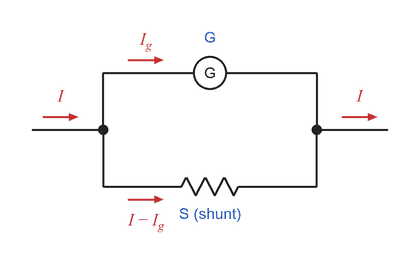
The p.d. across the galvanometer and the shunt is the same:
The resistance of the ammeter, , is very low.
Step 4 — Convert the galvanometer into a voltmeter, part (b)(ii).
To make a voltmeter of range , we connect a high resistance in series with the galvanometer, so that a p.d. drives exactly through it.
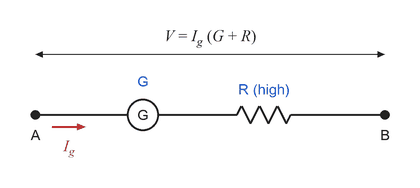
By Ohm's law for the whole combination:
The resistance of the voltmeter, , is very high.
Step 5 — Explain why an ammeter goes in series, part (c).
An ammeter measures the current through an element, so that same current must pass through the ammeter: it is connected in series. Its resistance is very low, so it hardly changes the current it measures.
Step 6 — Explain why a voltmeter goes in parallel, part (c).
A voltmeter measures the p.d. between two points, so it must be connected across those points: in parallel. Its resistance is very high, so it draws almost no current and hardly changes the p.d. it measures.
Therefore, a shunt is a low resistance in parallel that extends the range and protects the galvanometer; an ammeter uses a shunt and goes in series, while a voltmeter uses a series resistance and goes in parallel.