
Question 543 marksMedium
How can a moving coil galvanometer be converted into (i) an ammeter and (ii) a voltmeter of given ranges? Draw a labelled diagram to illustrate the conversions.
Confirming your payment
Sign up now and get 250 free tokens.
Torque on a Current-Carrying Loop - Moving Coil Galvanometer · Question 54 of 68
How can a moving coil galvanometer be converted into (i) an ammeter and (ii) a voltmeter of given ranges? Draw a labelled diagram to illustrate the conversions.
Solution:
Key idea: A galvanometer of resistance gives full-scale deflection for a small current . A low resistance in parallel (a shunt) lets it measure a large current, and a high resistance in series lets it measure a large p.d.
Step 1 — Convert it into an ammeter of range .
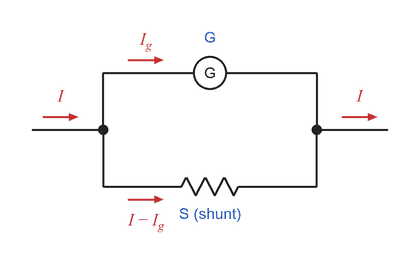
We connect a low resistance (the shunt) in parallel with the galvanometer. Of the total current , a current goes through the galvanometer and through the shunt.
Step 2 — Find the shunt resistance.
The galvanometer and the shunt are across the same two points, so the p.d. across them is equal:
Step 3 — Describe the resistance of the ammeter.
The ammeter's resistance is that of and in parallel:
This is even smaller than . An ammeter is connected in series because the current to be measured must flow through it, and its very low resistance means it hardly changes that current.
Step 4 — Convert it into a voltmeter of range .
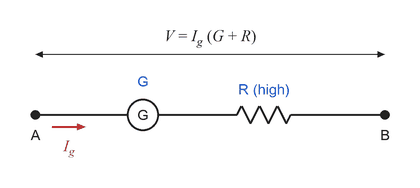
We connect a high resistance in series with the galvanometer and connect the combination across the two points whose p.d. is to be measured.
Step 5 — Find the series resistance.
At full scale the current flows through the total resistance when the p.d. is :
Step 6 — Describe the resistance of the voltmeter.
The voltmeter's resistance is , which is very high. A voltmeter is connected in parallel because it must measure the p.d. between two points, and its very high resistance means it draws very little current and hardly changes that p.d.
Therefore, the galvanometer becomes an ammeter of range with a shunt in parallel, and a voltmeter of range with a resistance in series.