
Question 492 marksEasy
How will you convert a galvanometer into a voltmeter?
Confirming your payment
Sign up now and get 250 free tokens.
Torque on a Current-Carrying Loop - Moving Coil Galvanometer · Question 49 of 68
How will you convert a galvanometer into a voltmeter?
Solution:
Key idea: A galvanometer gives full-scale deflection when a small current flows through it. To read a large p.d. , a high resistance is put in series with it, so that drives only through the combination.
Step 1 — Connect a high resistance in series.
We connect a high resistance in series with the galvanometer of resistance , as shown, and connect the combination across the two points A and B whose p.d. is to be measured.
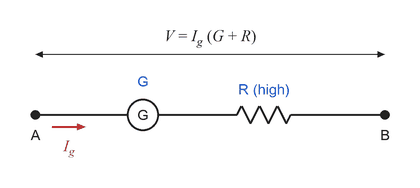
Step 2 — Write the condition for full-scale deflection.
At full scale the current through the combination is when the p.d. across it equals the range . The total resistance is , so by Ohm's law
Step 3 — Find the series resistance.
Dividing by and then subtracting gives the series resistance:
Step 4 — Recalibrate the scale.
The scale is marked in volts, so that full scale reads . The voltmeter's resistance is very high, so when it is connected across two points it draws very little current and hardly changes the p.d. it measures.
Therefore, a galvanometer is converted into a voltmeter of range by connecting a high resistance in series with it.