
Question 472 marksEasy
How will you convert a galvanometer into an ammeter?
Confirming your payment
Sign up now and get 250 free tokens.
Torque on a Current-Carrying Loop - Moving Coil Galvanometer · Question 47 of 68
How will you convert a galvanometer into an ammeter?
Solution:
Key idea: A galvanometer gives full-scale deflection for a small current . To measure a larger current , most of the current is sent round the galvanometer through a low resistance connected in parallel with it, called a shunt.
Step 1 — Connect a shunt in parallel.
We connect a low resistance (the shunt) in parallel with the galvanometer of resistance , as shown. Of the total current , only goes through the galvanometer and the rest, , goes through the shunt.
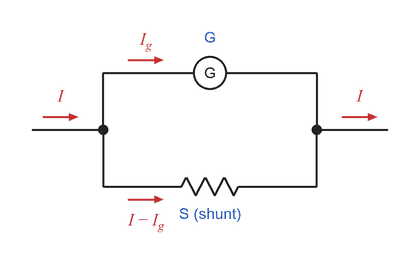
Step 2 — Use the equal p.d. across parallel branches.
The galvanometer and the shunt are joined across the same two points, so the p.d. across them is the same:
Step 3 — Find the shunt resistance.
Dividing both sides by gives the shunt needed:
Step 4 — Recalibrate the scale.
The scale is now marked so that full-scale deflection reads . The combination has a very low resistance, , so it hardly changes the current when it is put in series in a circuit.
Therefore, a galvanometer is converted into an ammeter of range by connecting a low resistance in parallel with it.