Solution:
Concept: In a common emitter (CE) amplifier the signal is applied between base and emitter, and the output is taken from the collector circuit. A small change in base current ΔIB gives a change βΔIB in collector current, and this changing current through the load resistance gives a large changing output voltage. Its voltage gain is Av=−βRinRAC, where RAC is the a.c. load of the collector circuit and Rin the input resistance; the minus sign shows the 180∘ phase reversal. Its power gain uses the size of the voltage gain, Ap=β∣Av∣.
Given: Change in signal (base–emitter) voltage ΔVBE=0.05 V; ΔIB=20 μA (2×10⁻⁵ A); ΔIC=2 mA (2×10⁻³ A); collector resistance RC=10 kΩ; load resistance RL=50 kΩ.
Step 1 — Find the current gain for part (i). The current gain is the change in collector current divided by the change in base current:
β=ΔIBΔIC
β=2×10−52×10−3
β=100
Step 2 — Find the input impedance for part (ii). The input impedance is the change in input (signal) voltage divided by the change in base current:
Rin=ΔIBΔVBE
Rin=2×10−50.05 Ω
Rin=2.5×10³ Ω
Step 3 — Find the effective a.c. load. The changing collector current flows into two paths: through RC to the supply, and through the coupling capacitor into the load RL (the battery and the capacitor act as short circuits for the changing signal). So for the signal, RC and RL are in parallel, as the figure shows:
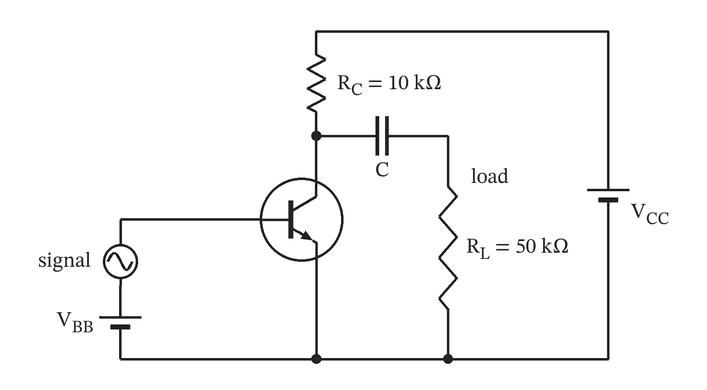
RAC=RC+RLRCRL
RAC=10+5010×50 kΩ
RAC≈8.3333 kΩ
Step 4 — Find the voltage gain for part (iii). The size of the voltage gain is β times the ratio of the a.c. load to the input resistance:
∣Av∣=β×RinRAC
∣Av∣=100×2.5×1038.3333×103
∣Av∣≈333.33
The output is reversed in phase, so with its sign the voltage gain is about −333.33.
Step 5 — Find the power gain for part (iv). The power gain is the current gain times the size of the voltage gain:
Ap=β×∣Av∣
Ap=100×333.33
Ap≈33333
Watch out: Using RL=50 kΩ alone would give a voltage gain of 2000, and using RC alone would give 400. Both are wrong here, because the signal current divides between RC and RL, which act in parallel.
Therefore, (i) the current gain is 100, (ii) the input impedance is 2.5×10³ Ω, (iii) the voltage gain is about 333.33 in size, with the output 180∘ out of phase with the input, and (iv) the power gain is about 33 333.
