
Question 131 markMedium
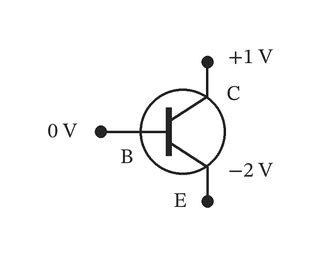
In the given figure, is (i) the emitter and (ii) the collector forward or reverse biased?
Confirming your payment
Sign up now and get 250 free tokens.
Junction Transistor · Question 13 of 62
In the given figure, is (i) the emitter and (ii) the collector forward or reverse biased?
Solution:
Concept: A junction is forward biased when its side is at a higher potential than its side, and reverse biased when the side is lower. The type of transistor is shown by the arrow on its emitter: for a -- transistor the arrow points towards the base.
Step 1 — Note what the figure gives. The base is at , the emitter at and the collector at . The symbol is printed without an arrow on the emitter, so the answer depends on which type of transistor is meant; the expected answer treats it as a -- transistor.
Step 2 — Judge the emitter junction of a -- transistor. The emitter is -type and the base is -type. The emitter at is below the base at , so the emitter junction is reverse biased.
Step 3 — Judge the collector junction. The collector is -type. The collector at is above the base at , so the collector junction is forward biased.
Note: if the symbol were an -- transistor (arrow pointing away from the base), every junction would be the other way round: the emitter junction would be forward biased and the collector junction reverse biased, the normal working condition.
Therefore, for the -- transistor intended here, (i) the emitter is reverse biased and (ii) the collector is forward biased.