
Question 545 marksMedium
(a) What is a Zener diode? Explain its working.
(b) Draw the characteristic curve of a Zener diode.
(c) Explain the working of Zener diode as a voltage regulator.
Confirming your payment
Sign up now and get 250 free tokens.
Semiconductor Diodes · Question 54 of 65
(a) What is a Zener diode? Explain its working.
(b) Draw the characteristic curve of a Zener diode.
(c) Explain the working of Zener diode as a voltage regulator.
Solution:
Concept: A Zener diode is a heavily doped - junction that is normally used in reverse bias, in its breakdown region, where the voltage across it stays almost constant at .
Step 1 — (a) Define the Zener diode. A Zener diode is a properly (heavily) doped - junction diode with a sharp breakdown voltage, designed to operate in the reverse breakdown region without damage. It is also called a breakdown diode.
Step 2 — (a) Explain its working. Heavy doping makes the depletion layer very thin. When the reverse voltage reaches , the intense field across this thin layer breaks covalent bonds and produces many electron–hole pairs (Zener breakdown); in diodes with higher the avalanche effect does this. The reverse current then rises sharply while the voltage across the diode stays almost constant at . A series resistor limits the current so that the diode is not overheated.
Step 3 — (b) Draw the characteristic. The figure shows the characteristic. In forward bias it is like an ordinary diode. In reverse bias the current is tiny up to ; at the curve turns sharply and becomes almost vertical.
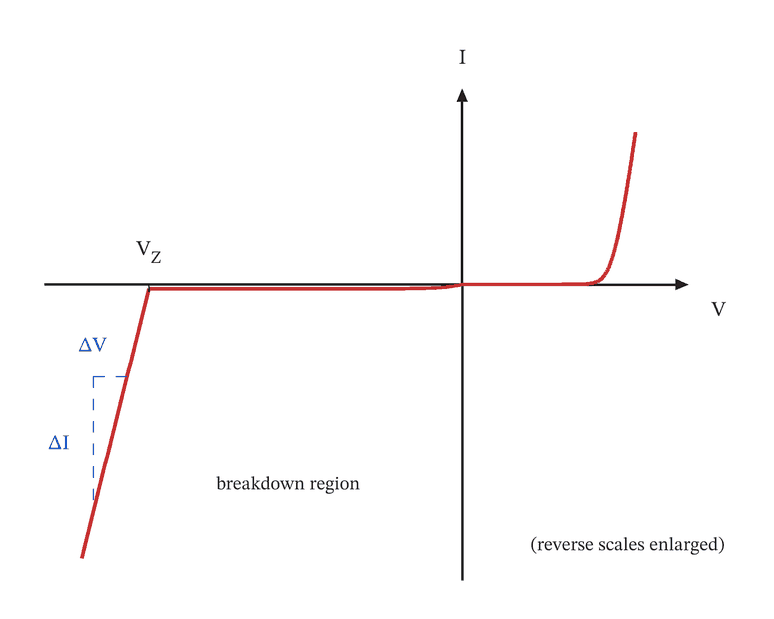
Along this steep part a large change in current goes with only a small change in voltage, so the dynamic resistance is small.
Step 4 — (c) Draw the regulator circuit. The Zener diode is connected in reverse bias across the load , with a series resistor between the unregulated input and the pair, as in the figure.
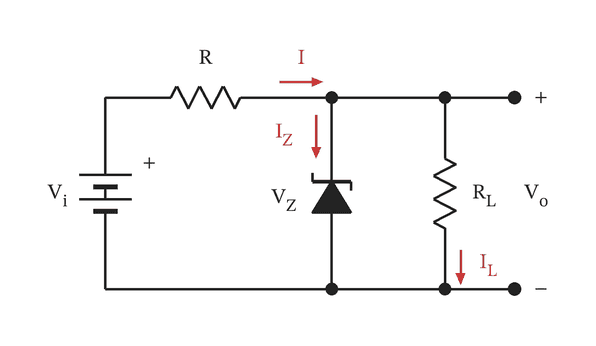
Step 5 — (c) Write the circuit equations. The current in divides between the Zener and the load:
The input voltage is shared between and the Zener:
The output voltage equals the Zener voltage:
Step 6 — (c) Explain the regulation. If increases, increases; the extra current passes through the Zener diode and the extra voltage drops across , while stays constant. If is increased, falls and rises by the same amount, since is fixed by ; again stays at .
Therefore, (a) a Zener diode is a heavily doped junction diode working in reverse breakdown, where its voltage stays nearly constant at ; (b) its characteristic turns sharply into an almost vertical line at in reverse bias; (c) reverse biased across a load with a series resistor, it absorbs changes in current so that the output stays at .