
Question 473 marksMedium
What is LED? Explain how radiations are given out by LED.
Confirming your payment
Sign up now and get 250 free tokens.
Semiconductor Diodes · Question 47 of 65
What is LED? Explain how radiations are given out by LED.
Solution:
Concept: In a semiconductor, electrons in the conduction band have more energy than holes in the valence band by the band gap . When an electron falls into a hole, this energy can be given out as light.
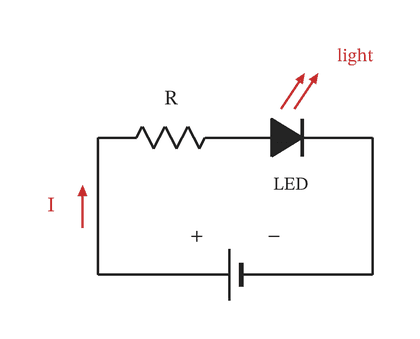
Step 1 — Define the LED. A light emitting diode (LED) is a heavily doped - junction which is forward biased and converts electrical energy into light. A series resistor limits the current, as in the figure.
Step 2 — Describe the injection of carriers. Under forward bias the barrier is lowered. Electrons from the side and holes from the side move towards the junction and cross it, so there are extra carriers on each side.
Step 3 — Describe the recombination. After crossing, the electrons recombine with the holes. Each electron falls from the higher energy level in the conduction band to the lower energy level in the valence band, as the energy-band figure shows.
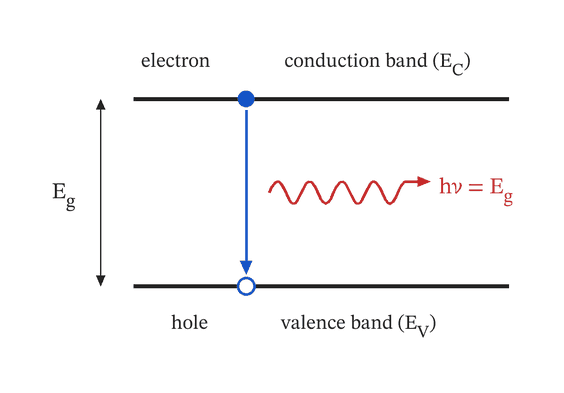
Step 4 — Explain the radiation. The energy difference is given out as a photon of electromagnetic radiation of frequency :
The colour therefore depends on the band gap of the material: GaAs gives infrared, GaAsP red to yellow, and GaP green (or yellow or red, depending on the impurities added).
Therefore, an LED is a heavily doped forward-biased - junction; electrons and holes injected across the junction recombine, and each electron falling from the conduction band to the valence band emits a photon of energy .