
Question 372 marksEasy
What happens when a - junction is reverse biased?
Confirming your payment
Sign up now and get 250 free tokens.
Semiconductor Diodes · Question 37 of 65
What happens when a - junction is reverse biased?
Solution:
Concept: In reverse bias the positive terminal of the battery is joined to the side, as in the figure. The applied voltage then adds to the internal potential barrier.
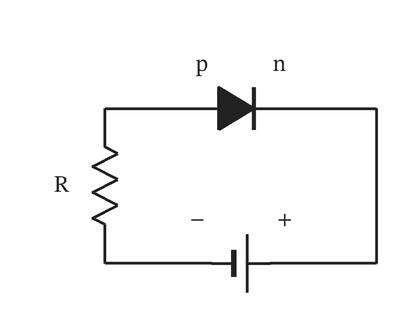
Step 1 — State the effect on the barrier and the layer. The barrier increases by the applied voltage, and the depletion layer becomes wider.
Step 2 — State the effect on the resistance and current. The majority carriers cannot cross the higher barrier, so no current flows due to them. The junction offers a very high resistance (the reverse resistance). Only a very small current of minority carriers flows, the reverse saturation current, which is of the order of nanoamperes for silicon and microamperes for germanium.
Therefore, under reverse bias the potential barrier rises, the depletion layer widens, the resistance becomes very high and only a tiny reverse current of minority carriers flows.