
Question 432 marksMedium
Explain the working of a photodiode.
Confirming your payment
Sign up now and get 250 free tokens.
Semiconductor Diodes · Question 43 of 65
Explain the working of a photodiode.
Solution:
Concept: A photodiode is a reverse-biased - junction with a window that lets light reach the junction. A photon of energy greater than the band gap () can break a covalent bond and create an electron–hole pair.
Step 1 — Show the circuit. The photodiode is reverse biased through a load , and light falls on its junction, as in the figure.
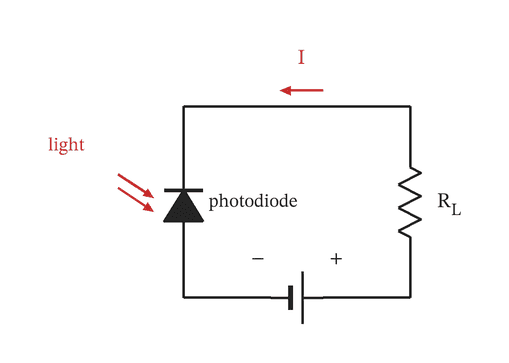
Step 2 — Explain the dark current. With no light, only the tiny reverse saturation current, called the dark current, flows.
Step 3 — Explain the effect of light. Light with creates electron–hole pairs in and near the depletion layer. The junction field sweeps the electrons to the side and the holes to the side, which adds a photocurrent to the reverse current.
Step 4 — Relate the current to the intensity. More intense light creates more pairs, so the reverse current increases with the intensity of light, nearly in proportion to it. Measuring the current therefore measures the light.
Therefore, a photodiode works in reverse bias: light with creates electron–hole pairs that the junction field separates, so the reverse current grows with the intensity of the light.