
Question 61 markMCQEasy
The output waveform of a full-wave rectifier is
Confirming your payment
Sign up now and get 250 free tokens.
Semiconductor Diodes · Question 6 of 65
The output waveform of a full-wave rectifier is
(A) an AC voltage
(B) a DC voltage
(C) zero
(D) a pulsating unidirectional voltage
Answer: (D) a pulsating unidirectional voltage
Concept: A full-wave rectifier makes the current through the load flow in the same direction during both halves of the input cycle, but the size of the output still rises and falls with the input.
Step 1 — Look at the output waveform. The figure shows the input and the output of a full-wave rectifier. The output is a series of humps, all on the same side of the time axis.
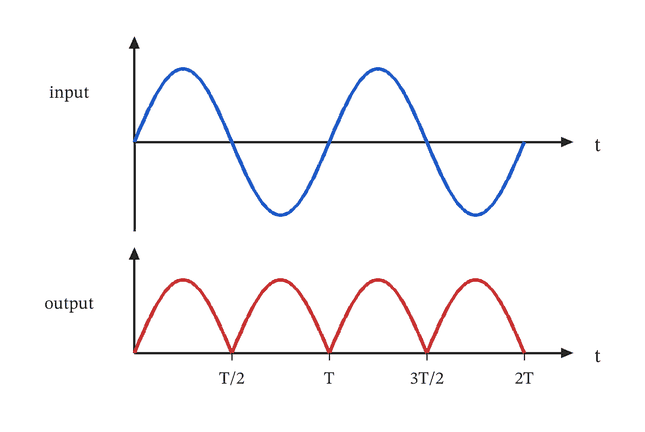
Step 2 — Describe it. All the humps are positive, so the output is unidirectional. Its value keeps rising to the peak and falling to zero, so it pulsates. A filter is needed to make it a steady d.c.
Step 3 — Check the other options. Each of the others misdescribes the output:
Therefore, the output of a full-wave rectifier is a pulsating unidirectional voltage, option (D).