
Question 583 marksMedium
Draw separate energy level bands for conductors, semiconductors and insulators and label each of them to illustrate the behaviours of
(i) a conductor,
(ii) a pure semiconductor and
(iii) an insulator.
Confirming your payment
Sign up now and get 250 free tokens.
Semiconductor Electronics · Question 58 of 66
Draw separate energy level bands for conductors, semiconductors and insulators and label each of them to illustrate the behaviours of
(i) a conductor,
(ii) a pure semiconductor and
(iii) an insulator.
Solution:
Concept: The electrical behaviour of a solid depends on whether its valence and conduction bands overlap, or how wide the forbidden gap between them is.
Step 1 — Draw the three diagrams. The figure shows labelled band diagrams of a conductor, an insulator and a semiconductor:
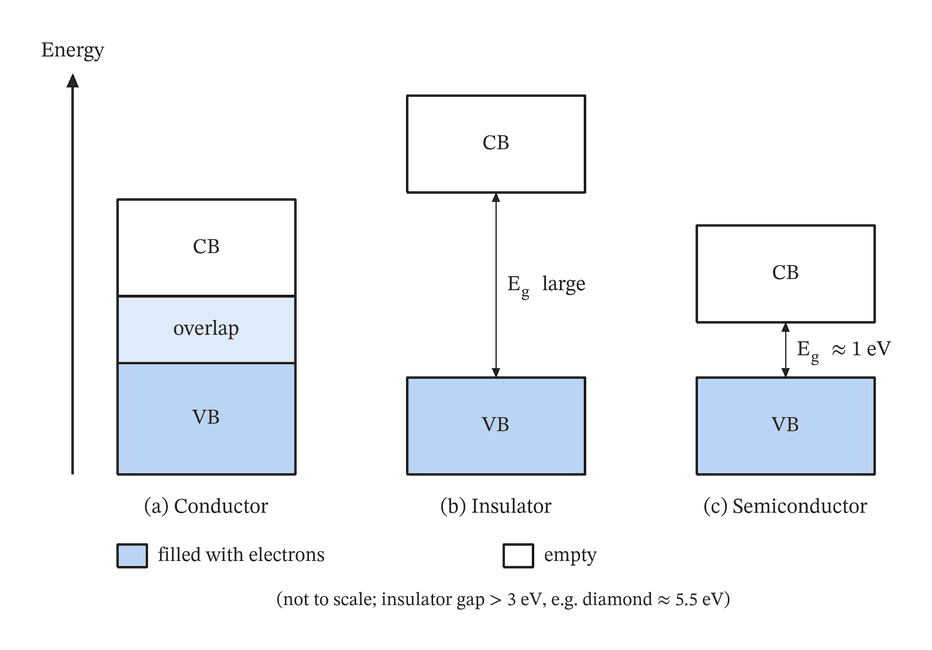
Step 2 — Explain each diagram. We take the three solids in the order asked.
(i) In a conductor either the valence band and the conduction band overlap or the highest occupied band is only partly filled, so there is no forbidden gap. Many electrons are already free in the conduction band and a small potential difference makes them flow. Copper, silver and aluminium are examples.
(ii) In a pure semiconductor the bands are separated by a small gap, about 1 eV (1.1 eV for Si). At 0 K the VB is full and the CB empty, so it behaves as an insulator. At room temperature a few electrons cross the gap and leave holes, so it conducts a little, and its conductivity rises with temperature.
(iii) In an insulator the gap is large, more than about 3 eV (about 5.5 eV for diamond). At ordinary temperatures practically no electron crosses it, so the CB stays practically empty and practically no current flows. Glass, mica and dry wood are examples.
Therefore, the conductor's bands overlap or its highest band is partly filled (no gap, free electrons always present), the semiconductor's bands are separated by a small gap of about 1 eV (it conducts a little at room temperature), and the insulator's bands are separated by a large gap of more than about 3 eV (it conducts practically not at all).