
Question 563 marksMedium
Explain briefly what is meant by extrinsic semiconductors, including the terms donor and acceptor impurities as well as -type and -type semiconductors.
Confirming your payment
Sign up now and get 250 free tokens.
Semiconductor Electronics · Question 56 of 66
Explain briefly what is meant by extrinsic semiconductors, including the terms donor and acceptor impurities as well as -type and -type semiconductors.
Solution:
Concept: An intrinsic (pure) semiconductor conducts poorly. A semiconductor to which a small controlled amount of a suitable impurity has been added is called an extrinsic semiconductor. Its conductivity is much larger and can be controlled by the amount of impurity.
Step 1 — Define a donor impurity and an -type semiconductor. A pentavalent impurity (group 15), such as arsenic, antimony or phosphorus, has five valence electrons. Four form covalent bonds with the neighbouring Si or Ge atoms and the fifth is set free. Because each such atom donates a free electron, it is called a donor impurity:

The resulting material has electrons as majority carriers and is called an -type semiconductor.
Step 2 — Define an acceptor impurity and a -type semiconductor. A trivalent impurity (group 13), such as boron, indium, gallium or aluminium, has only three valence electrons. One of the four bonds round it lacks an electron, which is a hole. The atom readily accepts an electron from a neighbouring bond, so it is called an acceptor impurity:
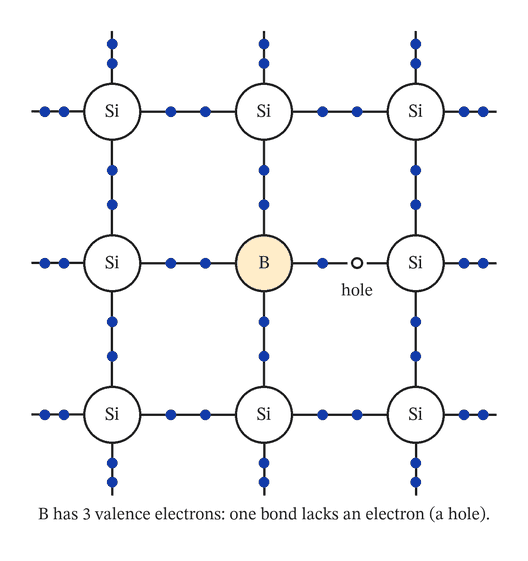
The resulting material has holes as majority carriers and is called a -type semiconductor.
Step 3 — Show the energy bands. Donor atoms add an energy level just below the conduction band; acceptor atoms add an energy level just above the valence band:
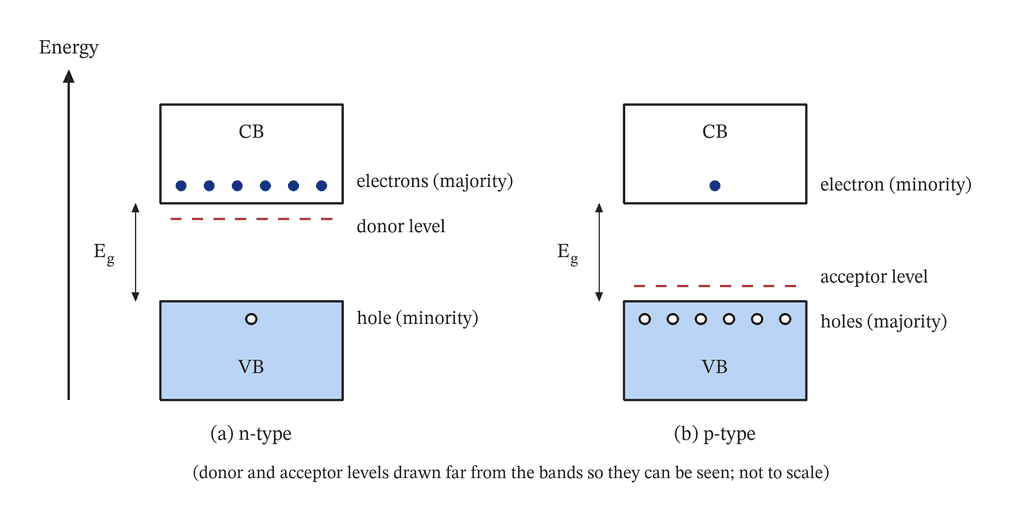
Step 4 — Note the minority carriers. In both types a few covalent bonds are also broken by heat. These give holes in -type material and electrons in -type material, which are the minority carriers.
Therefore, an extrinsic semiconductor is a doped semiconductor; a donor (pentavalent) impurity gives free electrons and makes an n-type semiconductor with electrons as majority carriers, while an acceptor (trivalent) impurity creates holes and makes a p-type semiconductor with holes as majority carriers.