
Question 312 marksMedium
Using energy band, explain the difference between an insulator and a semiconductor.
Confirming your payment
Sign up now and get 250 free tokens.
Semiconductor Electronics · Question 31 of 66
Using energy band, explain the difference between an insulator and a semiconductor.
Solution:
Concept: Whether a solid conducts depends on how easily electrons can be raised from the full valence band to the empty conduction band, that is, on the size of the forbidden gap .
Step 1 — Draw the two band diagrams. The figure shows an insulator and a semiconductor:
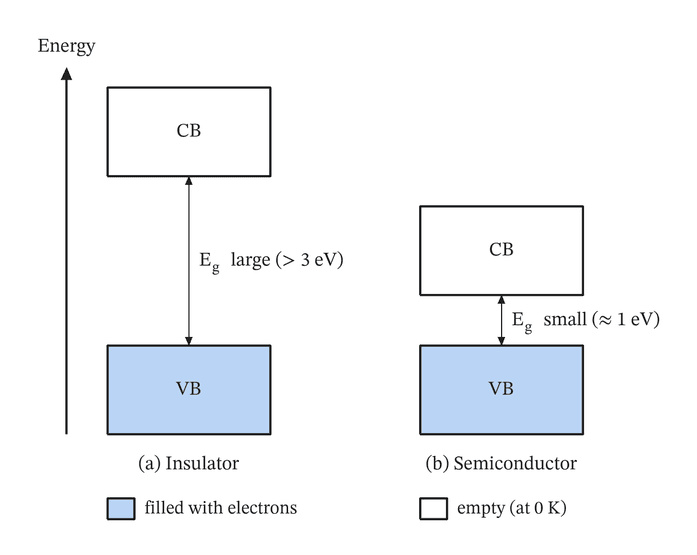
Step 2 — Explain the insulator. In an insulator the gap is large (more than about 3 eV; about 5.5 eV for diamond). At room temperature is only about 0.026 eV, so thermal energy almost never lifts an electron across it. The conduction band stays practically empty, and practically no current flows.
Step 3 — Explain the semiconductor. In a semiconductor the gap is small (1.1 eV for Si, about 0.7 eV for Ge). At room temperature some electrons gain enough energy to cross into the conduction band, leaving holes behind, so a small current can flow.
Therefore, an insulator has a large forbidden gap that practically no electron crosses at ordinary temperatures, while a semiconductor has a small gap (about 1 eV) that some electrons cross, so it conducts a little.