
Question 442 marksMedium
Using a diagram, explain the flow of current through an intrinsic semiconductor.
Confirming your payment
Sign up now and get 250 free tokens.
Semiconductor Electronics · Question 44 of 66
Using a diagram, explain the flow of current through an intrinsic semiconductor.
Solution:
Concept: In an intrinsic semiconductor the free electrons and the holes are equal in number. In an electric field electrons drift towards the positive terminal and holes drift towards the negative terminal.
Step 1 — Draw the circuit. A battery is connected across a bar of intrinsic semiconductor, with end A joined to the negative terminal and end B to the positive terminal:
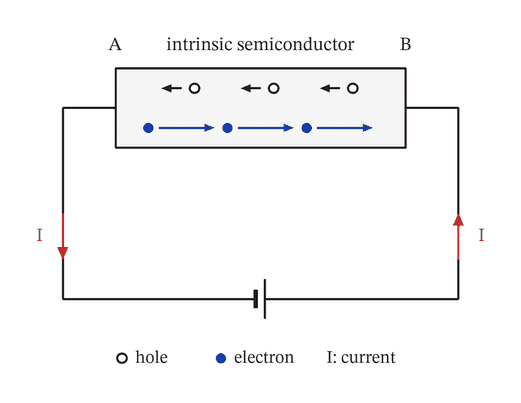
Step 2 — Describe the motion of the carriers. The free electrons drift from A towards B (towards the positive terminal), giving the electron current . The holes drift from B towards A (towards the negative terminal), giving the hole current . A hole moves when a valence electron from a neighbouring bond jumps into it, so the valence electrons move the opposite way.
Step 3 — Add the two currents. Electrons moving one way and holes moving the other way both carry conventional current from B to A, so the two currents add:
Step 4 — Describe the outside wire. In the external connecting wires the current is carried only by free electrons of the metal.
Therefore, current in an intrinsic semiconductor is carried by electrons drifting towards the positive end and holes drifting towards the negative end; the total current is I = Iₑ + Iₕ, while in the outer wires it is carried by electrons only.