
Question 725 marksHard
(a) How will you prove that electromagnetic waves are transverse in nature?
(b) Obtain the relation connecting electric field, magnetic flux density and the velocity of electromagnetic waves.
Confirming your payment
Sign up now and get 250 free tokens.
Electromagnetic Waves · Question 72 of 79
(a) How will you prove that electromagnetic waves are transverse in nature?
(b) Obtain the relation connecting electric field, magnetic flux density and the velocity of electromagnetic waves.
Solution:
Key idea: (a) Gauss's laws for and , applied to a closed box in a region with no charge, show that a plane wave can have no field component along its direction of travel. (b) Faraday's law, applied to a thin rectangle, links the change of in space to the change of in time, and this gives .
Step 1 — Set up a box at the wave front (part a).
We take a plane electromagnetic wave travelling along the -axis, so its wave fronts are planes parallel to the -plane. We draw a rectangular box OABCDEFG with edges along the axes, as in the figure, with the face ABCD placed just ahead of the wave front at some instant.
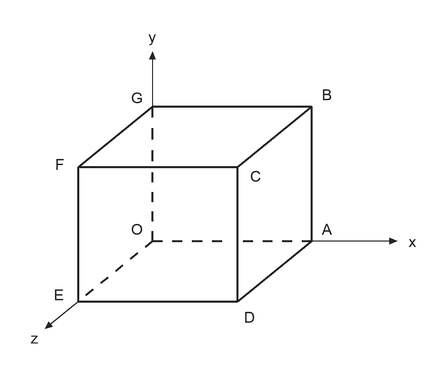
Ahead of the wave front the wave has not yet arrived, so the fields there are zero. Behind it, because the wave is plane, the fields depend only on and , not on or .
Step 2 — Apply Gauss's law for the electric field.
The box encloses no charge, so the total electric flux out of it is zero.
Step 3 — Cancel the flux through the side faces.
Since does not change with or , the field is the same on the opposite faces BGFC and OEDA. Their outward normals point in opposite directions, so their fluxes cancel. The same happens for the pair DCFE and OABG, which leaves only the faces ABCD and OGFE.
Step 4 — Show that the component is zero.
The face ABCD lies in the field-free region just ahead of the wave front, so the field on it, and hence its flux, is zero. The flux through OGFE must therefore be zero too.
Let the face OGFE have area and let the -component of the field on it be . Its outward normal points along , so its flux is .
The face OGFE can be placed anywhere behind the wave front, so has no component along the direction of propagation anywhere in the wave.
Step 5 — Repeat for the magnetic field.
Gauss's law for magnetism says that the magnetic flux out of every closed surface is zero.
The same argument therefore gives . So both and lie in the -plane, perpendicular to the direction of travel, and the electromagnetic wave is transverse.
Step 6 — Write the fields of the wave (part b).
For a plane wave travelling along , with along and along , we write the fields as follows.
Here is the speed of the wave.
Step 7 — Apply Faraday's law to a thin rectangle.
We take a thin rectangle in the -plane, of width and height , and go round it anticlockwise, so its normal is along . The field is along , so only the two vertical sides contribute to the line integral.
The bracket is the change of over the small width .
The magnetic flux through the rectangle is , and Faraday's law sets the line integral equal to minus the rate of change of this flux.
Step 8 — Put in the wave expressions.
We differentiate with respect to and with respect to .
Substituting both into the result of Step 7, the cosine cancels.
Step 9 — Obtain the relation.
Dividing by gives the ratio of the amplitudes, and is the speed of the wave.
Since and have the same phase, the same ratio holds at every point and instant.
In vacuum, the Ampère–Maxwell law used in the same way also gives , about .
Therefore, (a) Gauss's laws for and show that a plane electromagnetic wave has no field component along its direction of travel, so it is transverse; (b) Faraday's law gives at every point and instant, where is the speed of the wave.