
Question 683 marksMedium
What is displacement current? How is it related to conduction current? What are its characteristics?
Confirming your payment
Sign up now and get 250 free tokens.
Electromagnetic Waves · Question 68 of 79
What is displacement current? How is it related to conduction current? What are its characteristics?
Solution:
Key idea: Maxwell showed that a changing electric field produces a magnetic field, just as a current does. He called the term the displacement current , and added it to the conduction current in Ampère's circuital law.
Step 1 — Define displacement current.
The displacement current through a surface is the current that arises from a changing electric flux through that surface, not from moving charges.
Step 2 — Set up a charging capacitor.
Consider a parallel-plate capacitor of plate area being charged by a cell through a key K, as shown. A conduction current flows in the connecting wires, but no charge crosses the gap between the plates.
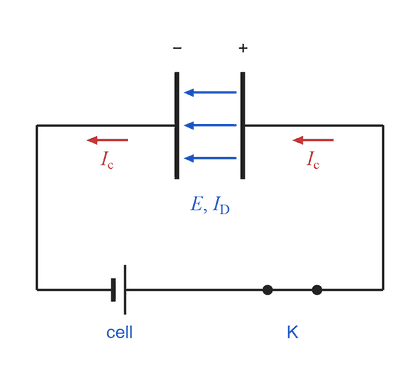
Step 3 — Find the electric flux between the plates.
When the plates carry charges and , the field between them is uniform, and we use the field of a parallel-plate capacitor.
The flux through a surface between the plates, parallel to them, is the field times the plate area.
Step 4 — Find the displacement current in the gap.
As the capacitor charges, changes, so the flux changes. We put into the definition.
Since is the conduction current in the wires, the two currents are equal.
Step 5 — Relate the two currents.
The displacement current in the gap equals the conduction current in the wires at every instant. So the total current, conduction plus displacement, is the same all round the circuit, and the Ampère–Maxwell law includes both.
Step 6 — List its characteristics.
The displacement current has these features:
Therefore, displacement current is , the current due to a changing electric flux; across a charging capacitor it equals the conduction current in the wires, so the current is continuous, and it produces a magnetic field like an ordinary current.