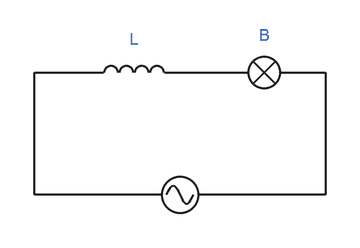
An inductor 'L' of reactance XL , is connected in series with a bulb 'B' to an AC, source as shown in the given figure.
Question 892 marksMedium
An inductor 'L' of reactance XL, is connected in series with a bulb 'B' to an AC, source as shown in the given figure. Briefly explain how does the brightness of the bulb change when (i) number of turns of the inductor is reduced and (ii) a capacitor of reactance XC=XL is included in series in the same circuit.
Solution:
Key idea: The bulb's brightness depends on the current I=V/Z, where Z=R2+(XL−XC)2 and R is the resistance of the bulb (and coil). A smaller impedance gives a larger current and a brighter bulb.
Step 1 — Find how the inductance changes in part (i).
The self-inductance of a coil of given size is proportional to the square of its number of turns (L∝N2). Reducing the number of turns therefore reduces L.
Step 2 — Find the effect on the bulb in part (i).
A smaller L gives a smaller reactance XL=ωL, so the impedance R2+XL2 falls. The current rises, and the bulb glows more brightly.
Step 3 — Find the impedance in part (ii).
When a capacitor with XC equal to XL is put in series, the two reactances cancel exactly.
XL−XC=0
Z=R2+02
Z=R
Step 4 — Find the effect on the bulb in part (ii).
The impedance now has its least possible value, so the current has its greatest value, V/R, and is in phase with the voltage. The circuit is at series resonance, and the bulb glows with its maximum brightness.
Therefore, (i) reducing the number of turns makes the bulb brighter, and (ii) adding a capacitor with XC equal to XL makes the bulb glow with its maximum brightness, since the circuit is then at resonance.