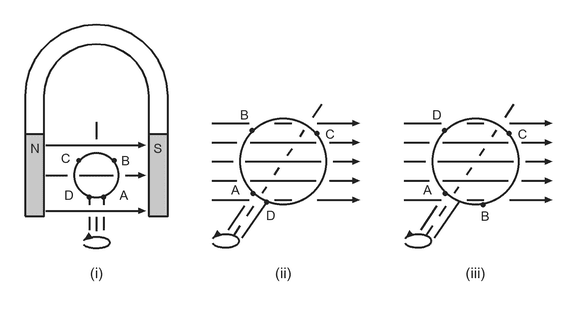
Solution:
Key idea: A coil of N turns and area A turning with uniform angular speed ω in a uniform field B has the e.m.f. e=NBAωsinωt, where ωt is the angle between the field and the normal to the coil. The e.m.f. is largest when the sides of the coil cut the field lines fastest. The direction of the current in a side that cuts the field is given by Fleming's right-hand rule.
Step 1 — Find the current in orientation (i).
In (i) the plane of the coil lies along the field lines, which run from the N pole to the S pole. As the coil turns anticlockwise, its sides move straight across the field lines. Fleming's right-hand rule, applied to the sides that cut the field, gives a current that flows round the coil along ABCD.
Step 2 — Find the current in orientation (ii).
In (ii) the coil has turned on, so its labelled sides now cross the field lines in the opposite sense to (i). The right-hand rule therefore gives a current in the reverse direction, along ADCB.
Step 3 — Find the current in orientation (iii).
In (iii) the plane of the coil is perpendicular to the field lines. At this instant the sides move along the field lines and cut none of them. The flux through the coil is at its maximum and is momentarily not changing (sinωt=0), so no e.m.f. is induced and the current is zero.
Step 4 — Decide where the e.m.f. is greatest (part b).
The e.m.f. in the Key idea is greatest when sinωt=1. The normal to the coil is then at 90∘ to the field. The plane of the coil is then parallel to the field lines, as in orientation (i). The flux through the coil is zero at that instant, but it is changing at its fastest rate.
emax=NBAω
Watch out: The e.m.f. is greatest when the flux is zero, and zero when the flux is greatest. The e.m.f. depends on the rate of change of flux, not on the flux itself.
Therefore, (a) the current flows along ABCD in (i), along ADCB in (ii) and is zero in (iii); (b) the e.m.f. is greatest, equal to NBAω, when the plane of the coil is parallel to the field lines, as in orientation (i).