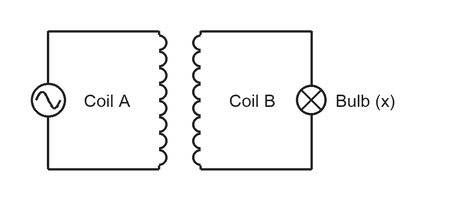
Solution:
Key idea: A changing current in one coil sends a changing flux through a nearby coil and induces an e.m.f. in it (mutual induction). A changing flux through a sheet of metal induces eddy currents in the sheet, and by Lenz's law these oppose the change in flux.
Step 1 — Name the phenomenon (part i).
The alternating current in coil A sets up an alternating flux, part of which passes through coil B. This changing flux induces an alternating e.m.f. in B, which drives a current through the bulb. Inducing an e.m.f. in one coil by a changing current in another is mutual induction.
Step 2 — Find what the copper sheet does to the flux (part ii).
The alternating flux from A also passes through the copper sheet, so eddy currents are induced in the sheet. By Lenz's law these currents set up their own field, which opposes the change of flux. On the far side of the sheet the two effects largely cancel.
Step 3 — Find the effect on the bulb.
Less changing flux now reaches coil B, so the e.m.f. induced in B is smaller and less current flows through the bulb. Some energy is also lost as heat in the sheet. The bulb therefore glows less brightly.
Therefore, (i) the phenomenon is mutual induction; (ii) the bulb becomes dimmer, because eddy currents induced in the copper sheet oppose the changing flux, so less of it links coil B.