
Question 341 markEasy
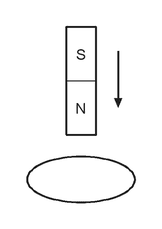
A bar magnet falls freely through a metal ring as shown in the given figure. Will the acceleration of the magnet be less than g, equal to g or greater than g?
Confirming your payment
Sign up now and get 250 free tokens.
Electromagnetic Induction · Question 34 of 78
A bar magnet falls freely through a metal ring as shown in the given figure. Will the acceleration of the magnet be less than g, equal to g or greater than g?
Solution:
Key idea: By Lenz's law, the current induced in the ring opposes the motion of the magnet that causes it, so the ring exerts an upward magnetic force on the falling magnet.
Step 1 — Look at the magnet approaching the ring.
As the N pole comes down towards the ring, the flux through the ring increases. The induced current makes the upper face of the ring a north pole, which repels the approaching N pole, so the force on the magnet is upwards.
Step 2 — Look at the magnet leaving the ring.
After the magnet has passed through, its S pole moves away below the ring and the flux through the ring decreases. The induced current now makes the lower face of the ring a north pole, which attracts the receding S pole, so the force on the magnet is again upwards.
Step 3 — Compare the acceleration with g.
The net downward force on the magnet is its weight minus this upward magnetic force, so its acceleration is less than .
Note: The ring must be a closed conductor; a ring with a cut carries no current and the magnet falls with acceleration . Just as the middle of the magnet passes the ring, the flux is momentarily not changing and the force is zero for that instant.
Therefore, the acceleration of the magnet is less than g.